

Artificial intelligence has quickly become the centrepiece of business strategy. From customer service chatbots and personalised marketing to predictive analytics and automated decision-making, organisations across industries are investing heavily in AI to improve efficiency and stay competitive.
Yet, despite these investments, many AI initiatives struggle to deliver the results businesses expect.
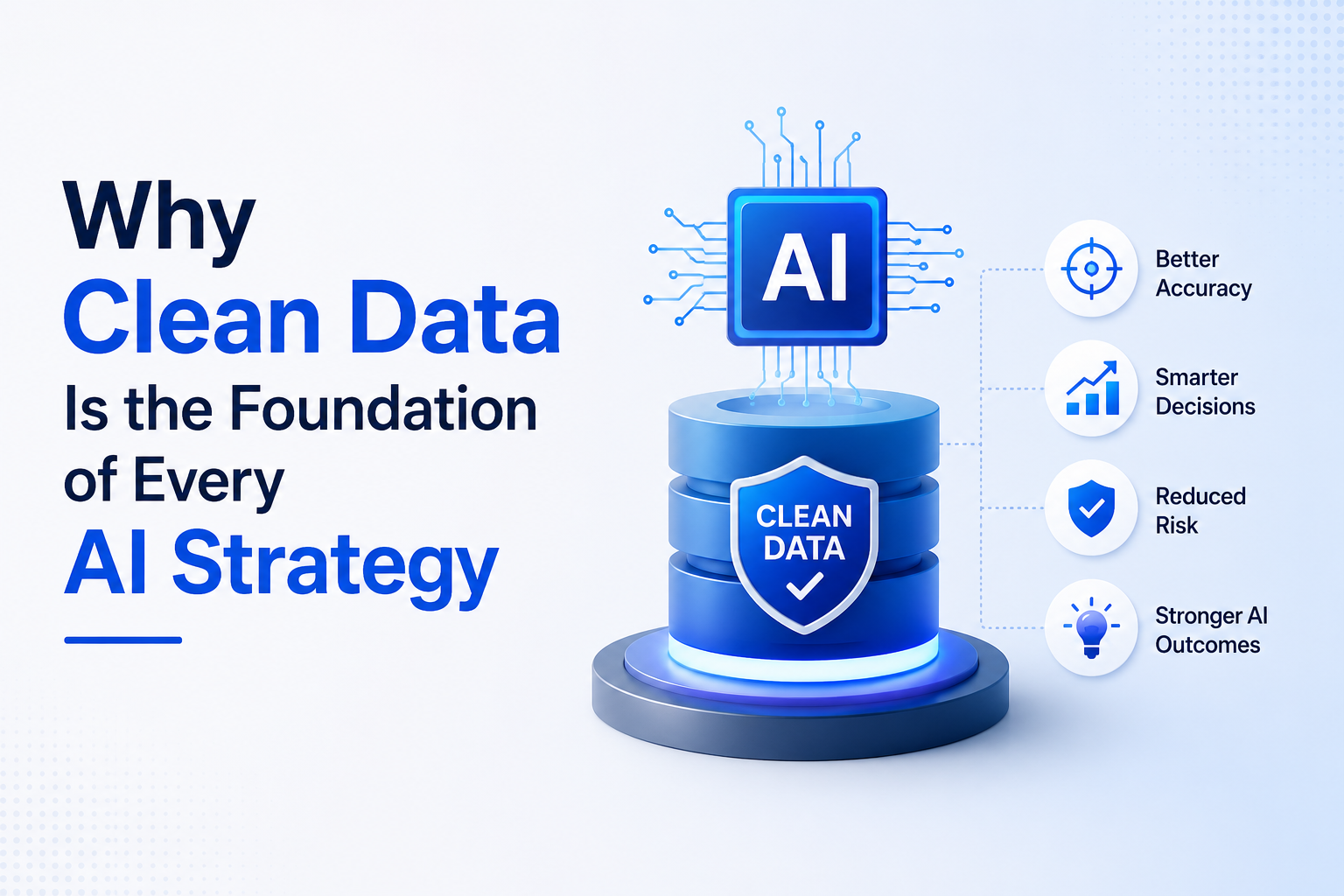
The reason is surprisingly simple. Companies are focusing on the intelligence but overlooking the information that powers it.
An AI model is only as effective as the data it learns from. If that data is incomplete, outdated, duplicated, or scattered across disconnected systems, even the most advanced AI solution will produce inconsistent results.
As Reem Saied, Co-Founder & CMO at Oogw.ai Analytics, puts it:
“An AI chatbot is not a magic box.”
It is a reminder that AI cannot compensate for poor data quality. Instead, it amplifies whatever information it is given.
The Hidden Problem Behind AI Failure
Many organisations believe they are ready for AI because they have adopted cloud platforms, digital tools and automation software. But beneath these investments lies a common challenge: fragmented data.
Customer information often exists across CRMs, spreadsheets, marketing platforms, ERP systems, support software, and countless departmental databases. Each team stores and manages data differently, creating isolated pockets of information that rarely communicate with one another.
The result is a business that appears digitally mature on the surface but lacks a unified view of its own operations.
This creates significant problems for AI.
An AI assistant might retrieve outdated customer information because sales and support systems aren’t synchronised. A recommendation engine might miss relevant purchase history because marketing data is stored separately. Internal AI copilots may provide incomplete answers simply because they cannot access enterprise knowledge spread across multiple repositories.
This is where many organisations misunderstand AI. The quality of the prompt matters, but the quality of the underlying data matters even more.
As Saied explains:
“Just to give you an example, people often think AI is all about the prompt. But AI is only as good as the data behind it. If you put in garbage, you’ll get garbage out.”
No AI model can consistently generate high-quality outputs if the underlying data is unreliable.
Data Silos Are the Biggest Barrier to AI
Businesses often assume their biggest AI challenge is selecting the right model or platform. In reality, the greater obstacle is breaking down data silos.
Every disconnected spreadsheet, isolated database, and standalone application creates another barrier between AI and the knowledge it needs to perform effectively.
Without connected data, AI cannot understand the complete picture of a customer, a business process, or an organisation’s history.
This doesn’t just reduce accuracy. It also limits trust.
Employees quickly stop relying on AI tools if responses are inconsistent, incomplete or obviously incorrect. Customers lose confidence when automated systems fail to recognise previous interactions or provide irrelevant recommendations.
The problem isn’t that AI lacks intelligence. It’s that businesses have failed to give it a reliable foundation.
First-Party Data Is Becoming a Competitive Advantage
As digital privacy regulations evolve and third-party data becomes less reliable, first-party data is becoming one of the most valuable assets a business owns.
Unlike externally sourced information, first-party data comes directly from customer interactions, purchases, website behaviour, support conversations and communication channels. It is more accurate, more relevant, and uniquely reflects how customers engage with a business.
For AI, this shift has become especially important. Models perform far better when they learn from accurate, organisation-specific data rather than fragmented or outdated information.
Businesses that organise and enrich their first-party data can build AI systems that generate more relevant recommendations, provide better customer support and deliver deeper operational insights.
Saied sums it up well:
“Your AI is only as good as the data you feed it. Start with your own enterprise data. Just as first-party data is more valuable than cold outreach in marketing, your enterprise data should be the foundation of every AI strategy.”
Enterprise Knowledge Is Often the Missing Piece
Data alone is not enough.
Many organisations also possess years of valuable enterprise knowledge that never reaches their AI systems. Internal documentation, standard operating procedures, policy manuals, training materials, technical documentation, and institutional expertise often remain trapped in disconnected folders or individual employees’ knowledge.
This creates another gap between AI capability and business reality.
An AI assistant cannot answer questions using information it has never been given.
Making enterprise knowledge accessible, searchable and well organised enables AI to become a genuinely useful business assistant rather than a generic chatbot.
AI Readiness Begins Before AI
Organisations often ask when they should begin their AI transformation.
The answer is before they deploy AI.
Preparing data may not be the most exciting part of an AI strategy, but it is unquestionably the most important.
In Saied’s view:
“There’s simply too much data that’s become bogged down over the years. Managers have to take on the painful, one-time task of cleaning it up. Every large company needs one or two superstars who are willing to do this. It’s not a glamorous job, it’s a boring job. But it’s one of the most important jobs.”
Cleaning duplicate records, standardising formats, removing outdated information and connecting disconnected systems may not generate headlines, but these are the activities that determine whether AI succeeds or fails.
Without this groundwork, businesses risk investing in sophisticated technology that cannot deliver meaningful outcomes.
Building a Strong Foundation
Successful AI adoption is less about choosing the latest model and more about building the right data foundation. Before AI can generate meaningful insights, organisations need to connect, organise and standardise the information they already have.
Saied summarises:
“Take all the spreadsheets and all the databases, do that one-time linking, and create a seamless data bank. Then feed it into the model. Once you’ve done that, you can build customer-facing interfaces on top of it.”
When businesses bring together customer data, operational information and enterprise knowledge into a connected ecosystem, AI becomes far more than an automation tool. It becomes a reliable partner that can support decision-making, improve customer experiences, and drive measurable business value.
The future of AI will not belong to the organisations with the biggest models or the highest technology budgets. It will belong to those who have invested in the quality, accessibility, and governance of their data.
Clean data is not an optional step in an AI strategy—it is the foundation of the strategy itself. Before businesses can build intelligent AI, they must first build intelligent data.