


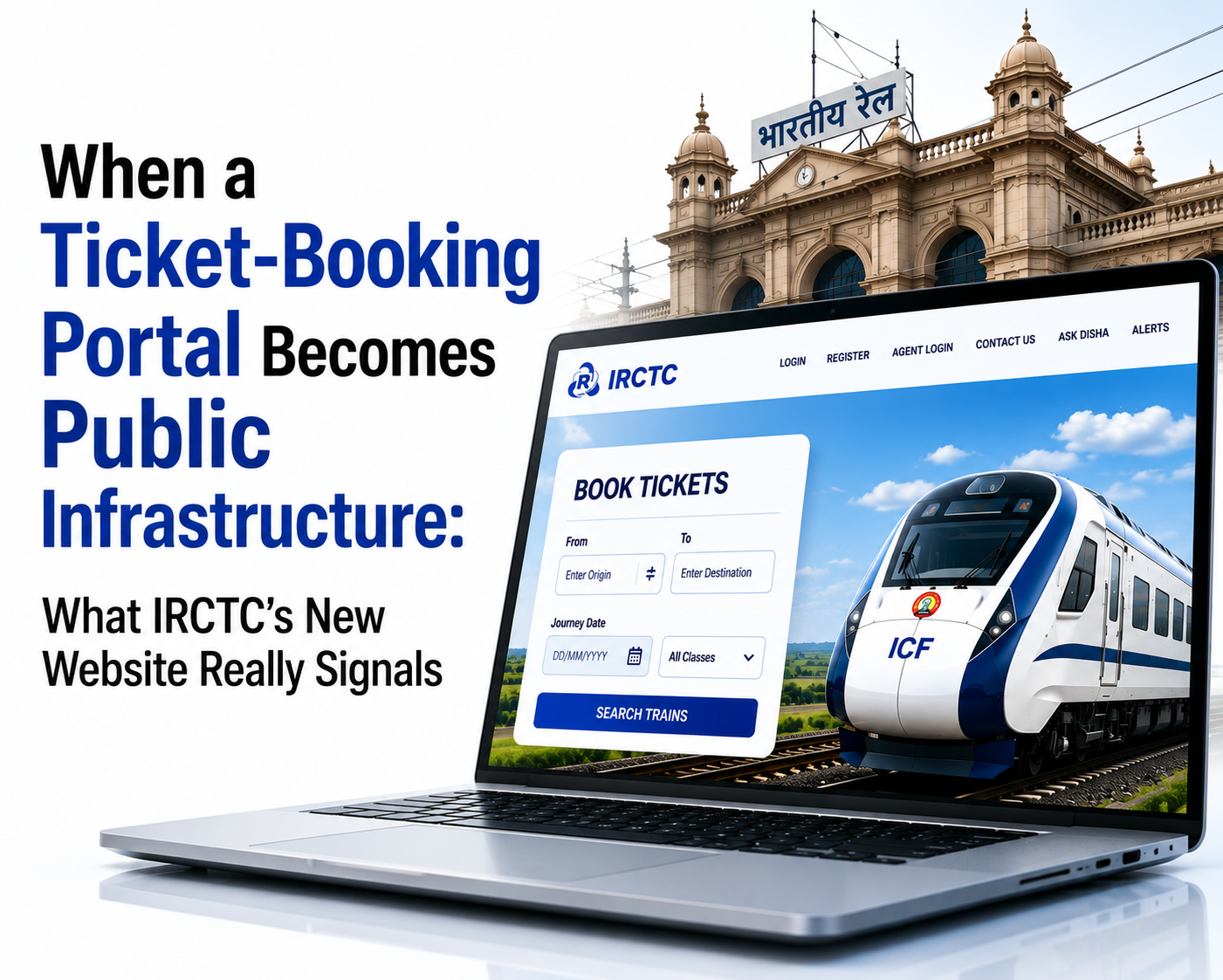
For millions of Indians, booking a train ticket has never been just another online transaction. It is an experience often accompanied by slow-loading pages, failed payments, frozen sessions, and the frantic rush of securing a Tatkal ticket before it disappears. Add repeated CAPTCHA checks, unnecessary pop-ups, and interrupted booking flows, and what should be a simple transaction can quickly become a test of patience. For many, especially during peak travel seasons, securing a confirmed ticket has often felt less like using a digital service and more like competing against it.
That is why the launch of IRCTC’s revamped website on July 15, 2026, deserves attention beyond the technology community. While the headlines have focused on faster page loads, higher booking capacity and new booking features, the bigger story is that Indian Railways is beginning to treat its digital platforms as public infrastructure rather than transactional websites. At a time when millions depend on railways for work, education, healthcare and family travel, improving the digital experience is no longer simply about convenience. It is about making essential public services more accessible, reliable and equitable.
Listening to citizens, not just servers
The redesign did not emerge solely from a technology roadmap. It was prompted by a public commitment from Railway Minister Ashwini Vaishnaw after students highlighted the difficulties they faced while booking tickets at an interaction earlier this year.
That moment reflects an important shift in how public digital services are evolving. Traditionally, technology upgrades within government departments were driven by backend requirements such as system maintenance, compliance, or infrastructure expansion. Increasingly, however, citizen feedback is becoming a catalyst for product design.
This mirrors the expectations users now bring to every digital platform. Whether booking a cab, ordering groceries, or transferring money, people have become accustomed to intuitive interfaces and seamless experiences. Government platforms are no longer compared only with one another; they are measured against the best consumer apps people use every day.
In that environment, user experience is no longer a luxury. It is becoming a benchmark for public trust. (Source: OneIndia)
Designing for every citizen, not the average user
One of the most meaningful aspects of the new IRCTC website is its emphasis on accessibility and inclusion.
The platform now supports multiple Indian languages beyond English and Hindi, allowing users to search and book tickets in their preferred language. It also integrates concession bookings for students, Divyangjan passengers and patients into a single, streamlined process rather than requiring fragmented workflows.
These updates may appear incremental, but they represent a fundamental change in design philosophy.
Digital services often optimise for the “average” user, inadvertently creating barriers for those with different needs. Public platforms, however, serve a far more diverse population. Designing for inclusivity means recognising that accessibility is not an additional feature; it is central to delivering public services fairly.
For Indian Railways, whose users span different regions, languages, and socio-economic backgrounds, lowering friction for those who depend most on rail travel is as important as introducing new functionality.
At India’s scale, performance is a trust issue.
The revamped platform has also been engineered to handle significantly higher traffic. It is designed to process over 1.5 lakh bookings per minute, a substantial increase from the earlier capacity of around 32,000 bookings per minute. The upgraded Passenger Reservation System (PRS) backend can now support more than 40 lakh enquiries every minute.
These numbers are impressive, but their significance extends far beyond technical performance.
During Tatkal bookings, festival seasons and long holiday weekends, every second matters. Slow-loading pages, session timeouts, or payment failures can determine whether a traveller secures a ticket or misses an important journey altogether.
In markets operating at India’s scale, performance is not simply an engineering metric. It is a measure of digital inclusion.
A platform that performs reliably under pressure ensures that access to essential services is not determined by luck, internet speed, or repeated attempts. Reliability, in this context, becomes an important driver of public confidence. (Source: MoneyControl)
Moving from managing users to empowering them
The redesign also introduces several improvements aimed at simplifying the booking experience. Users can now select seat preferences during booking, compare fares across multiple travel dates through a fare calendar, and view seat availability across different classes on a single screen.
Alongside these additions, the interface has been streamlined with fewer unnecessary pop-ups, reduced CAPTCHA interruptions and a more intuitive, mobile-first booking flow. Frequent users, particularly those booking Tatkal tickets, are likely to notice fewer flashing banners and interruptions between searching for a train and confirming a booking. The objective is straightforward: reduce distractions and help passengers complete their journeys with greater confidence.
Perhaps the most significant improvement isn’t a new feature at all. It is the deliberate effort to remove friction. Good digital experiences are not always defined by what gets added; they are often defined by what gets out of the user’s way. Simplifying booking flows, reducing interruptions, and eliminating unnecessary steps reflect a growing recognition that ease of use is just as important as introducing new functionality.
For years, many public-sector platforms were designed around administrative processes, requiring citizens to adapt to the system. Increasingly, that approach is giving way to one centred on user journeys, where clarity, predictability and control become core design principles.
The objective is no longer simply to manage demand. It is to help people complete their tasks with confidence and minimal friction. (Source: Business Today)
A visible face of a broader digital transformation
The new website is also part of Indian Railways’ wider technology modernisation efforts, including upgrades to the Passenger Reservation System, digital tribunal systems and other initiatives aimed at improving transparency, responsiveness and operational efficiency.
While backend reforms often go unnoticed by the public, the website serves as the most visible expression of these investments.
This combination of stronger infrastructure and improved user experience offers an important lesson for governments worldwide. Modern digital services cannot rely on attractive interfaces alone. Equally, backend upgrades deliver limited value if citizens continue to struggle with confusing or unreliable experiences. Lasting transformation happens when technology, capacity, and design evolve together.
What leaders across industries can learn
The implications of IRCTC’s redesign extend well beyond public transportation.
First, organisations should begin viewing high-traffic digital platforms as experience infrastructure rather than IT projects. Every interaction shapes trust, particularly when the service is essential.
For platforms that monetise via advertising, every creative shown is part of that experience infrastructure. In 2019, IRCTC faced public criticism when a user reported “obscene and vulgar” ads on its ticket‑booking app; the official support handle clarified that the ads were served via Google’s ad tool and targeted based on the user’s browsing history and cookies, not because IRCTC was intentionally promoting adult content. This episode underlines how ad‑tech choices, targeting controls and partner integrations are now central to the trust architecture of high‑traffic public platforms, not just peripheral revenue decisions. (Source: YourStory)
Second, accessibility should be built into the product from the outset. Supporting multiple languages, simplifying journeys for special user groups, and reducing unnecessary friction should be considered core product decisions rather than optional enhancements.
Finally, performance and user experience deserve to be treated as strategic business metrics. Fast, reliable, and intuitive platforms create confidence long before a marketing campaign begins.
The same thinking applies across industries. Banks can redesign onboarding journeys based on recurring customer complaints instead of internal assumptions. Telecom providers can simplify support experiences before launching customer acquisition campaigns. Mobility platforms can strengthen reliability during peak demand rather than relying solely on promotional offers.
IRCTC’s new website is ultimately about much more than booking train tickets faster. It reflects a broader evolution in how India’s public digital services are being designed—placing citizens, rather than systems, at the centre of the experience. As governments and organisations continue to digitise essential services, the real benchmark of success will no longer be how many features a platform offers, but how effortlessly people can use them. In the years ahead, the quality of digital infrastructure will increasingly be measured not by the technology powering it, but by the trust and confidence it inspires in the people who rely on it every day.