

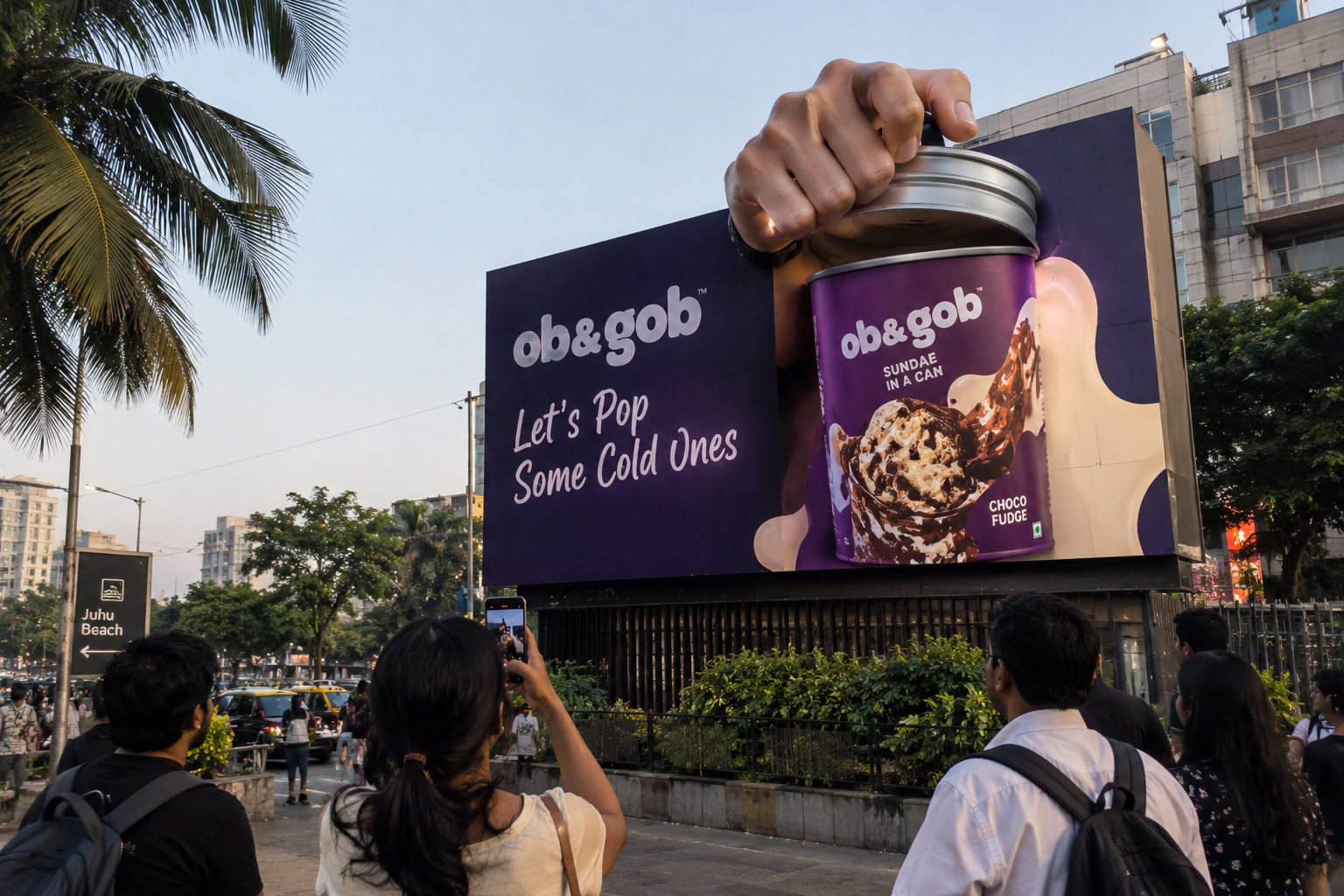
There was a time when a billboard was simply a space for brands to display their message to thousands of people. Find a busy road, book an advertising space, put up a creative, and let visibility do the rest. Today, that approach is evolving. Billboards are no longer just static displays; they are becoming larger-than-life brand experiences, featuring moving installations, product demonstrations, interactive formats and even life-sized recreations of products.
At a time when consumers are constantly exposed to digital advertisements, Out-of-Home (OOH) advertising is making a strong comeback. Far from being an outdated medium, it is reinventing itself to compete for attention in an increasingly crowded media landscape.
What Is Bringing OOH Back into the Game?
Out-of-Home advertising refers to brand communication that reaches consumers outside their homes. This includes traditional billboards, hoardings, bus shelters, public transport advertising, airport displays and digital screens across public spaces.
What makes OOH relevant again is its ability to bring brands into the real world. While digital advertising competes for attention across mobile screens, websites and social media feeds, outdoor advertising occupies spaces that consumers naturally move through every day.
However, the renewed interest in OOH is not simply about visibility. It is about how brands are using physical spaces more creatively. From three-dimensional billboards and unconventional installations to immersive public experiences, outdoor campaigns are increasingly designed to make people pause, engage and remember.
There is also a growing connection between physical and digital visibility. A striking outdoor campaign can quickly find a second life on Instagram, LinkedIn, and other social platforms as people photograph, share, and discuss it. This allows a campaign that begins on a street or at a public location to reach audiences far beyond its original geography.
When Billboards Become More Than Advertising Spaces
Several recent campaigns show how brands are using the billboard itself to communicate their ideas. Blinkit and UNO Flip, for instance, brought the game’s signature move to a billboard in Gurugram. The installation physically switched between two messages: “The UNO you know” and “The UNO you don’t”. Instead of simply displaying the game’s cards, the billboard recreated its flipping feature, making the advertisement part of the experience.
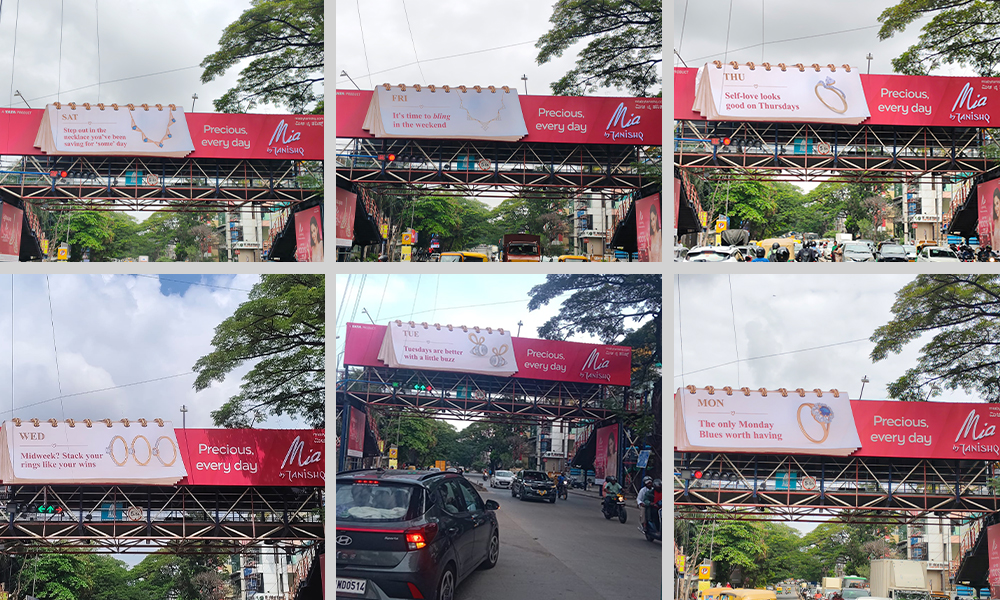
Mia by Tanishq took a different approach with its ‘Precious, Every Day’ campaign. First introduced in Bengaluru and later extended to Mumbai, the brand transformed a large billboard into a physical calendar. Its pages changed every day, revealing a new jewellery design and a message connected to everyday moods and experiences. The Bengaluru installation ran for 30 days, giving commuters something different to discover each day. (Source: Media4Growth)
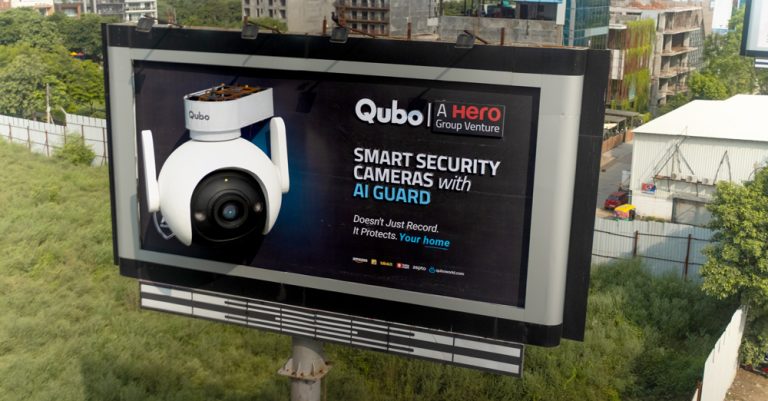
Qubo, the Hero Group’s smart devices brand, also moved beyond conventional product displays with its installations on Golf Course Road in Gurugram. One featured an Outdoor 360° Smart Security Camera with illuminated lights and motorised movement, making it appear as though the camera was scanning its surroundings. The campaign brought its message, “Doesn’t Just Record. It Protects.”, to life by demonstrating the product’s purpose through the advertisement itself. (Source: Passionate in Marketing)
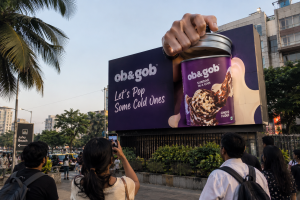
Ob & Gob, the new-age ice cream brand, brought its festive campaign, ‘Let’s Pop Some Cold Ones’, to Juhu Beach in Mumbai through an unusual billboard installation. Featuring a motorised hand that popped open a giant sundae can, the installation turned a familiar action into a larger-than-life visual experience. Building on its Ravi Shastri-led campaign, the execution put the brand’s signature sundae-in-a-can format at the centre of the outdoor advertisement, showing how a simple product feature can become the main attraction of a campaign. (Source: Adgully)
Blinkit caught attention with a creative outdoor advertisement that turned a simple seasonal reminder into an eye-catching billboard. As winter approaches, the campaign encouraged people to give their sweaters some sunshine before bringing them out for the colder days. By using a familiar everyday activity as its central idea, Blinkit showed how brands can make outdoor advertising more relatable, timely and memorable.
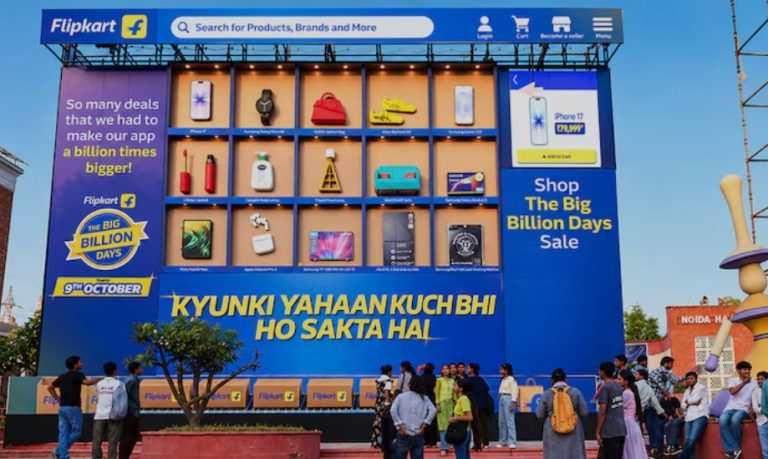
Flipkart also brought its digital shopping experience into the physical world during its Big Billion Days campaign. Executed by OAP Mediatech, the brand created a four-storey installation resembling its shopping app. Visitors could select products and place them into a physical shopping cart, turning a familiar online activity into an outdoor experience. (Source: Storyboard18)
From Moving Trucks to Larger-Than-Life Experiences
OOH advertising is not limited to fixed structures. Chheda’s took its Ganesh Chaturthi campaign across Mumbai, Pune and Nashik to promote its festive Modak range. In Mumbai, a giant Modak box was installed that opened and closed at key locations. In Pune, the brand used full-wrap branding on electric buses, taking its message across the city’s streets. (Source: Business News This Week)
KitKat has found a clever way to bring its famous ‘Have a break’ message into everyday commuting. The brand used a metro’s route-map panel to create an outdoor advertising experience, placing visuals of KitKat bars along the station route and turning a regular metro ride into a reminder to pause and enjoy a break. By connecting its familiar tagline with a daily travel experience, KitKat showed how brands can make public transport advertising more engaging and contextually relevant.
Noice, Swiggy Instamart’s in-house brand, chose another moving format by transforming a truck into a colourful outdoor advertisement. Drawing inspiration from India’s decorated trucks, the vehicle featured bold patterns, oversized wheel motifs, and prominent product displays, allowing the campaign to travel across different locations.
Entertainment brands are also finding creative uses for the medium. Netflix promoted its film The Last House by turning a billboard on Los Angeles’ Sunset Boulevard into a fully furnished living room, with a performer living inside it. Seen eating and relaxing, the performer held a sign reading “Stuck in Here”. The installation brought an element of the film’s story into a real public space, encouraging curiosity among passers-by. (Source: Media4Growth)
Meanwhile, NEBULA by Titan used large-format billboards and visual installations across Mumbai to promote its first exclusive store in India, located in Khar. The campaign used the brand’s blue identity and watch imagery to build visibility around the launch, showing how outdoor advertising can also support a brand’s positioning and retail presence.
HDFC took an unconventional approach to outdoor advertising with a campaign that was hard to miss. From turning heads to making its presence felt across the streets, the execution showed how brands can use larger-than-life ideas to capture public attention. Sometimes, standing out means taking the message a little further than the conventional billboard.
How Technology is Changing Outdoor Advertising
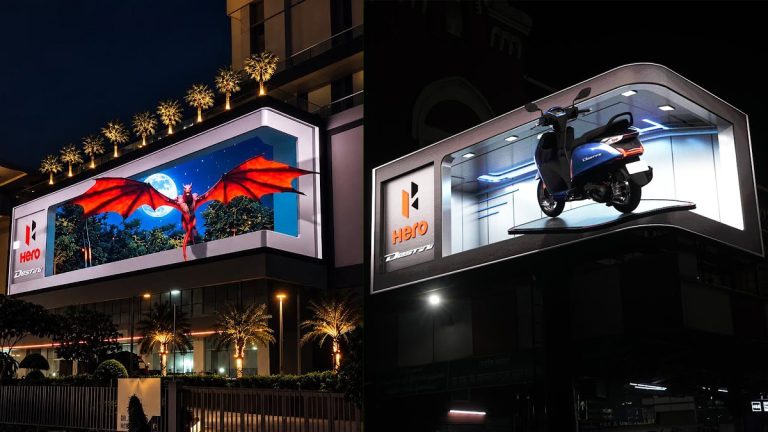
Beyond physical installations, digital technology is giving OOH another dimension. Digital Out-of-Home (DOOH) advertising uses electronic screens and LED displays to show videos, animations, and changing creatives instead of relying only on printed advertisements.
Hero MotoCorp demonstrated this through its ‘The Dragon’s Test’ campaign for the new Hero Destini. Rolled out across Delhi, Mumbai, Bengaluru and Chennai, the campaign used 3D anamorphic visuals to show a mythical dragon emerging beyond the edges of a digital billboard and putting the scooter through a durability test. Powered by Google DV360, it was also the brand’s first Programmatic Digital Out-of-Home campaign, using technology to support audience-led planning and campaign optimisation. (Source: Indian Television)
Programmatic DOOH adds another layer by giving brands greater flexibility in planning and managing digital outdoor campaigns. This allows outdoor advertising to move beyond fixed placements towards more dynamic ways of reaching audiences.
The Road Ahead for OOH Advertising
These campaigns show that outdoor advertising is no longer limited to putting a message on a large surface. Brands are using movement, physical demonstrations, storytelling, public transport, and digital technology to make their communication more noticeable and engaging.
Another important advantage is that these experiences can continue to attract attention beyond their physical locations. When people photograph an unusual billboard or share a video of an installation on social media, the campaign can reach audiences who may never have passed that particular location.
For brand leaders, the opportunity lies in choosing an outdoor format that fits the product, audience, and message. A creative installation may attract attention, but it must also give people a clear reason to remember the brand behind it.
As advertising formats continue to evolve, OOH is showing that sometimes the most effective way to reach people is to meet them where they already are.