

Most advertisements are designed to deliver a message. The most memorable ones invite people into a story.
That’s the difference between capturing attention and creating participation. As artificial intelligence and connected customer journeys reshape marketing, the brands making the biggest impression are no longer asking people to simply watch a campaign; they’re asking them to become part of it.
For decades, print advertising has largely been a one-way interaction. A reader notices an advertisement, absorbs the message, and turns the page. The experience begins and ends in a matter of seconds.
But what if the newspaper wasn’t the destination? What if it became the first touchpoint in a much larger customer journey? That is precisely the question Hero Destini’s latest campaign attempts to answer.
The Campaign
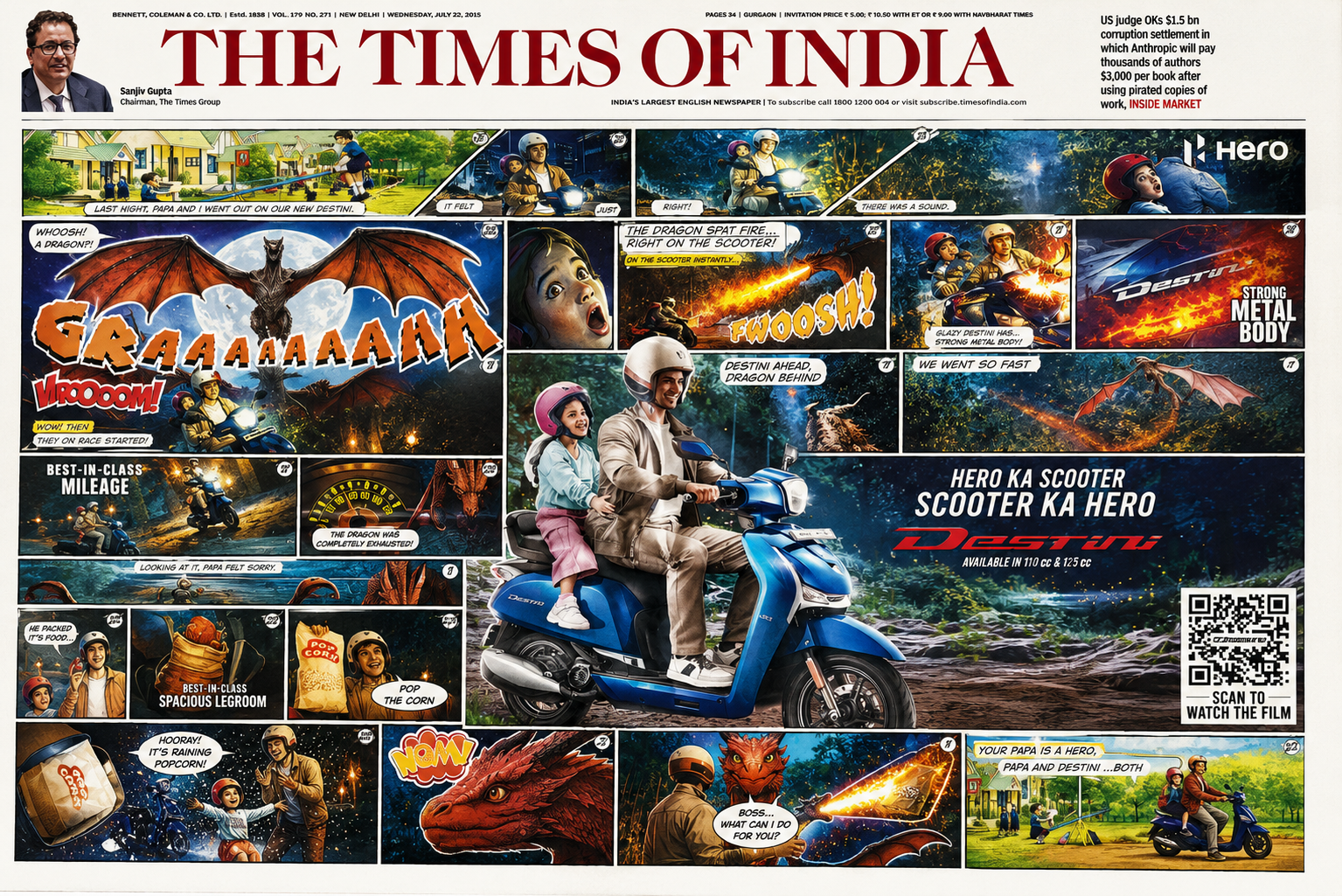
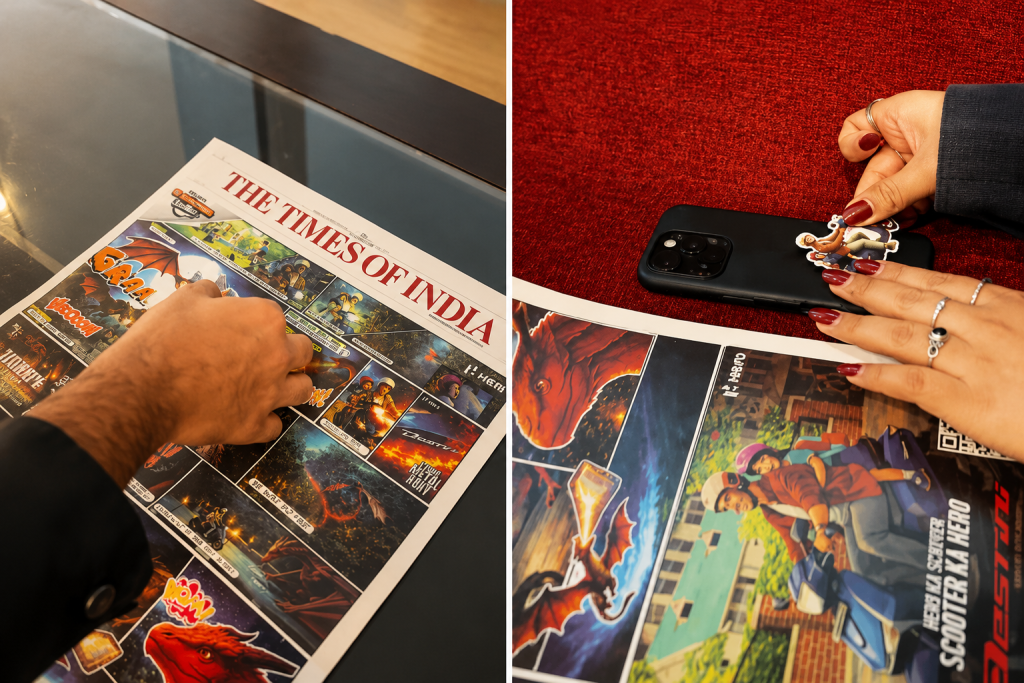
Instead of treating a newspaper advertisement as a static placement, Hero Destini transformed the front page into a four-page comic strip complete with peelable stickers. Rather than leading with product specifications, the comic follows a father and daughter embarking on an imaginative adventure filled with mythical creatures, dramatic landscapes, and, of course, the Hero Destini scooter at the centre of the narrative.
The storytelling, however, doesn’t stop with the newspaper.
QR codes embedded throughout the experience invite readers into the Hero Destini Fantasy World, where the campaign shifts from passive storytelling to active participation. Users can upload photographs of themselves and their children, personalise the characters, select from multiple Indian languages, and generate an AI-powered version of the adventure starring their own family.
The completed story is then delivered directly to WhatsApp, turning what began as a newspaper advertisement into a personalised digital experience that users can watch, share, and revisit.
The campaign is notable not because it used AI, many brands already do, but because every touchpoint served a specific purpose within a connected journey. Print sparked curiosity. Mobile enabled interaction. AI created personalisation. WhatsApp became the platform that completed the experience.
Rather than existing as separate channels, each interaction naturally led to the next. (Source: YouTube: Campaign Chronicles)
The Bigger Shift: Marketing Is Becoming Participatory
Hero Destini’s campaign reflects a broader transformation taking place across modern marketing.
For years, advertising has largely revolved around delivering the same creative message to millions of people. The audience’s role was straightforward: watch, read, or listen.
Today’s consumers expect something far more engaging.
They don’t just consume brand experiences; they interact with them. They personalise them, influence them, and increasingly expect brands to recognise them as individuals rather than anonymous audiences. Whether it’s customised shopping recommendations, AI-generated content, or interactive experiences, participation has become a defining characteristic of customer engagement.
Artificial intelligence has accelerated this evolution.
Experiences that once required weeks of production and manual customisation can now be generated dynamically at scale. Instead of creating a single campaign for everyone, brands can now create frameworks capable of producing thousands, or even millions, of personalised experiences without rebuilding the campaign from scratch.
The shift is subtle but significant. Marketing is moving away from telling customers a story and towards inviting them to become characters within it.
Hero Destini’s campaign reflects another important shift in brand storytelling. Rather than leading with mileage, storage space or safety features, it began with a simple emotional truth: every child sees their father as a hero. The scooter’s features were then woven naturally into that story, making the product feel like an enabler of meaningful moments rather than the centre of attention. (Source: Power On Wheel)
Why This Matters for Brands
The real strength of Hero Destini’s campaign isn’t the newspaper, the QR code, or even the AI-generated story in isolation.
It’s the way every element works together to remove friction between channels.
For years, brands have organised campaigns around media formats. Print teams managed print. Digital teams managed digital. Messaging platforms were often treated as customer support tools or channels for transactional communication.
Customers, however, don’t think that way. They experience every interaction as part of a single relationship with the brand. They don’t consciously move from an offline experience to an online one; they simply continue wherever the next interaction feels most intuitive. In many ways, this reflects the core principle of customer journey design: the experience should be viewed from the customer’s perspective rather than through the lens of individual channels or internal teams. When brands design journeys around how customers naturally move between touchpoints, disconnected campaigns begin to feel like one continuous experience. (Source: NN Group)
This campaign embraces that reality by transforming traditional print into an entry point for digital engagement rather than positioning it as a standalone advertisement. The newspaper creates curiosity, mobile deepens engagement, AI personalises the experience, and WhatsApp delivers the final story in a familiar environment where users already communicate every day.
This approach reflects a broader shift in omnichannel strategy. Rather than optimising individual touchpoints in isolation, leading brands are increasingly designing end-to-end journeys that account for how customers naturally move between channels. As McKinsey notes, focusing on isolated interactions often creates fragmented experiences, whereas seamless handoffs across touchpoints are what ultimately shape customer satisfaction. (Source: McKinsey&Company)
It demonstrates that traditional media doesn’t have to compete with digital channels. Instead, it can become the bridge that connects customers to them.
The Marketing Lesson
The future of marketing is unlikely to be defined by individual channels. It will be defined by how seamlessly brands connect them.
Hero Destini’s campaign offers a glimpse of that future. Not because it reinvented print advertising, but because it paired technology with a simple human truth: every child sees their father as a hero. AI, WhatsApp, and print were never the story themselves—they were simply the tools that brought that emotion to life across multiple touchpoints. The campaign demonstrates that even the most advanced technology is most effective when it amplifies an insight people already recognise.
The lesson extends well beyond newspapers.
Every customer touchpoint, whether it’s a billboard, a product package, a retail store, a website, or a messaging app, has the potential to become the beginning of something larger. The brands that will stand out are not necessarily those producing more content or adopting the latest technology first. They will be the ones designing journeys where every interaction naturally invites customers into the next chapter.
Because in an era of connected experiences, the most powerful campaigns don’t simply capture attention. They keep the story going.