

For years, Meta has been one of the most predictable growth engines in digital marketing. Businesses refined audience targeting, optimised campaigns, monitored return on ad spend (ROAS), and scaled what worked. While the platform evolved, the fundamentals remained familiar.
That assumption no longer holds.
Throughout 2026, advertisers across industries have reported rising acquisition costs, inconsistent campaign performance, and longer optimisation cycles. The immediate reaction has been to blame the algorithm or attribute the decline to another “bad month” on Meta. But that explanation misses the bigger picture.
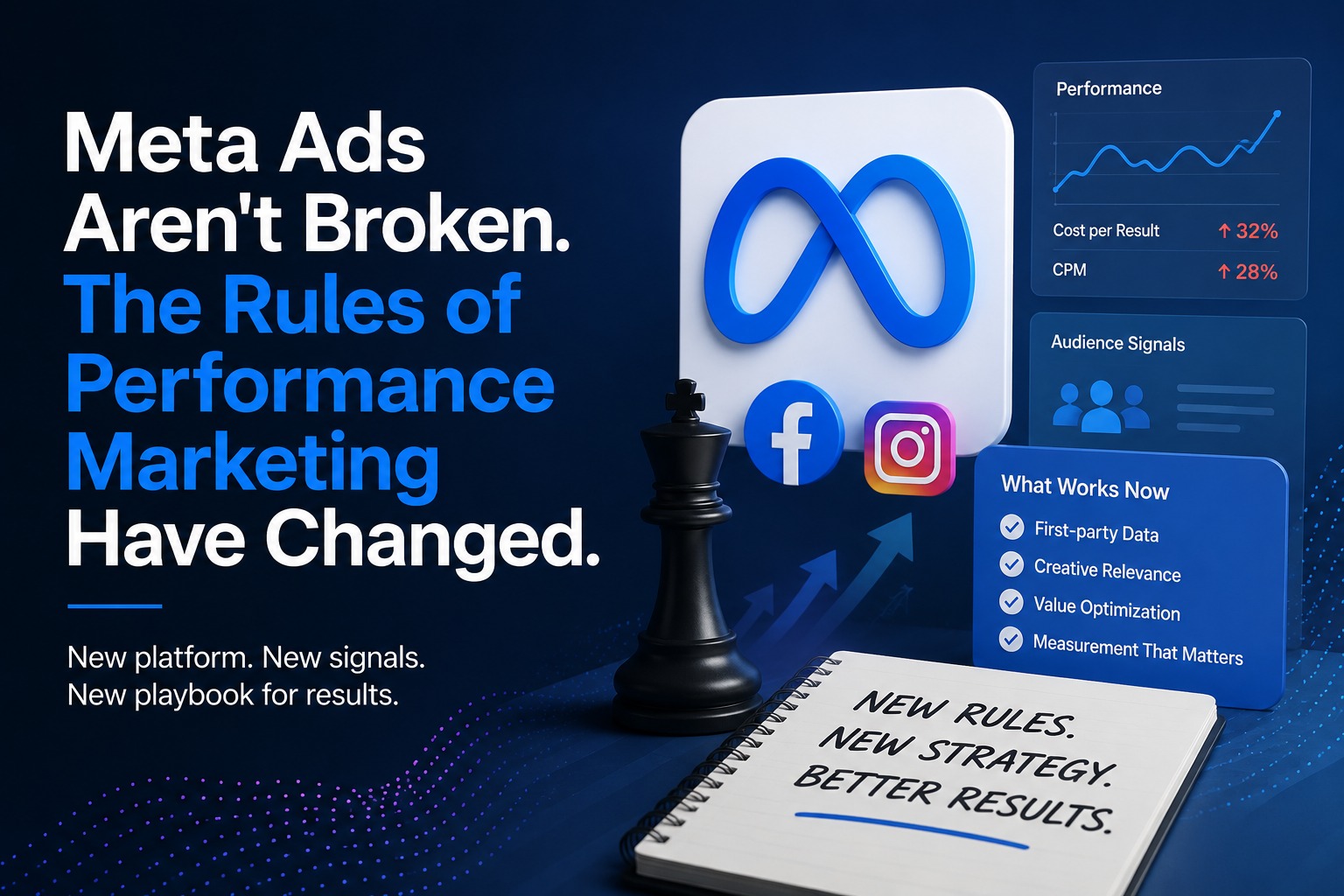
Meta hasn’t become a worse advertising platform. It has become a fundamentally different one. The company is redesigning how advertising works through AI-driven automation, broader targeting, and privacy-conscious measurement. In the process, it is exposing weaknesses in marketing strategies that once delivered reliable results.
This transformation is also reflected in Meta’s own business performance. Ahead of the company’s second-quarter 2026 earnings, analysts at Morningstar identified AI-powered ad automation—particularly Advantage+, which has reached an annualised run rate of around $60 billion—as one of the biggest drivers of Meta’s advertising business. The platform’s continued ad growth suggests that while advertising on Meta has become more complex, demand for its AI-driven ecosystem remains strong. The challenge, therefore, is less about whether Meta works and more about whether businesses are adapting to how it now works. (Source: Morningstar)
AI Is Changing the Rules of Campaign Optimisation
Meta’s latest advertising updates are part of a broader shift towards automation. Features such as Advantage+ campaigns, AI-powered delivery and outcome-based optimisation are steadily reducing the number of manual decisions advertisers make. Instead of rewarding marketers who can fine-tune audiences, placements and bidding strategies, Meta increasingly expects its AI systems to make those decisions.
This transition inevitably creates uncertainty. Businesses accustomed to making frequent campaign adjustments often find themselves working against the algorithm rather than with it. Campaigns now require more time and sufficient conversion data before performance stabilises, making early results less predictable than they once were.
While many advertisers see this as declining performance, it is more accurately a shift in how performance is generated. Success depends less on tactical optimisation and more on providing Meta’s AI with the signals it needs to make effective decisions.
Competitive Advantage Has Moved Beyond Media Buying
Perhaps the biggest misconception about Meta in 2026 is that campaign success still depends primarily on audience targeting.
Increasingly, it does not.
As automation takes over targeting and bidding, competitive advantage is moving elsewhere. Creative quality, first-party customer data, accurate conversion tracking, and continuous experimentation are becoming the factors that separate high-performing advertisers from everyone else.
AI is also changing what “good creative” means. As tools like Meta’s AI creative suite make it easier to generate hundreds of on-brand variations, volume is becoming less of a differentiator. The real advantage now lies in developing genuinely distinct creative concepts rather than repeatedly iterating on the same idea. In other words, AI is lowering the cost of execution, but originality remains a human advantage. (Source: Ads Uploader)
This explains why two businesses selling similar products with comparable budgets can experience dramatically different outcomes. The difference is rarely the campaign settings alone. It is the organisation’s ability to produce relevant creative at scale, maintain clean measurement infrastructure and generate reliable customer signals for the algorithm.
In many ways, Meta is no longer rewarding better media buying. It is rewarding better marketing.
Why Operational Excellence Matters More Than Ever
Many of the challenges advertisers are experiencing today stem from operational rather than platform issues.
Incomplete Conversions API implementations, inconsistent Pixel events, fragmented account structures and poor data hygiene all reduce the quality of signals available to Meta’s optimisation models. As the platform becomes increasingly dependent on AI, these weaknesses become more expensive.
As Meta’s automation becomes more sophisticated, the quality of the data businesses feed into the platform matters more than ever. AI can only optimise for the signals it receives, making first-party data, Conversions API integrations, CRM connectivity and offline conversion tracking strategic assets rather than technical add-ons. In an AI-driven advertising ecosystem, better inputs increasingly lead to better outcomes. (Source: Pixis)
At the same time, businesses are navigating rising media costs, evolving attribution models and greater privacy expectations from both regulators and consumers. These changes leave far less room for inefficient campaign management than in previous years.
More importantly, many of the performance declines businesses are reacting to are measurement changes rather than delivery failures. Meta’s 2026 attribution updates changed how conversions are classified, meaning dashboards may look worse even when underlying campaign performance remains unchanged. For business leaders, the risk is not simply lower performance but making strategic decisions based on misread data. (Source: Admanage)
As a result, operational excellence has become a competitive advantage. Organisations that invest in measurement, first-party data and disciplined testing are better positioned to adapt, while those relying on yesterday’s playbook often interpret structural change as declining platform performance.
The Bigger Lesson Extends Beyond Meta
Although Meta is at the centre of this conversation, the underlying trend is far broader.
Google, TikTok and other advertising platforms are following similar paths, relying increasingly on machine learning to automate optimisation decisions. Across digital advertising, human expertise is shifting away from managing algorithms and towards strengthening the inputs that algorithms depend upon.
That means developing stronger creative systems, improving customer data quality, building more resilient measurement frameworks and understanding customer behaviour beyond platform dashboards.
These capabilities are harder to replicate than campaign tactics, making them more valuable over the long term.
The Future Belongs to Businesses That Adapt
For business leaders, the question is no longer whether Meta’s advertising platform has changed. It clearly has.
The more important question is whether their organisation has changed with it.
Companies that continue to treat Meta as a platform where success comes from constant manual optimisation are likely to face increasing frustration. Those that invest in creative excellence, reliable first-party data, robust measurement and long-term experimentation will find that Meta remains a powerful driver of growth, even if the path to that growth now looks very different.
Ultimately, Meta’s transformation reflects a larger shift in digital marketing itself. As AI takes greater control of optimisation, competitive advantage no longer lies in outsmarting the algorithm. It lies in building a business that gives the algorithm better decisions to make.