


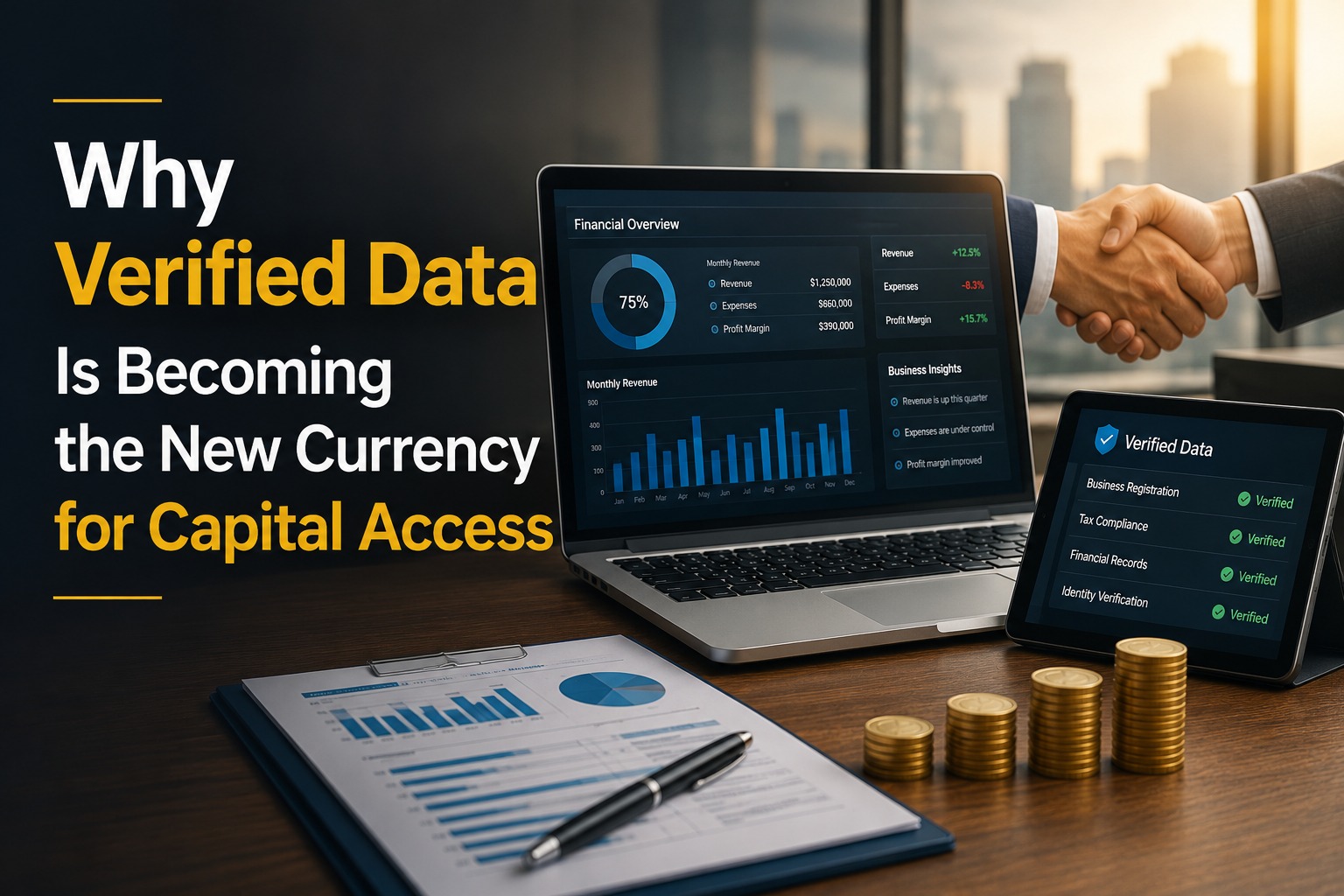
For decades, the path to capital ran through a familiar checklist: financial statements, credit history, collateral, and relationships. That checklist hasn’t disappeared — but it’s no longer sufficient. A new variable now sits at the centre of every lending, investment, and insurance decision: verified data.
Whether a business is applying for a loan, courting an investor, negotiating an insurance premium, or simply trying to unlock better credit terms, one question increasingly decides the outcome — can you prove what you claim, in real time? In an economy that rewards speed and punishes ambiguity, verified data has moved from “nice to have” to non-negotiable.
The Credibility Gap Capital Markets Can’t Ignore
Information asymmetry has always been the quiet tax on business financing. Lenders, investors, and insurers rarely see a company the way it sees itself — and traditional due diligence, built on audits, paperwork, and periodic reviews, only ever captures a snapshot. It’s a photograph in a video economy.
That gap is now closing — and regulators are pushing it along. In July 2026, India rolled out CKYC 2.0, introducing confidence scores that quantify data accuracy and verification at the point of financial onboarding. It’s a small technical update with a large signal: credibility is being quantified, and quantified credibility is being built into the infrastructure of finance itself.
Why Verified Data Now Moves The Needle
In finance, credibility has always been the currency behind the currency. What’s changed is that credibility can now be measured, scored, and priced.
The numbers back this up. Recent IFC data shows women-owned SMEs posting a non-performing loan ratio of 3.6%, against 3.8% for the broader SME portfolio — proof that granular, verified data can surface lower-risk borrower segments that generic scoring would otherwise miss.
The payoff cuts across the ecosystem:
- Lenders sharpen credit assessments and cut default risk.
- Investors spend less time policing claims and more time evaluating opportunity.
- Insurers price risk with precision instead of padding for uncertainty.
The net effect is a capital market that runs on evidence, not assumption — and evidence, unlike reputation, compounds. Verified businesses don’t just get funded faster; they get funded on better terms.
Data Is The New Oil — But Only If It’s Refined
Data has spent the last two decades graduating from business byproduct to economic asset. The comparison to oil is well-worn, but it holds: crude data, like crude oil, is worth little until it’s refined. As financial institutions lean harder on AI and analytics to make decisions, the quality of the data feeding those models has become the real bottleneck — not the sophistication of the algorithm.
This is reshaping how risk gets modelled. Verified operational, financial, and compliance data is fast becoming the backbone of credible risk assessment. Businesses that can produce reliable data signals are read as lower-risk — and lower risk cascades into faster approvals, sharper financing terms, cheaper insurance, and deeper investor interest. Companies that can’t are quietly pushed into longer diligence cycles and thinner access to capital.
Credibility Is Bigger Than The Balance Sheet
Capital providers used to stop at the financial statement. Not anymore. Today’s credibility profile spans regulatory compliance, governance, operational stability, digital footprint, and even the standing of a company’s supplier and customer relationships. Verified data is what stitches these fragments into a single, coherent signal of reliability.
This shift matters most for SMEs — the businesses least likely to have a decade of audited financials behind them. For them, verified operational credentials aren’t a compliance exercise; they’re a competitive equalizer, a way to stand toe-to-toe with larger, longer-established rivals for the same capital.
Credibility Is Becoming A Balance-Sheet Asset
Reliability in business has always mattered. What’s new is that it’s becoming measurable — and measurable reliability behaves like an asset in its own right: the accumulated value a business builds by consistently offering accurate, transparent, verifiable information to the market.
As financial systems grow more interconnected and more automated, that reliability is shaping up to be as consequential as financial capital itself. It’s not a soft metric anymore. It’s underwriting real decisions, at scale.
What This Means For The Next Decade Of Financing
Speed, transparency, and confidence will define the next era of capital access. As verification technology matures, it won’t just streamline financing — it will decide who gets access to it, and on what terms.
The businesses that invest now in building clean, verifiable, real-time data infrastructure aren’t just checking a compliance box. They’re building the relationships — with lenders, insurers, and investors — that the next financial cycle will run on.
The takeaway for business leaders is blunt: capital no longer flows to what companies say about themselves. It flows to what they can prove. In this emerging order, verified data isn’t just supporting evidence — it’s fast becoming the most valuable asset on the table.