


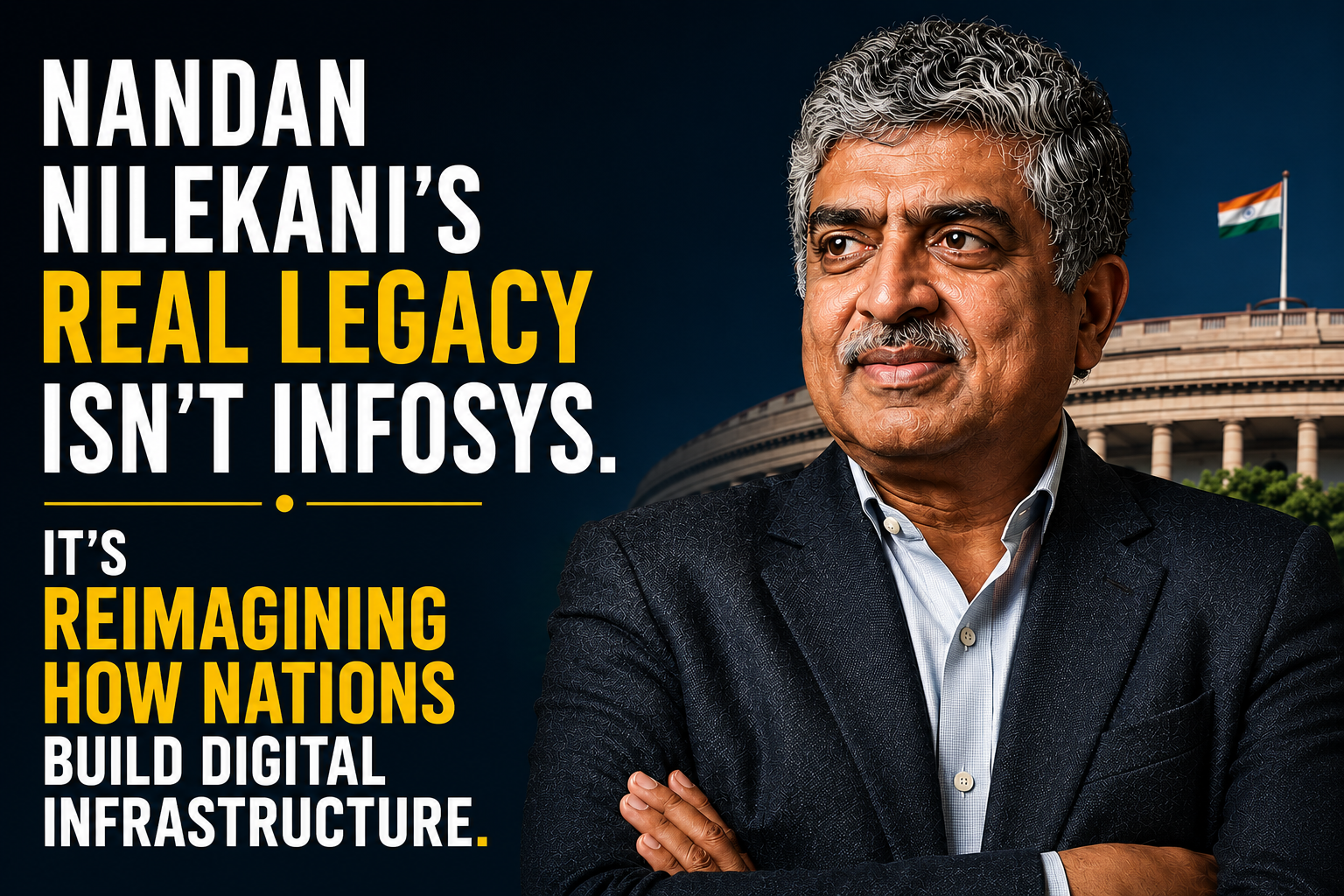
Most entrepreneurs build products. A handful build companies. Very few help build the infrastructure that an entire country depends on.
That is what makes Nandan Nilekani’s legacy different.
While he is widely recognised as the co-founder of Infosys, his larger contribution has been helping shape India’s digital public infrastructure (DPI)—the open digital rails powering identity verification, payments, and access to public services for more than a billion people. At a time when governments worldwide are exploring how technology can improve governance without sacrificing inclusion, India’s experience has become a global reference point, and Nilekani’s philosophy sits at its centre.
Thinking beyond products
Infosys established India as a global technology powerhouse, but Nilekani’s move into public service reflected a broader ambition. Instead of solving problems for enterprises, he began asking how technology could solve problems at a national scale.
That shift led him to the Unique Identification Authority of India (UIDAI) in 2009, where he oversaw the creation of Aadhaar. Initially viewed by many as an ambitious and complex undertaking, Aadhaar has since become the world’s largest biometric identity programme. By 2026, more than 99% of Indian adults had been issued an Aadhaar number, making digital identity a foundational layer for banking, welfare, telecom, and countless public services.
More importantly, Aadhaar demonstrated a different way of thinking about technology. Rather than creating another government application, it established an identity layer that others could build upon. Identity became infrastructure rather than a standalone product.
The power of digital public rails
That philosophy eventually expanded into India Stack, an interoperable ecosystem that includes Aadhaar, e-KYC, eSign, DigiLocker, and the Unified Payments Interface (UPI).
UPI illustrates the impact of this approach better than any policy paper could. In May 2026 alone, the platform processed more than 23 billion transactions worth nearly ₹30 trillion, transforming digital payments from a banking feature into an everyday utility. Over the past decade, transaction volumes have grown exponentially, making UPI one of the world’s most widely adopted real-time payment systems.
The significance extends well beyond payments.
Instead of creating closed platforms that compete with one another, India adopted open standards that allow banks, fintechs, startups, and government agencies to innovate on the same digital foundation. Competition shifted from owning infrastructure to delivering better customer experiences on top of shared infrastructure.
That distinction has become one of India’s most influential digital exports.
Why the world is paying attention
Digital public infrastructure has become a recurring theme at global policy forums, particularly as countries search for affordable ways to modernise financial services, healthcare, education, and citizen services.
Nilekani has consistently argued that governments should think of themselves as providers of foundational digital infrastructure rather than operators of every digital service. Public systems should create common building blocks while allowing private innovation to flourish above them.
This model is increasingly relevant as artificial intelligence moves from experimentation to national strategy. AI systems require trusted digital identity, secure payments, reliable data flows, and governance frameworks before they can scale responsibly. In that sense, India’s DPI offers more than a payments success story—it provides the institutional foundation for the next generation of AI-enabled public services.
Infrastructure is only as valuable as its trust
Building digital infrastructure at national scale inevitably raises questions around privacy, governance, and security.
Nilekani’s long-standing argument has been that openness and accountability must evolve together. Infrastructure should encourage innovation through open APIs while ensuring strong safeguards for citizens’ data and rights.
That balance is becoming increasingly important as governments grapple with issues such as AI regulation, algorithmic transparency, and digital trust. The challenge is no longer simply digitising services, but creating systems that citizens are willing to use at scale.
India’s experience suggests that adoption follows when infrastructure is designed to be interoperable, accessible, and useful in everyday life.
A blueprint for the AI era
Nilekani’s influence continues to extend beyond the systems he helped create. His recent work on education reforms and responsible AI reflects the same principle that has defined his career: build foundational capabilities first, then allow innovation to emerge around them.
That may ultimately become his most enduring lesson.
Technology leadership is no longer measured solely by the number of startups a country produces or the size of its digital economy. Increasingly, it will depend on whether nations can create trusted digital infrastructure that enables millions of people—and thousands of businesses—to innovate simultaneously.