

Artificial intelligence has become the defining investment priority for customer experience. Every quarter introduces new AI-powered assistants, agents and automation tools, each promising faster responses, greater personalisation and more efficient customer engagement. Yet despite the rapid pace of innovation, one question remains surprisingly unresolved: are these technologies actually making customers trust brands more?
The evidence suggests not. As AI becomes increasingly embedded across marketing, sales and customer support, many businesses are discovering that automation alone does not create stronger relationships. Instead, it often exposes a growing disconnect between the experiences brands believe they are delivering and the ones customers actually remember.
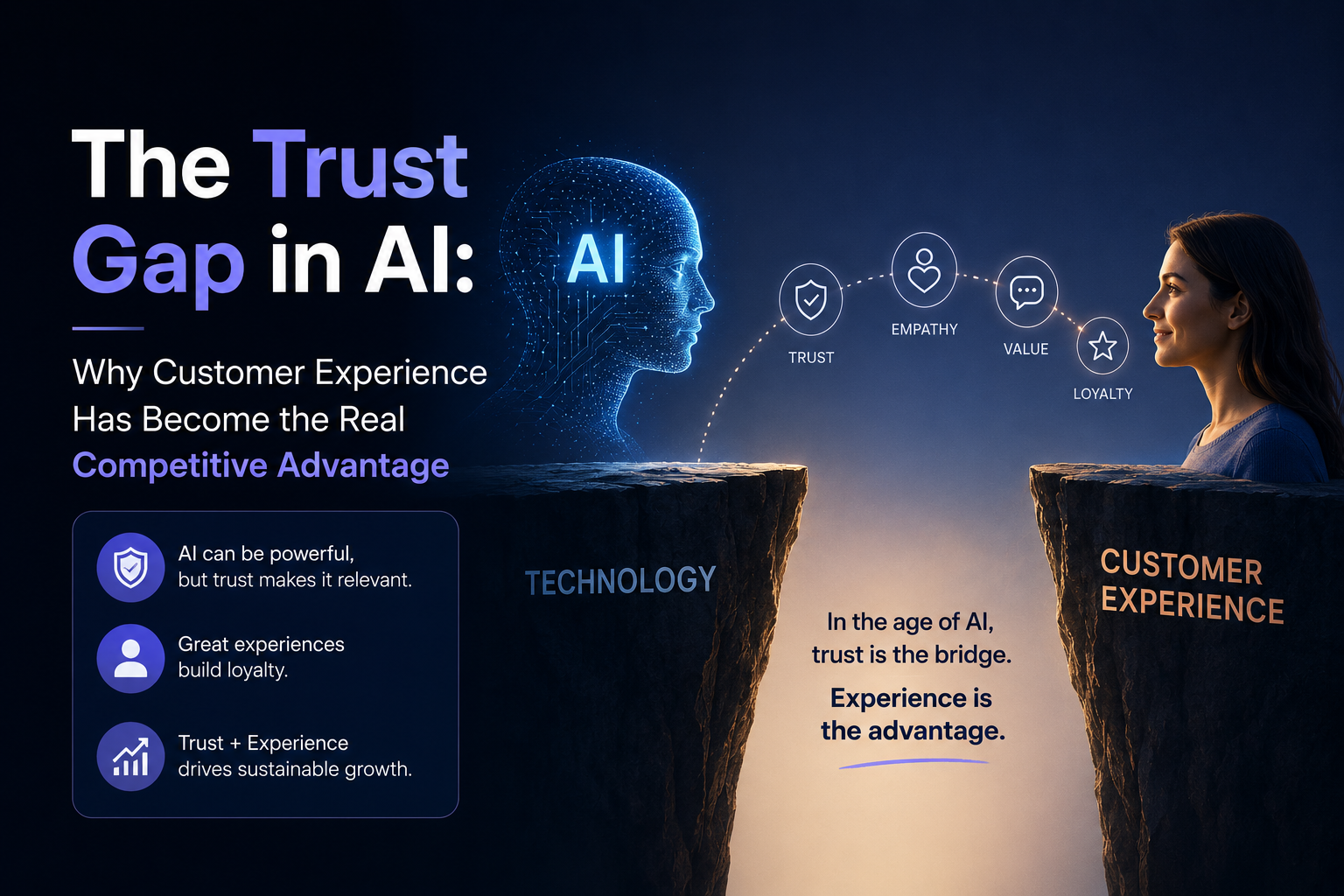
The 2026 Braze Customer Engagement Review describes this disconnect as the “Trust Gap”—a widening expectation divide between AI’s promised sophistication and the lived experience of the people on the receiving end of it. (Source: Braze) That gap is becoming one of the defining customer experience challenges of the AI era. The brands that succeed will not necessarily be those with the most advanced AI, but those that use it to remove friction, create consistency, and make every interaction feel more human. That shift in thinking is reshaping what effective customer engagement looks like—and why experience, not technology alone, has become the real competitive advantage.
AI Isn’t Replacing Trust
The rapid adoption of AI has created an assumption that better technology naturally leads to better customer relationships. It doesn’t. While AI is becoming a standard layer across marketing, commerce and customer service, trust continues to operate by a different set of rules.
The scale of adoption makes that contrast impossible to ignore. Marketers’ use of AI has climbed to 69.1% in 2026, up from 61.4% just a few years earlier, with usage among professional marketers reaching 81.6%. (Source: Amra & Elma, 2026) Yet consumers remain far more cautious. Klaviyo’s 2026 AI Consumer Trends Report found that only 13% of consumers completely trust AI, while 36% “somewhat” trust it and 30% remain neutral—leaving the majority unconvinced rather than fully confident. (Source: Klaviyo, 2026) Separate 2026 research reinforces the point, with 86% of U.S. consumers saying they do not fully trust AI-generated answers and wanting greater transparency into how those responses are produced. (Source: FutureProof, 2026)
This disconnect reveals a misconception shaping many AI strategies today. Businesses often measure success by how much AI they have deployed, while customers judge success by whether an interaction solved a problem, respected their time, and felt reliable.
As Mr. Akhil Rumandia, Business Head – D2C at XYXX, observed during a recent panel discussion at a Meta event in Mumbai:
“People don’t mind interacting with AI if it is helping them solve something.”
In other words, customers rarely reject AI itself—they reject experiences that fail to deliver meaningful value. They are not evaluating whether AI is involved; they are evaluating whether the experience feels genuinely useful and relevant.
AI can accelerate responses, personalise recommendations and predict intent, but none of those capabilities automatically translate into confidence. In fact, as automation becomes more common, trust becomes an even stronger differentiator because customers are paying closer attention to the quality of the experience, not the sophistication of the technology behind it.
That is why the conversation should shift from AI adoption to AI application. Faye Digital’s 2026 customer experience analysis argues that trust in AI-driven interactions depends on outcomes as much as on transparency and clear explanations of how automated decisions are made. (Source: Faye Digital, 2026) In other words, AI is an enabler of customer experience, not the experience itself. The brands creating lasting relationships are not those using the most AI, but those using it to make every interaction more consistent, more transparent and genuinely more useful.
Personalization Beats Automation
As AI becomes widely accessible, automation is rapidly losing its competitive advantage. Faster responses, automated workflows and AI-generated content are no longer differentiators—they are increasingly becoming the baseline. What customers notice instead is whether a brand understands their context, intent and needs well enough to make an interaction feel genuinely relevant.
This is where many AI strategies fall short. Businesses often optimise for operational efficiency, while customers evaluate the quality of the experience. Involve.me’s 2026 personalisation report notes that AI can accelerate scoring, testing and routing, but “it will not fix a weak offer or a confusing page.” Automation without relevance simply moves friction through the customer journey more quickly. (Source: Involve.me, 2026)
The same principle extends across customer engagement. Klaviyo’s 2026 marketing automation research argues that while technology powers campaigns, trust is what drives sustainable growth. AI delivers the greatest value not when it automates every interaction, but when it helps brands make those interactions more timely, contextual, and genuinely useful. (Source: Klaviyo, 2026)
The commercial impact reflects this shift. Amra & Elma’s 2026 personalisation statistics found that top-performing organisations consistently outperform their peers on revenue growth, with AI-powered personalised campaigns delivering strong returns across sectors including retail, travel and financial services. (Source: Amra & Elma, 2026) The reason is straightforward: effective personalisation makes customers feel recognised, while poor automation simply makes brands feel more efficient at being impersonal. In a market where AI capabilities are becoming increasingly similar, the experience a brand creates—not the technology it deploys—is emerging as the real competitive advantage.
Human Creativity Remains the Competitive Advantage
As AI tools become commoditized, execution quality stops being the differentiator — judgment becomes the differentiator. A 2026 analysis on brand identity argues that AI has “commoditised” the mechanics of design, logos, and palettes, but it has not commoditised “conviction about what your brand stands for” or the “discipline about what it is not”. The same piece notes a widening split between a rising aesthetic floor, where AI tools make bad design rarer, and a rising strategic ceiling, where what separates strong brands is positioning, evidence, and restraint, all of which remain distinctly human work. (Source: Freshly Brewed, 2026)
This principle is becoming increasingly clear in customer experience. AI is most effective when it removes repetitive work, allowing people to focus on conversations that require empathy, critical thinking, and context. The strongest customer experiences are not those with the most automation, but those where customers can move effortlessly from AI assistance to human support whenever the situation demands it.
As Mr. Suresh Nemani, Senior Vice President at Sushil Finance, points out:
“Human intervention is unavoidable, particularly when customers require personalised advice.”
AI can improve efficiency, but trust is often built through human expertise when decisions become more complex. Creativity and judgment are not tasks to be automated away; they are the layer that determines whether AI-assisted interactions feel considerate or hollow.
AI Should Amplify Brand Identity, Not Erase It
The competitive advantage no longer comes from simply adopting AI. It comes from teaching AI what makes a brand distinctive. Models grounded in first-party customer data, product expertise, and clear brand guidelines produce outputs that feel relevant and authentic, while generic implementations often result in content that is interchangeable with everyone else’s.
As Reem Saied, Co-Founder & CMO at Oogw.ai Analytics, noted during the discussion:
“Use your own enterprise data first… create a trusted foundation, and then use AI.”
The more AI is grounded in a brand’s own customer knowledge and identity, the more likely it is to produce experiences that customers recognise and trust.
This principle extends far beyond marketing. AI delivers its greatest value by automating repetitive production and maintaining consistency, not by replacing creative thinking. Its real contribution is giving people more time to focus on strategy, storytelling and the ideas that make a brand distinctive.
The same conclusion appears at the brand level. AI strengthens brand credibility when it is embedded within a clear, consistent and transparent brand strategy. Rather than creating trust on its own, AI reinforces trust that has already been established through authentic experiences and a recognisable brand identity.
That distinction may become one of the defining competitive realities of the next decade. As AI capabilities become increasingly accessible, they will be less likely to separate market leaders from everyone else. What will remain difficult to replicate is a brand that consistently understands its customers, communicates with clarity, and delivers experiences people genuinely remember.
The question for businesses, then, is no longer “How much AI should we adopt?” It is “What kind of experience are we using AI to create?” Customers rarely remember whether an interaction was powered by a chatbot, an AI agent or a human representative. They remember whether it solved their problem, respected their time and reinforced their confidence in the brand.
Technology will continue to evolve. Trust still has to be earned. And in a marketplace where AI is becoming available to everyone, the brands that stand out will not be those with the most intelligent systems, but those that use them to make every customer experience feel unmistakably human.