


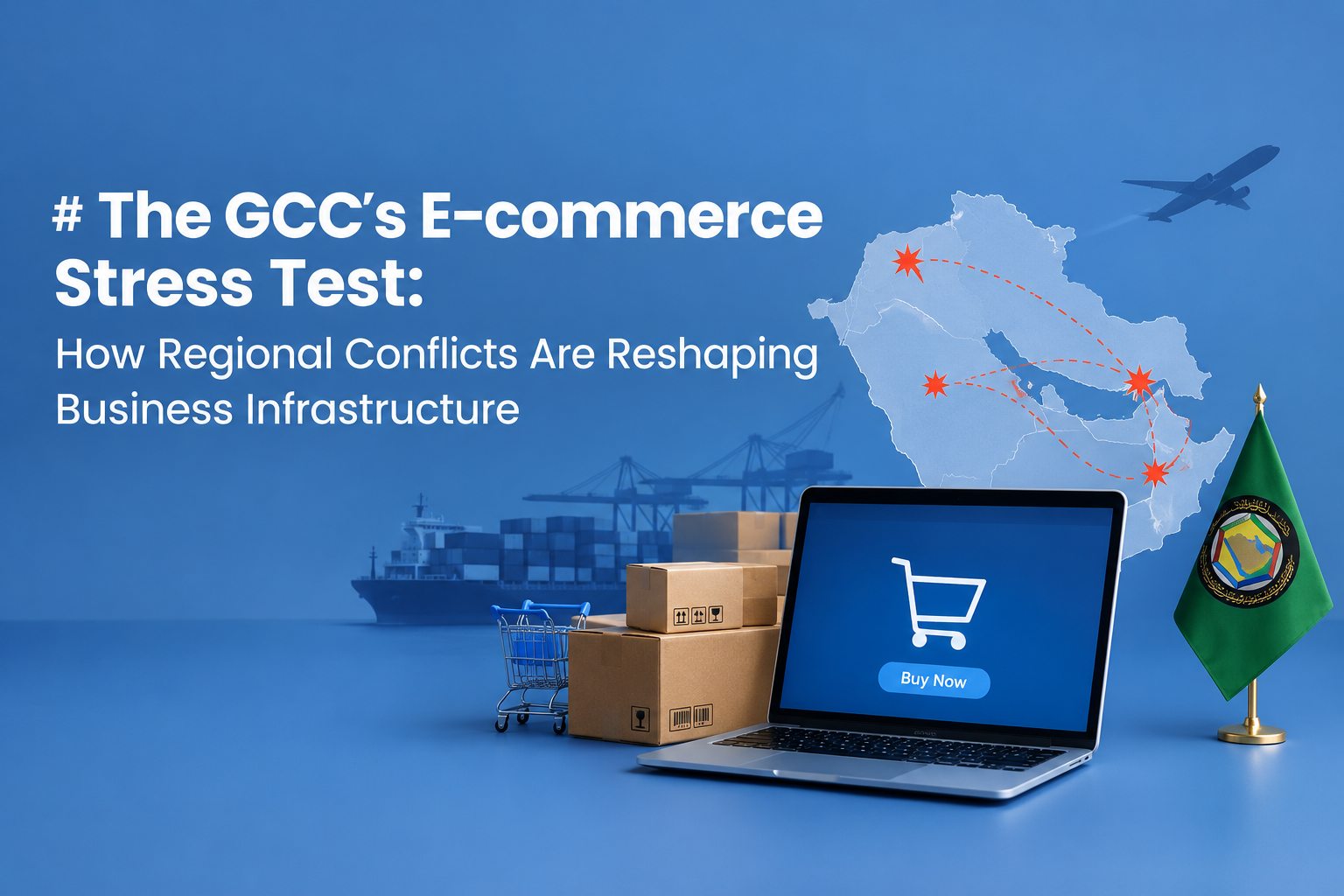
The GCC has spent years building itself into one of the world’s most connected commercial regions. Dubai, Abu Dhabi, Riyadh and other major cities have become hubs for international trade, retail, tourism and e-commerce, supported by sophisticated ports, airports, logistics networks and digital infrastructure.
But the region’s exposure to repeated periods of geopolitical disruption has also revealed another side of that growth story: how quickly commerce can be affected when the infrastructure connecting businesses to suppliers, markets and customers comes under pressure.
For e-commerce brands, the impact is rarely confined to one part of the business. A change in shipping routes can affect inventory. Longer delivery times can affect customer expectations. Higher freight costs can influence pricing. And when a product cannot reach a customer on time, the problem ultimately becomes a customer-experience issue.
The events of 2026 have therefore provided an important test for the GCC’s commercial infrastructure — and for how prepared businesses are to adapt when normal routes and consumer patterns change.
When Trade Routes Change, E-commerce Feels It First
One of the clearest pressure points has been logistics.
The Strait of Hormuz is central to the region’s trade and energy flows, and disruptions around the waterway have affected shipping activity, freight economics and vessel availability. By September, shipping costs and insurance premiums had risen significantly, while some cargo was being redirected through longer routes. For an e-commerce business, these developments quickly move beyond the logistics department.
A shipment taking longer can mean an inventory gap. A higher freight bill can change the economics of a product. A delayed container can affect a promotional campaign planned weeks in advance.
The impact was visible even among the region’s largest digital retailers. During the March disruption, Amazon temporarily closed its fulfilment centre operations in Abu Dhabi and suspended deliveries across the region, illustrating how quickly regional disruption can move from transport networks into the everyday mechanics of e-commerce. Reuters also reported that the company instructed employees in Saudi Arabia and Jordan to remain indoors. (Source: Reuters)
The customer, however, does not see any of that complexity. They see an order that says “delayed”, a product that is temporarily unavailable or a delivery date that has changed.
This is why supply-chain infrastructure and customer experience are increasingly connected. Brands operating across the GCC need not only alternative logistics routes, but also the systems and communication capabilities to keep customers informed when those routes change.
The UAE’s Infrastructure Is Being Tested — and Adapted
The GCC offers a useful example of how a highly connected commercial region responds when traditional trade routes come under pressure. Rather than relying on a single corridor, businesses and authorities have increasingly turned to alternative ports, land routes and logistics networks to keep goods moving. Customs authorities also introduced fast-tracked trade measures and alternative transit routes to support business continuity and maintain the flow of goods even as conventional shipping routes faced disruption.
This shift has been visible across the wider GCC as well. Goods bound for Gulf markets have been rerouted through ports on the Gulf of Oman and the Red Sea, while Saudi Arabia has increased cargo-train frequencies and established new intra-GCC shipping routes connecting Dammam with Abu Dhabi and Sharjah. These alternatives have helped businesses keep goods moving even as conventional routes faced disruption. (Source: Dubai Customs)
That matters for e-commerce because modern commerce depends on more than a single warehouse or delivery partner. It relies on an ecosystem of ports, roads, storage facilities, customs systems, fulfilment centres and last-mile networks working together.
The same flexibility was visible at the retail level. Reuters reported that Chalhoub Group, which operates around 900 stores for brands including Versace, Jimmy Choo, and Sephora, closed its Bahrain stores while keeping operations open in the UAE, Saudi Arabia, and Jordan with lean teams. The approach reflected a market-by-market response rather than a blanket shutdown across the region. (Source: Reuters)
When one part of that ecosystem becomes less predictable, having alternative routes, fulfilment options and operating models can determine how quickly a business continues serving customers. The wider GCC is moving in the same direction. Investment in alternative ports, logistics corridors and trade routes is increasingly becoming part of how the region prepares its commerce infrastructure for a more interconnected, but less predictable, operating environment.
One example is the 1,700 km GCC Railway project, which is now 50% complete and is expected to strengthen regional logistics connectivity while reducing dependence on traditional shipping routes. (Source: PwC)
What Happens to E-commerce Demand?
Infrastructure is only half the story. Regional disruption also changes how consumers shop. The UAE’s non-oil private sector continued to expand in March 2026, but the pace slowed considerably. The S&P Global UAE PMI fell to 52.9 from 55.0 in February, while customer demand, output, and new business growth weakened. Supplier delivery times also deteriorated as supply-chain pressures increased. (Source: Mubasher TV)
The shift was also visible in retail behaviour. EDITED data shows that UAE mall footfall fell 15% in March 2026, with luxury platforms recording double-digit declines. This suggests that the disruption was not only affecting how goods moved through the market, but also how consumers were choosing to spend. (Source: EDITED)
The important point is that consumers did not simply disappear from the market. They became more selective. For e-commerce brands, this can change everything from product assortment to promotions. Consumers may prioritise essentials, value and immediate utility while becoming more cautious about discretionary purchases. That means the response cannot simply be “offer a bigger discount”.
The GCC Is Not One E-commerce Market
Another lesson from periods of disruption is that the GCC cannot always be treated as a single market. Countries differ in their trade routes, infrastructure, consumer behaviour, and exposure to particular disruptions. Even within the UAE, the availability of different ports and transport corridors can create different options for businesses. For e-commerce companies, this makes regional planning more granular. A brand selling across the GCC may need different inventory positions for different markets, multiple fulfilment options and market-specific demand signals rather than relying on one regional forecast.
This also changes how companies think about expansion. The question is no longer simply: How quickly can we enter another GCC market? It increasingly becomes: Can our operating model adapt to the conditions of that market?
Customer Communication Is Becoming Part of Infrastructure
There is another layer of business infrastructure that is easy to overlook: communication. When deliveries are delayed, stock availability changes, or fulfilment routes are adjusted, customers need information quickly. For a modern e-commerce brand, that means transactional communication is no longer just a support function. SMS, WhatsApp, email, and other messaging channels can become part of business continuity. A customer who receives a clear update about a delayed delivery is having a very different brand experience from one who is left waiting without information.
This becomes particularly important in markets such as the GCC, where digital adoption is high and customers increasingly expect businesses to communicate through convenient, familiar channels. The infrastructure supporting e-commerce therefore extends beyond warehouses and logistics. It also includes the technology that allows brands to maintain a relationship with customers when operations become more complicated.
Resilience Is Being Built Into the Business Model
The UAE’s response also shows that resilience does not necessarily mean preparing for business to stop. It can mean creating enough flexibility for business to keep moving. The March 2026 PMI remained above the 50-point mark, indicating that the non-oil private sector was still expanding even as demand and supply conditions weakened.
Government and customs measures similarly focused on keeping trade moving rather than simply waiting for conditions to normalise. Dubai Customs’ economic packages provided more than AED79 million in private-sector liquidity while helping maintain AED33.9 billion in trade flows between March and June. For businesses, the lesson is straightforward. (Source: WAM AE)
Resilience is not necessarily about building a completely separate system for every possible disruption. It is about having enough flexibility within the existing system to change routes, suppliers, inventory allocations, fulfilment models and customer communication when circumstances require it.
The Next Advantage May Be Adaptability
The GCC’s growth story has always been closely connected to connectivity — between markets, consumers, businesses and the rest of the world. Periods of regional conflict have put that connectivity under pressure. But they have also highlighted the importance of the infrastructure underneath it.
For e-commerce brands, the lesson extends beyond logistics. A resilient business needs visibility across its supply chain, flexibility in fulfilment, a clear understanding of local demand and reliable ways to communicate with customers.
The brands best positioned for the GCC’s next phase of growth may therefore not simply be the ones with the largest inventories or the biggest physical footprint. They may be the ones capable of adjusting those systems quickly when circumstances change.
The region’s experience in 2026 is a reminder that modern commerce is only as strong as the infrastructure supporting it. And as the GCC continues to develop as a global commercial hub, the ability to adapt that infrastructure may become just as important as the infrastructure itself.