

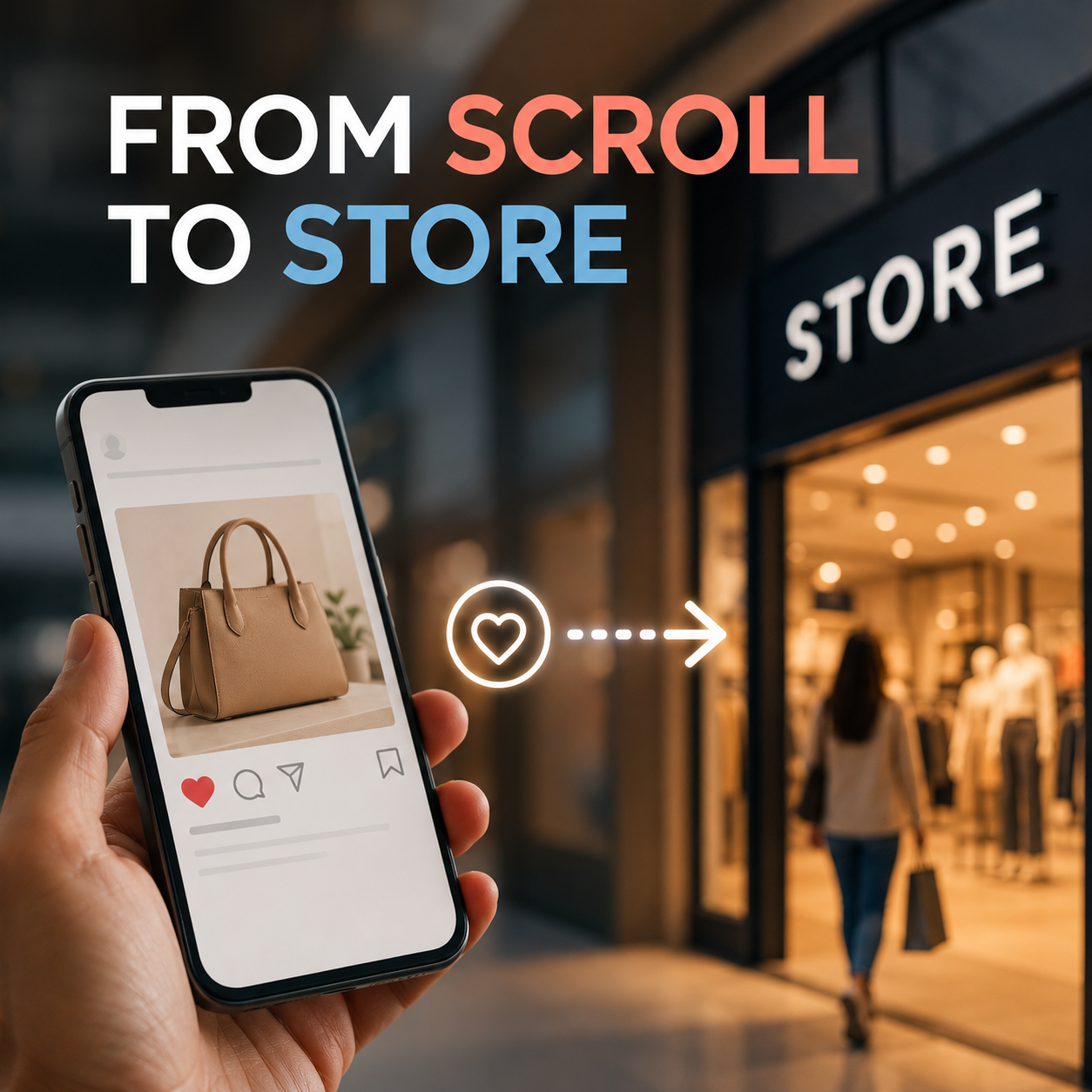
The journey to a physical store no longer begins on the high street. Increasingly, it starts online, through a swipe, a scroll, or a saved reel. The retail consumer journey has fundamentally transformed, with social media evolving far beyond a platform for entertainment or brand awareness.
In 2026, more than 5.4 billion people, nearly 66% of the global population, actively use social media platforms, while mobile devices account for 91% of global access. Short-form video alone now drives 63% of user engagement, increasing average viewing time by 28%. As consumer attention continues shifting toward social platforms, product discovery is increasingly happening within these digital environments rather than through traditional retail channels.
That shift is already influencing how consumers interact with physical stores. Nearly 40% of users now begin local searches on social media platforms, making them the second-most-used discovery channel after Google. The market reflects the scale of this transformation as well, projected to grow from USD 8.49 billion in 2026 to USD 53.62 billion by 2035 at a CAGR of 25.92%.
For retailers, the implications are becoming difficult to ignore. Social media is no longer simply shaping online engagement; it is increasingly influencing where consumers choose to shop in person. The question now is no longer whether social media impacts retail behaviour, but whether it is actively becoming the driver of physical store visits. (Source: Business Research Insights)
The Creator Economy as a Bridge to Offline Conversions
The influence of the creator economy is no longer limited to online engagement or digital purchases. Increasingly, creators are shaping real-world consumer behaviour by influencing where people shop, what products they explore in-store, and which brands they choose to trust. As social media becomes a primary discovery channel, creators are emerging as a powerful bridge between online inspiration and offline retail action.
The data supports this transformation. According to LTK’s 2025 Creator Economy Report, creators now surpass brands, retailers, celebrities, and store associates in influencing purchase decisions, with 73% of Gen Zers and 57% of millennials relying on creators for purchase decisions. Even more telling, 84% of consumers trust brands more when they see creator content on a brand’s website. (Source: LTK)
This digital-to-offline connection is proving critical for retailers. According to industry analysis, 70% of the total ROI from influencer engagement is found in-store, rather than online, marking a turning point in how retailers approach influencer marketing. In 2026, brands and creators are no longer confined to social media feeds for reaching target audiences, with creators transitioning into advisory roles that guide consumers toward physical retail experiences. (Source: The Interline)
The creator economy itself reflects this momentum: valued at $250 billion today and projected to nearly double to $480 billion by 2027, according to Goldman Sachs research. (Source: Impact) The global influencer marketing market reached a record $32.55 billion in 2025, with 80% of brands either maintaining or increasing their influencer marketing budgets. (Source: PR Newswire)
How Styling Content Drives Offline Intent
Fashion and jewelry brands report that Instagram reels, styling content, occasion-specific campaigns, and collaborations with local influencers effectively link digital engagement with in-person conversions. Hemant Chavaan, Head of Marketing at PNG Jewellers, notes that social media serves as the primary entry point for jewelry discovery, whether for fashion-related or occasion-specific purchases. (Source: Exchange4Media)
Consumers increasingly browse collections and offers online before visiting physical locations. At PNG Jewellers, creator-led styling content has helped position jewelry as more accessible, fashionable, and wearable for younger audiences. Creators bridge the trust divide through styling videos, demonstrations of everyday wear, and occasion-focused content, making contemporary pieces seem relatable and wearable.
The beauty sector reflects similar patterns. At Oriflame India, creators function as trust-builders and educators rather than mere visibility drivers. Abhishek Chakraborty, Head of Brand Communication at Oriflame India, explains that relatable digital narratives combined with personalized consultations online and offline increasingly influence purchasing in beauty and wellness, where trust and product comprehension are paramount. This translates into heightened branded searches, product inquiries, and deeper engagement during launches. (Source: Exchange4Media)
Gen Z and the Searchless Shopping Reality
Younger consumers are leading this transformation. According to Sprout Social’s May 2026 Social Media Statistics, social media platforms like YouTube, TikTok, and Instagram now collectively drive over 60% of product discovery, while Google only accounts for 34.5% of total search share. Among Gen Z, 52% say they trust brand or product information found on social media more than information from Google or AI chatbots, and 41% of Gen Z turn to social media networks first when searching for information online. (Source: Sprout Social)
According to eMarketer’s January 2026 FAQ on Gen Z, 90% of Gen Zers are social media users, and Gen Z’s social media buyer rate is 56.0% versus 36.5% for the total population. They discover products primarily through TikTok and Instagram, with Instagram having higher penetration (74.8%) than TikTok (69.8%) among Gen Z. Around 52% of users prefer social search over AI chatbots when looking for user-generated content and personal experiences. (Source: EMarketer)
According to National University’s March 2026 Social Media Trends report, social networks are now the main media channel for audiences aged 16 to 34 when it comes to online brand research – a social scroll is outpacing traditional text-based search as the go-to discovery engine for young adults. TikTok is the most-searched-for short-form video platform globally, with 51% of people naming its short-form content as their top influencer for impulse buys. Without a doubt, the data confirms that Gen Z is leading the shift toward “searchless shopping,” where social platforms replace traditional search engines as the primary discovery mechanism. (National University)
For brands, this marks a major behavioural shift. Discovery is no longer happening primarily through intentional keyword searches, but through algorithm-driven content consumption where products appear naturally within entertainment, creator recommendations, and social conversations. In many cases, consumers are deciding what to buy before they ever visit a search engine or a store.
From Digital Discovery to Physical Verification
The journey doesn’t end at discovery. According to Idea Grove’s 2026 Study (April 2026), 98% of consumers verify before buying after an AI recommendation, while only 2% purchase from an unfamiliar brand based solely on AI without further research. When AI recommendations occur, 45% immediately Google the brand, and 18% go directly to review sites. (Source: Business Wire)
This verification behavior is particularly important for retail. Yext’s April 2026 Consumer Search Behaviors Report reveals that 40% of consumers start their local search on social media, making it the second-most-used channel behind Google. After discovering products on social media, 62% immediately search Google afterward, and 58% visit the business’s website for verification. (Source: Yext) Additionally, 78% say customer reviews increase trust after an AI recommendation, making it the most influential trust signal. (Source: Business Wire)
This verification journey increasingly includes creator-led and user-generated content that helps consumers evaluate products in real-world contexts before visiting stores. Saved reels, styling videos, demonstrations, and reviews are becoming forms of visual reassurance that strengthen purchase confidence and shorten in-store decision-making.
Measuring What Matters: Beyond Clicks to Footfall
As brands intensify digital platform use to enhance offline consideration, assessing tangible effects has emerged as crucial. Agencies now assist brands in linking online engagement with sales through omnichannel attribution and measurement strategies. Brands monitor metrics beyond clicks and online sales, including store visits, appointment bookings, WhatsApp engagement, branded searches, and geo-targeted engagement surrounding locations.
For Big Trunk Communications, measurement has transitioned from platform-centric to behavior-centric, focusing on whether digital communications translate into actual consumer intent and movements. As social media’s influence on offline behaviour grows, proving real-world impact is becoming just as important as generating online engagement.
The Bottom Line: Social Media as the New Retail Starting Point
The modern retail journey no longer begins with a storefront visit or even a search engine query. Increasingly, it begins during moments of passive discovery — through a swipe, a scroll, a creator recommendation, or a saved reel. Social media has evolved from a platform for engagement into a powerful influence on how consumers discover products, build trust, and make purchasing decisions.
At the same time, physical retail has not lost relevance. Instead, stores are becoming the final step in a much longer digital-first journey, where consumers arrive more informed, intentional, and ready to buy. For younger audiences, especially, discovery is becoming increasingly social, visual, and algorithm-driven rather than search-led.
The shift ultimately reflects a larger change in consumer behaviour: people are no longer simply searching for products — they are encountering them through content, communities, and conversations. In many ways, the scroll is no longer just shaping attention; it is quietly shaping real-world retail behaviour itself.