


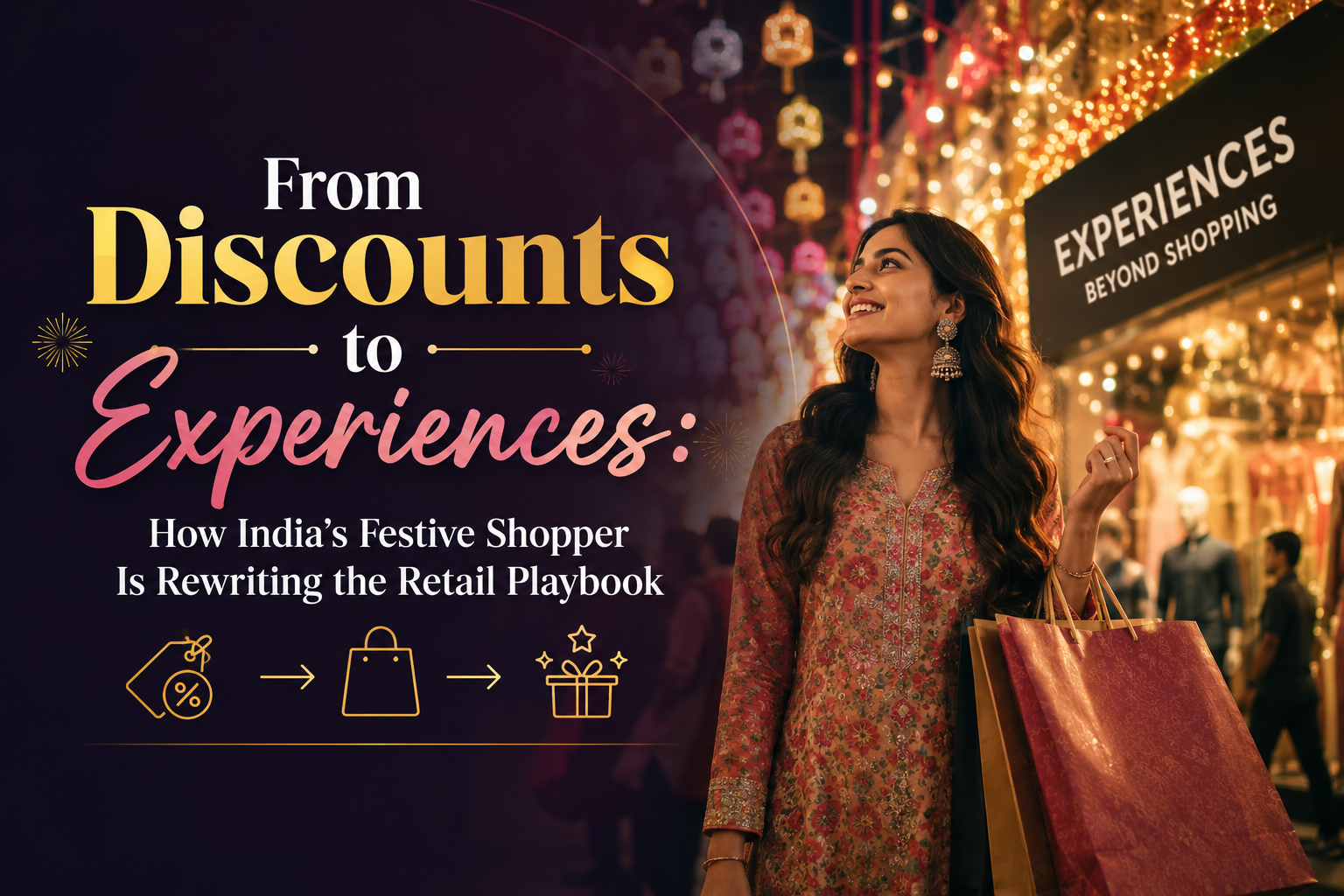
For nearly two decades, India’s festive retail calendar has revolved around one simple proposition: offer the deepest discount and consumers will come. Whether it was Diwali electronics sales, fashion mega-events, or end-of-season offers, the festive season became synonymous with price wars. Retailers conditioned consumers to postpone purchases until brands slashed prices, while marketplaces competed on cashback, coupons, and limited-time deals.
That strategy built India’s modern e-commerce economy. Today, however, it is reaching its limits.
For years, India’s festive shopping season has largely been associated with one simple promise: the bigger the discount, the better the deal. For more than 1.4 billion Indians, the festive season—from Raksha Bandhan, Ganesh Chaturthi, and Durga Puja to Diwali and Christmas—is as much about shopping as it is about celebration, with festive consumption estimated at ₹12–14 lakh crore (Source: The Economic Times). From festive flash deals to year-end mega events, across categories ranging from apparel and electronics to jewellery, travel, automobiles, and gifting, remains one of the country’s biggest consumption engines. Yet the forces driving that spending are changing rapidly. Consumers are no longer asking only “How much can I save?” Increasingly, they are asking “What am I getting beyond the discount?”
This subtle shift is forcing marketers to rethink one of retail’s oldest assumptions: price alone is no longer enough to create preference.
The Shift from Price Sensitivity to Value Sensitivity – The New Definition of Value
Indian consumers remain value-conscious—but value no longer means the lowest price.
Economic uncertainty, inflation, and rising living costs have made shoppers more deliberate rather than more frugal. According to consumer research, nearly seven in ten consumers now indulge in small, intentional purchases as a form of emotional well-being, indicating that buying decisions are increasingly driven by emotional satisfaction rather than pure financial savings.
The implication is significant.
Consumers still compare prices, but they also evaluate whether a purchase feels worthwhile. Trust, convenience, quality, exclusivity, after-sales service, sustainability, and brand purpose have become part of the value equation.
In other words, India is gradually moving from price sensitivity to value sensitivity.
For brands, this represents a structural change rather than a seasonal trend.
Discount Fatigue Is Real
The challenge for retailers is that discounts have become ubiquitous.
Every major marketplace now launches multiple shopping festivals each year. Fashion platforms run near-continuous promotions. Electronics brands compete aggressively on exchange offers, no-cost EMIs, and cashback programmes. Quick commerce platforms push instant coupons almost daily.
When every retailer promises “the biggest sale of the year,” the promise loses its ability to differentiate.
Consumers have become remarkably sophisticated. They track historical prices through browser extensions, compare offers across platforms in seconds, and increasingly understand promotional pricing tactics.
As discounts become the norm, they stop being a competitive advantage—they become merely the cost of participation.
This is one reason why customer acquisition costs continue to rise while brand loyalty continues to weaken.
Premiumisation: A Parallel Trend Reshaping Festive Spending
Perhaps the most interesting contradiction in India’s retail story is that even as consumers actively seek deals, they are simultaneously spending more on premium products.
Recent consumer studies by Deloitte show Indian households increasingly “trading up” across multiple categories—from premium travel experiences and luxury beauty products to gourmet food, smartphones, and curated gifting.
Rather than buying more products, consumers are increasingly buying better products.
This trend is particularly visible during festive periods, when purchases often carry emotional significance.
A handcrafted festive hamper, a premium skincare gift box, limited-edition sneakers, artisanal sweets, or personalised jewellery communicates far more than utility. It represents aspiration, identity, and thoughtfulness.
Premiumisation therefore should not be viewed as the opposite of value.
It is, in fact, a new expression of value.
Consumers are willing to spend more—but only when they perceive greater meaning in the purchase.
The Experience Economy Comes to Festive Commerce
The festive season has always been emotional. Brands are finally learning to monetise that emotion. Today’s most successful festive campaigns are not built around products. They are built around stories.
Ferrero India’s recent Diwali strategy illustrates this shift, combining QR-enabled packaging, curated gifting boxes for quick commerce, and short-form digital content to transform gifting from a purely transactional purchase into a more immersive experience. (Source: Social Samosa)
Similar approaches are now common across digital-first campaigns, where products are introduced through stories about family, celebration, gifting, and identity rather than price alone. When storytelling creates emotional context, the purchase feels like a natural extension of the experience. In this model, the product is no longer the hero—the experience is.
Rewards Over Discounts: Building Relationships, Not Just Sales
Another major evolution in festive commerce is the rise of rewards and loyalty ecosystems.
Brands that offer cashback, loyalty points, and exclusive access are gaining greater traction. Rather than rewarding a single purchase, these programmes encourage customers to keep coming back through personalised benefits and long-term engagement.
Loyalty ecosystems such as Tata Neu Rewards, Myntra Insider, and Nykaa Prive reflect this shift, encouraging repeat engagement through personalised benefits and exclusive access rather than one-time discounts.
While a discount ends at checkout, a reward system creates continuity. It encourages repeat engagement, builds familiarity, and fosters long-term loyalty. Over time, this transforms customers into communities.
For brands, this is a critical shift. Festive seasons are no longer just about driving spikes in sales—they are about strengthening customer lifetime value.
Content-Led Commerce: Where Stories Drive Sales
Another defining change is how consumers discover and engage with products.
Festive shopping today is deeply influenced by content—whether it’s Instagram reels, influencer recommendations, or brand storytelling. Product discovery now happens through Instagram Reels, creator content, and brand storytelling long before shoppers compare prices.
This has led to the rise of content-commerce, where storytelling plays a central role in shaping purchase decisions.
A product showcased within a relatable festive moment—a family celebration, a gifting ritual, or a personal milestone—feels far more compelling than a standalone discount banner. Content creates context, and context builds desire.
Even large-scale sale events are now positioned as experiences rather than just discount windows. The anticipation, curated recommendations, and storytelling around these events contribute as much to their success as the deals themselves.
Speed, Convenience, and the Rise of Instant Gratification
While experiences and storytelling are gaining importance, convenience remains non-negotiable.
The rise of quick commerce has fundamentally altered consumer expectations. Today’s festive shopper expects both engaging experiences and seamless execution—fast deliveries, smooth interfaces, and reliable service.
This creates a dual expectation: emotional engagement and operational excellence.
Brands that can combine both—compelling storytelling with frictionless delivery—are the ones that win. A great campaign may attract attention, but a poor experience can quickly erode trust.
What Brands Need to Rethink
The festive playbook is no longer about choosing between discounts and experiences—it is about integrating them intelligently.
Discounts still play a role, but they must be part of a larger, more holistic value proposition. Brands need to think beyond short-term conversions and focus on building lasting connections.
This means investing in:
- Personalised customer journeys
- Strong brand storytelling
- Reward and loyalty ecosystems
- Seamless omnichannel experiences
- Emotional resonance with consumers
The brands that succeed will be those that move from transactional thinking to relationship-building.
Conclusion: From Deals to Meaningful Moments
India’s festive commerce landscape is undergoing a subtle yet powerful transformation.
Deals still capture attention—but they are no longer enough on their own. Today’s shoppers want experiences that feel memorable, rewards that feel valuable, and stories that feel authentic.
In this new reality, the most successful brands will not be the ones offering the biggest discounts—but the ones creating the most meaningful moments.
Because while discounts may win attention, it is experience, emotion, and engagement that win loyalty.