


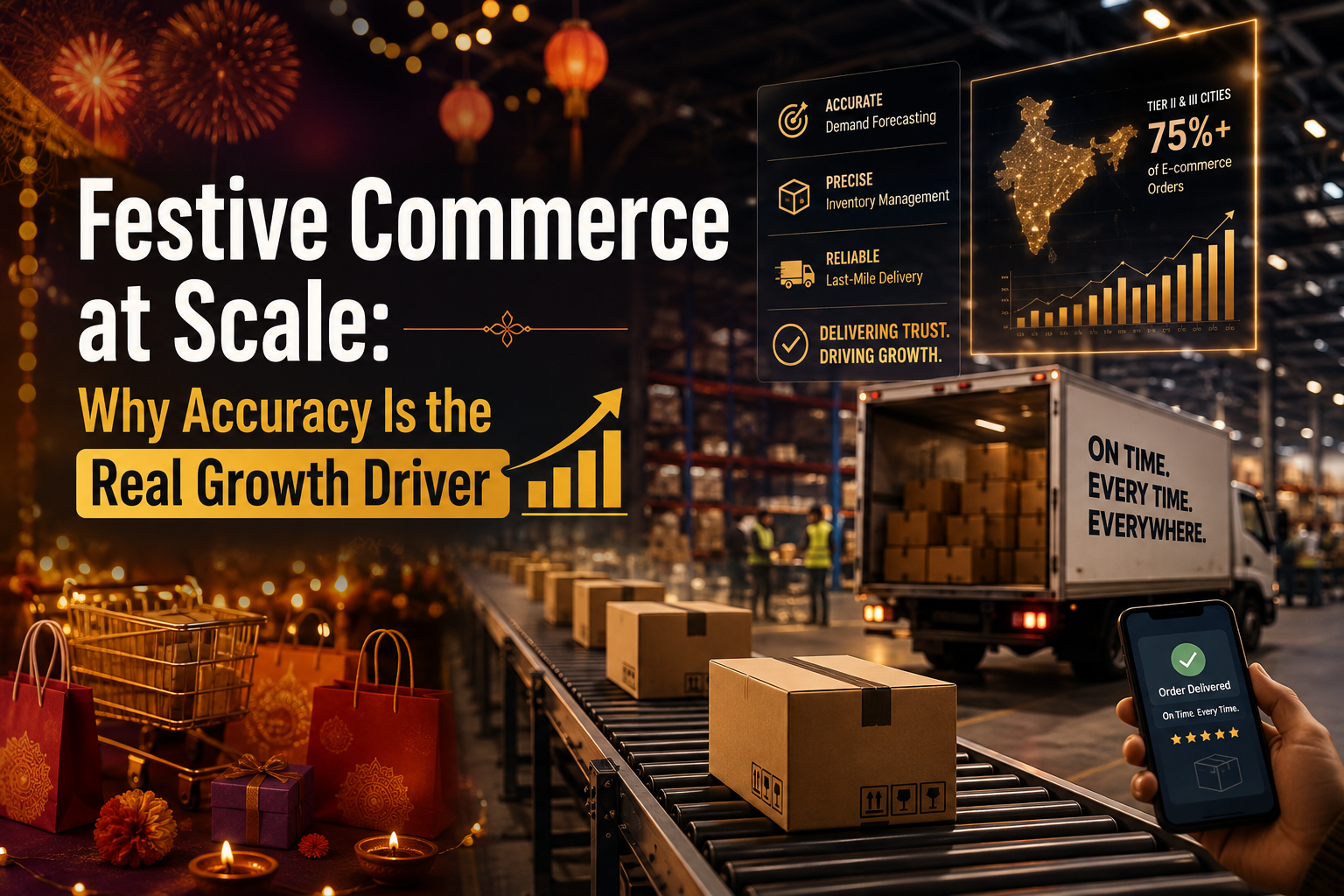
Every festive season, India’s brands compete for the same consumer attention. Advertisements become louder, discounts grow deeper, celebrity endorsements multiply, and marketing budgets reach their annual peak. For years, success during this period was largely defined by the strength of campaigns and the attractiveness of offers. However, as Indian commerce evolves, the rules of competition are shifting. The true differentiator is no longer the campaign that drives a purchase decision, but the operational capability that ensures the product is delivered seamlessly and on time.
The modern Indian consumer now evaluates brands through the lens of overall experience rather than just price or product quality. A delayed delivery during Diwali, an inaccurate delivery promise, or a cancelled order is no longer dismissed as a logistics issue—it is seen as a direct failure of the brand. With multiple alternatives readily available, reliability in fulfilment has become a key driver of trust and repeat purchase behaviour.
This expectation becomes significantly harder to meet when viewed against the scale of festive demand. During the 2025 festive season, the initial phase alone generated over ₹60,000 crore in GMV—nearly 3.5 times higher than business-as-usual levels—placing immense pressure on fulfilment systems. Such sharp spikes in order volumes compress operational timelines across warehousing, inventory management, and last-mile delivery, leaving minimal room for inefficiencies or errors(Source: redseer)
At the same time, the structure of demand itself is evolving. A majority of festive shoppers now come from Tier II and smaller cities, reflecting a clear shift beyond metro-centric consumption. This geographic spread introduces greater variability in delivery conditions, address standardisation, and infrastructure readiness, making consistent and accurate fulfilment far more complex than in earlier demand cycles.
As India’s festive economy becomes increasingly digital, logistics has transitioned from a backend function to a critical determinant of customer satisfaction, profitability, and long-term brand loyalty. The brands that will stand out during upcoming festive seasons will not necessarily be those investing the most in marketing, but those that can manage inventory with precision, forecast demand effectively, and deliver consistently—even under peak pressure.
A Festive Economy Growing Beyond the Metros
India’s festive economy has undergone a remarkable transformation over the last decade. While metropolitan cities continue to account for a significant share of premium consumption, the country’s growth story is increasingly being written by Tier 2, Tier 3, and emerging Tier 4 markets.
According to multiple industry estimates from the 2025 festive season, non-metro cities accounted for the majority of ecommerce order volumes, with Tier II and Tier III markets together contributing nearly three-fourths of total online orders across major marketplaces. Improved internet penetration, affordable smartphones, widespread digital payments, regional-language commerce, and deeper logistics networks have fundamentally changed how consumers in smaller cities shop.
Unlike earlier years, where festive campaigns primarily targeted urban consumers, brands today design region-specific assortments, localised promotions, vernacular advertising, and dedicated supply chain strategies for emerging markets. Logistics providers have similarly expanded fulfilment centres, sortation hubs, and last-mile delivery stations far beyond traditional metropolitan clusters.
The result is a festive marketplace where consumer expectations differ significantly across regions, forcing brands to rethink how inventory is allocated, how deliveries are promised, and how customer experience is managed.
Understanding these behavioural differences has become one of the most important competitive advantages for marketers and supply chain leaders alike.
Tier 1 Consumers: Where Convenience Has Become a Lifestyle
Consumers in metropolitan cities such as Bengaluru, Delhi NCR, Mumbai, Hyderabad, Chennai, and Pune have developed shopping habits that are fundamentally different from those of previous generations. They are digitally native, constantly connected, and heavily influenced by social media, creator recommendations, flash sales, and quick commerce platforms.
Perhaps the most defining characteristic of Tier 1 consumers is their increasing preference for convenience over cost. While discounts remain attractive, speed has emerged as an equally important purchase driver. Consumers willingly pay delivery charges or premium memberships if it means receiving products within hours rather than days.
Quick commerce has accelerated this behavioural shift. Platforms promising deliveries in ten or fifteen minutes have redefined expectations far beyond groceries. Whether consumers are purchasing cosmetics, fashion accessories, electronics, gourmet foods, or festive decorations, the expectation of immediate fulfilment has gradually become the norm.
This has also fuelled a dramatic rise in impulse buying.
A consumer browsing Instagram during lunch may discover a creator showcasing festive décor, click through to the brand’s website, complete the purchase within minutes, and expect delivery before evening. Similarly, influencer-led product launches, limited-edition festive collections, flash discounts, and live commerce sessions generate sudden spikes in demand that were almost impossible to predict using traditional forecasting models.
For brands, these behavioural shifts create operational complexity. Marketing campaigns no longer produce steady demand over several days; they generate thousands of simultaneous orders within minutes. Every viral campaign, celebrity collaboration, or festival offer effectively becomes a logistics stress test.
Success therefore depends not only on creating demand but also on having inventory positioned close enough to consumers to fulfil those orders without delays.
Tier 2 Consumers: Balancing Value with Convenience
Consumers in Tier 2 cities represent one of the fastest-growing segments of India’s festive economy. Cities such as Indore, Jaipur, Lucknow, Kochi, Bhubaneswar, Surat, Coimbatore, Nagpur, and Chandigarh have witnessed substantial increases in online shopping across categories including electronics, beauty, home décor, fashion, and premium consumer goods.
Unlike metro consumers, purchasing decisions in these markets remain relatively considered. Consumers compare prices across multiple platforms, read reviews, evaluate return policies, and actively seek festive offers before completing a purchase. Trust remains an important component of the buying journey, particularly for high-value products.
However, delivery expectations have evolved dramatically over the past few years. Customers who previously accepted delivery windows of five to seven days increasingly expect products within two or three days. The growing presence of regional fulfilment centres has shortened delivery timelines, raising customer expectations in the process.
Brands therefore face an interesting balancing act. While consumers remain price-conscious, they also associate faster delivery with professionalism and reliability. Meeting these expectations requires brands to decentralise inventory rather than relying exclusively on warehouses located near metropolitan regions.
Many retailers now maintain regional distribution centres specifically designed to support festive demand in Tier 2 markets, reducing transit time while lowering transportation costs.
Tier 3 and Tier 4 Markets: Bharat’s Consumption Story Comes Alive
If Tier 2 represents India’s fastest-growing ecommerce segment, Tier 3 and Tier 4 cities represent its largest long-term opportunity.
Consumers across smaller towns are embracing ecommerce at an unprecedented pace, purchasing everything from smartphones and apparel to jewellery, home appliances, furniture, and beauty products during festive periods. Increased digital literacy, affordable mobile data, government-backed digital payment initiatives, and greater availability of regional-language interfaces have significantly expanded online participation.
Yet consumer priorities remain distinct.
Unlike metropolitan shoppers who often prioritise instant gratification, consumers in smaller towns place greater emphasis on reliability, authenticity, affordability, and service assurance. Cash on Delivery continues to play a meaningful role in several categories, although UPI adoption has accelerated rapidly.
For these consumers, the delivery experience itself often determines whether they will trust online shopping in the future. A delayed shipment before Diwali, a damaged package, or a failed delivery attempt can discourage repeat purchases far more significantly than in mature ecommerce markets.
This makes logistics not merely an operational challenge but a market expansion strategy. Every successful delivery into a remote location builds confidence in ecommerce and expands the addressable customer base for brands.
The Rise of Impulse Commerce During Festivals
One of the defining characteristics of India’s festive economy today is the transition from planned shopping to continuous shopping.
A decade ago, consumers typically waited for major sale events before making large purchases. Today, festive shopping unfolds over several weeks, driven by influencer recommendations, payday spending, personalised offers, livestream commerce, social media advertising, and limited-period promotions.
Instead of one large demand spike, brands experience multiple waves of purchasing behaviour throughout the festive calendar.
These unpredictable surges present one of the biggest challenges for logistics planners. Traditional forecasting methods, built around historical sales trends, struggle to anticipate the impact of viral content, celebrity endorsements, or rapidly changing consumer preferences.
Inventory that appears sufficient on Monday may be exhausted by Wednesday after a product trends on social media. Conversely, overestimating demand can leave brands with excess inventory that ties up working capital long after the festive season has ended.
This unpredictability is forcing organisations to rethink supply chain planning altogether. Increasingly, companies are investing in AI-driven demand forecasting, real-time inventory visibility, and regional fulfilment strategies capable of responding dynamically as consumer demand evolves.
The festive season is therefore becoming less about moving products after customers place orders and more about positioning inventory intelligently before demand even materialises—a shift that will define the future of Indian retail.
When Marketing Wins but Logistics Loses
For marketers, the festive season is often measured in impressions, click-through rates, website traffic, and Gross Merchandise Value (GMV). For supply chain teams, however, success is measured by a very different set of metrics—order fulfilment rates, warehouse productivity, on-time deliveries, return percentages, and customer complaints.
The challenge is that these two worlds are deeply interconnected. A successful marketing campaign can quickly become an operational crisis if the logistics network is not prepared for the surge in demand. Every television commercial, influencer collaboration, or flash sale has a ripple effect across the supply chain, influencing inventory movement, warehouse capacity, transportation networks, and last-mile delivery operations.
In recent years, brands have become remarkably efficient at generating demand. The real challenge lies in fulfilling that demand consistently. During the festive season, order volumes can increase several times over normal business levels within a matter of hours, leaving little room for operational error. Even a well-planned supply chain can struggle when demand exceeds forecasts, delivery partners reach capacity, or inventory is concentrated in the wrong locations.
This is why logistics has become one of the biggest competitive differentiators during festive commerce. Consumers rarely remember how many advertisements a brand ran during Diwali, but they almost always remember whether their festive order arrived on time.
Forecasting Demand Has Become More Difficult Than Ever
Demand forecasting was once built around historical sales data, seasonal buying patterns, and previous festive trends. While these variables remain relevant, they are no longer sufficient to predict consumer behaviour in an era dominated by social media, creator-led commerce, and real-time digital engagement.
A product featured by a popular influencer can sell out within hours. A viral Instagram Reel, a celebrity endorsement, or even a trending meme can generate thousands of unexpected orders that traditional forecasting models simply cannot anticipate. Similarly, flash sales organised by ecommerce marketplaces often compress days’ worth of demand into a few hours, creating sudden spikes across warehouses and delivery networks.
The growing popularity of personalised marketing has further complicated forecasting. Instead of broadcasting the same campaign to every customer, brands now use AI-powered recommendation engines to deliver customised offers based on browsing history, purchase behaviour, location, and preferences. While this improves conversion rates, it also creates fragmented demand patterns that are harder to predict.
As a result, forecasting is shifting from a retrospective exercise to a predictive one. Increasingly, brands are combining historical sales data with real-time signals such as search trends, social media engagement, weather forecasts, regional festivals, and local events to anticipate where demand is likely to emerge. Artificial intelligence is playing an increasingly important role in this transformation, enabling companies to adjust inventory allocation dynamically rather than relying solely on pre-season planning.
The Warehouse Has Become the New Battleground
While consumers often associate festive shopping with colourful advertisements and attractive discounts, the real action takes place inside warehouses.
Every order passes through a series of operational steps that include inventory retrieval, quality checks, packaging, sorting, labelling, and dispatch. During peak festive periods, fulfilment centres process millions of individual items every day, making warehouse efficiency one of the most critical determinants of delivery performance.
The pressure begins long before the festive season officially starts. Brands must estimate demand months in advance, procure inventory, allocate stock across multiple fulfilment centres, recruit temporary staff, and ensure warehouse management systems can handle significantly higher transaction volumes.
Even small operational inefficiencies become magnified during peak periods. Delays in picking products from shelves, incorrect inventory counts, packaging bottlenecks, or equipment failures can quickly cascade into missed delivery commitments.
To reduce these risks, leading ecommerce companies have invested heavily in automation. Conveyor systems, automated sorting machines, handheld scanners, robotics-assisted picking, and AI-driven warehouse management platforms have become increasingly common across large fulfilment centres. These technologies improve processing speed while reducing human errors, allowing companies to handle significantly higher order volumes without proportionately increasing manpower.
However, automation alone cannot solve every challenge. Labour availability remains a significant concern during the festive season, when warehouses compete aggressively for temporary workers. Recruiting, training, and retaining seasonal staff while maintaining operational accuracy continues to be one of the industry’s biggest challenges.
Inventory Placement Is Becoming More Important Than Inventory Size
Traditionally, retailers believed that maintaining larger inventories was the best way to prepare for festive demand. Today, however, where inventory is located matters as much as how much inventory is available.
Consumers increasingly expect faster deliveries regardless of where they live. Meeting these expectations requires brands to position products closer to demand centres instead of storing all inventory in a handful of central warehouses.
Regional fulfilment centres, micro-warehouses, and dark stores are becoming integral components of modern logistics strategies. By distributing inventory across multiple locations, brands reduce transit distances, improve delivery speed, and minimise transportation costs.
This decentralised approach also creates greater resilience during periods of exceptionally high demand. If one warehouse reaches capacity or experiences operational disruptions, orders can be redirected to nearby facilities without significantly affecting delivery timelines.
However, decentralisation introduces its own complexities. Inventory must be continuously rebalanced across locations to prevent stockouts in one region and overstocking in another. Achieving this balance requires sophisticated demand forecasting models and real-time visibility across the supply chain.
Last-Mile Delivery Remains the Most Expensive Challenge
If warehousing represents the heart of festive logistics, last-mile delivery remains its most difficult and expensive component.
Industry estimates suggest that the final leg of delivery—from the local distribution centre to the customer’s doorstep—accounts for a substantial share of total logistics costs. During festive periods, these costs rise even further as delivery volumes increase and operational conditions become more unpredictable.
Traffic congestion, adverse weather, temporary road closures, housing society access restrictions, inaccurate addresses, and limited parking all contribute to delivery delays. In many urban areas, delivery partners must complete hundreds of deliveries every day while navigating densely populated neighbourhoods and increasingly complex traffic conditions.
The situation becomes even more challenging in smaller towns and rural areas, where infrastructure limitations, longer travel distances, and limited delivery density reduce operational efficiency. Reaching these consumers often requires additional transportation stages, increasing both delivery time and costs.
Despite these operational realities, consumers rarely adjust their expectations. Whether they live in central Bengaluru or a remote town several hundred kilometres away, they increasingly expect accurate delivery timelines and proactive communication.
This expectation gap is forcing logistics providers to invest heavily in route optimisation software, real-time tracking systems, predictive ETA calculations, and hyperlocal delivery partnerships capable of improving last-mile efficiency.
Quick Commerce Has Reset Consumer Expectations
Perhaps no development has influenced logistics more profoundly than the rapid rise of quick commerce.
Initially focused on grocery deliveries, platforms such as Blinkit, Zepto, Instamart, and BB Now have fundamentally changed how urban consumers think about convenience. Receiving products within ten or twenty minutes is no longer viewed as exceptional—it is increasingly becoming an expected standard for everyday purchases.
Although most festive purchases do not require ten-minute deliveries, the psychological impact of quick commerce extends far beyond groceries. Consumers who regularly receive daily essentials within minutes naturally expect faster delivery for beauty products, electronics, gifting items, fashion accessories, and home décor as well.
This phenomenon has created what industry experts describe as the “expectation transfer effect.” Consumers benchmark every ecommerce experience against the fastest delivery they have previously experienced, regardless of product category.
Brands therefore face growing pressure to shorten fulfilment timelines without significantly increasing delivery costs. Many have responded by adopting hybrid fulfilment models that combine central warehouses with city-based micro-fulfilment centres, allowing faster deliveries for high-demand products while maintaining cost efficiency for the broader catalogue.
Reverse Logistics: The Hidden Cost of Festive Commerce
While brands invest considerable effort in ensuring products reach customers quickly, the journey often does not end at delivery.
Festive shopping generates one of the highest return volumes of the year. Apparel purchased in incorrect sizes, duplicate gifts, damaged products, impulse purchases, and customer preference changes all contribute to increased reverse logistics activity.
Unlike forward logistics, which follows relatively predictable routes, reverse logistics is considerably more complex. Returned products must be collected, transported, inspected, sorted, refurbished where necessary, repackaged, and either returned to inventory or liquidated. Every additional step adds operational costs while delaying inventory availability.
For fashion and lifestyle brands, where return rates are naturally higher, reverse logistics can significantly erode festive profitability. Managing returns efficiently has therefore become almost as important as managing deliveries themselves.
Several retailers are now leveraging artificial intelligence to identify products with high return probabilities, improve size recommendations, strengthen product descriptions, and detect fraudulent return behaviour. These initiatives not only reduce logistics costs but also improve customer satisfaction by helping consumers make more informed purchasing decisions.
Communication Has Become a Logistics Capability
One of the most significant shifts in customer expectations has little to do with transportation itself. Increasingly, consumers value visibility as much as speed.
A customer is often more willing to accept a delayed delivery if they receive timely updates explaining the reason, revised delivery estimates, and proactive support. Conversely, a lack of communication can quickly transform a minor operational delay into a major customer service issue.
This has elevated communication from a marketing function to an integral part of logistics. Brands are investing in real-time order notifications, AI-powered customer support, WhatsApp updates, delivery alerts, and predictive delay notifications that keep customers informed throughout the fulfilment journey.
During the festive season, when emotions run high and purchases are often linked to celebrations or gifting, transparent communication becomes essential for preserving customer trust.
Ultimately, logistics is no longer judged solely by how quickly products move. It is increasingly judged by how confidently brands keep customers informed throughout every stage of the journey.
Technology Is Rewriting the Rules of Festive Logistics
If the last decade of Indian retail was defined by digital commerce, the next decade will be defined by intelligent commerce. The scale, speed, and unpredictability of festive demand have made it impossible for brands to rely solely on conventional supply chain planning. Increasingly, technology is becoming the operating system that powers modern logistics.
Artificial intelligence, machine learning, automation, and real-time analytics are no longer experimental tools reserved for large enterprises. They are rapidly becoming essential capabilities for brands that want to compete during India’s most important consumption periods.
The shift is visible across every layer of the supply chain. Demand forecasting models are becoming more predictive, warehouses are becoming more automated, transportation routes are becoming more efficient, and customer communication is becoming more personalised.
Rather than asking, “How much inventory should we maintain?”, brands are increasingly asking, “Where should inventory be placed before demand emerges?” This transition from reactive fulfilment to predictive fulfilment is shaping the future of festive commerce.
Leading retailers are now combining historical sales patterns with live signals such as search trends, social media conversations, weather conditions, regional festivals, and local events to estimate demand more accurately. A beauty brand may allocate higher inventory to cities where influencer campaigns are gaining traction, while an electronics retailer may increase stock availability in regions where search interest for premium devices is rising.
This ability to anticipate demand rather than simply respond to it could become one of the defining competitive advantages of festive commerce in the years ahead.
Automation Is Transforming Warehouses
The modern fulfilment centre bears little resemblance to the warehouse of a decade ago.
Large ecommerce companies and logistics providers are increasingly investing in robotics, automated sorting systems, intelligent conveyor networks, barcode scanning technologies, and AI-powered warehouse management platforms to improve speed and accuracy. These technologies allow millions of products to be processed efficiently, particularly during festive periods when order volumes can rise dramatically.
Automation also addresses one of the industry’s persistent challenges: workforce management. Seasonal demand often requires companies to recruit thousands of temporary workers within short periods. While human labour remains essential, automation helps reduce dependency on manual processes and improves operational consistency.
The future warehouse is likely to become more intelligent, with systems capable of dynamically prioritising orders, optimising storage locations, and identifying bottlenecks before they affect deliveries.
The Rise of Hyperlocal Fulfilment
One of the most important developments in Indian logistics has been the emergence of hyperlocal fulfilment models.
Quick commerce companies demonstrated that consumers value proximity. The closer products are to customers, the faster and more efficiently they can be delivered. This principle is now influencing broader retail strategies as well.
Brands are increasingly adopting networks of regional warehouses, dark stores, and micro-fulfilment centres to shorten delivery timelines. Physical retail stores are also evolving into fulfilment hubs, enabling companies to process online orders directly from local inventory.
This approach offers multiple benefits. It reduces transportation costs, improves delivery speed, and creates flexibility during periods of exceptionally high demand. More importantly, it enables brands to provide differentiated service levels based on customer location.
In the future, delivery promises may become increasingly personalised. Instead of offering uniform delivery timelines across the country, brands may tailor fulfilment commitments based on regional inventory availability, transportation conditions, and demand forecasts.
Case Studies: How Brands Are Building Smarter Supply Chains
Some of India’s leading consumer companies have already begun redesigning their supply chains to meet changing consumer expectations.
Amazon has expanded its fulfilment network significantly across India, investing in automation, regional warehouses, and machine-learning systems that improve demand forecasting and inventory placement. The company has also increased same-day and next-day delivery capabilities across several markets.
Flipkart has strengthened its logistics capabilities through technology investments, regional distribution centres, and partnerships designed to improve delivery reach across smaller towns and cities.
Fashion retailers such as Myntra and beauty brands like Nykaa are leveraging customer data, predictive analytics, and regional inventory strategies to improve fulfilment performance while managing high return volumes.
Value-commerce platforms such as Meesho have expanded ecommerce access across smaller cities by building logistics models suited to cost-sensitive markets.
Quick commerce players including Blinkit, Zepto, and Swiggy Instamart have accelerated the development of dark-store networks, demonstrating how proximity can transform customer experience.
Meanwhile, logistics specialists such as Delhivery, Shadowfax, and Ecom Express continue to expand delivery capabilities, strengthen technology platforms, and improve access to Tier 2, Tier 3, and rural markets.
Together, these organisations illustrate a larger industry trend: logistics is no longer merely about transportation; it is about building intelligent, responsive, and customer-centric networks.
Sustainability Is Becoming Part of the Logistics Conversation
Speed remains a critical consumer expectation, but sustainability is becoming an equally important consideration for brands.
As ecommerce volumes increase, the environmental impact of logistics is receiving greater attention. Packaging waste, fuel consumption, and carbon emissions have become important concerns for companies seeking to build responsible supply chains.
Many logistics providers are experimenting with electric delivery vehicles, route optimisation software, reusable packaging, and energy-efficient warehousing. Several companies have announced long-term goals to reduce emissions and increase the use of sustainable transportation solutions.
Consumers, particularly younger urban audiences, are also showing greater awareness of environmental issues. While speed often remains the primary decision factor, sustainability is likely to play a more significant role in shaping purchasing behaviour over time.
The future of logistics may therefore require balancing three priorities simultaneously: speed, cost efficiency, and environmental responsibility.
The Role of ONDC and Open Commerce
Another development likely to influence festive commerce is the growth of open digital networks.
The Open Network for Digital Commerce (ONDC) aims to create a more interoperable ecommerce ecosystem by enabling buyers and sellers to transact across multiple platforms. For smaller businesses, this could improve market access without requiring heavy dependence on large marketplaces.
From a logistics perspective, open commerce could encourage greater collaboration between sellers, logistics providers, and technology platforms, creating more efficient delivery networks.
As participation grows, ONDC has the potential to broaden ecommerce access, particularly in smaller cities and underserved markets, further expanding India’s festive economy.
Festive Commerce in 2026: What Comes Next?
The future of festive retail will not be defined by a single technology or business model. Instead, it will be shaped by the convergence of multiple trends.
Artificial intelligence will make demand forecasting more accurate. Hyperlocal fulfilment will reduce delivery timelines. Automation will improve warehouse productivity. Electric vehicles will strengthen sustainable logistics. Real-time communication will increase customer trust. Open commerce networks may create more inclusive marketplaces.
Most importantly, logistics will become increasingly personalised.
Customers may receive delivery promises tailored specifically to their location, purchase history, product category, and local supply chain conditions. Brands will move away from one-size-fits-all fulfilment models toward highly adaptive systems capable of balancing speed, cost, and reliability.
The distinction between commerce and logistics will continue to blur. Increasingly, supply chain decisions will influence marketing outcomes, customer experience, and long-term brand equity.
The Editorial View
India’s festive season has always represented the country’s biggest consumption opportunity. Yet the nature of competition is changing.
For years, brands competed primarily through advertising, pricing, and product innovation. While these factors remain important, they are no longer sufficient. The customer experience now extends far beyond the point of purchase, encompassing every interaction from order confirmation and delivery tracking to fulfilment and returns.
Consumers do not evaluate marketing and logistics separately. They evaluate the experience as a whole.
A seamless delivery strengthens trust. A delayed order weakens it. A transparent update reassures customers. Poor communication creates frustration. Every operational decision ultimately becomes a brand decision.
In many ways, logistics is emerging as the newest expression of brand promise.
As India enters the next phase of digital commerce, the winners of future festive seasons will not simply be those that generate the highest demand. They will be the brands capable of fulfilling that demand consistently, intelligently, and transparently.
Marketing may persuade consumers to click “Buy Now,” but logistics determines whether they return.
And in the experience economy of 2026, that difference may define the next generation of market leaders.