

The conversation around artificial intelligence has spent the last few years focused on a familiar question: Which companies are adopting AI? In the GCC, that question may already be becoming outdated.
The more important question now is what businesses do once AI becomes part of everyday work.
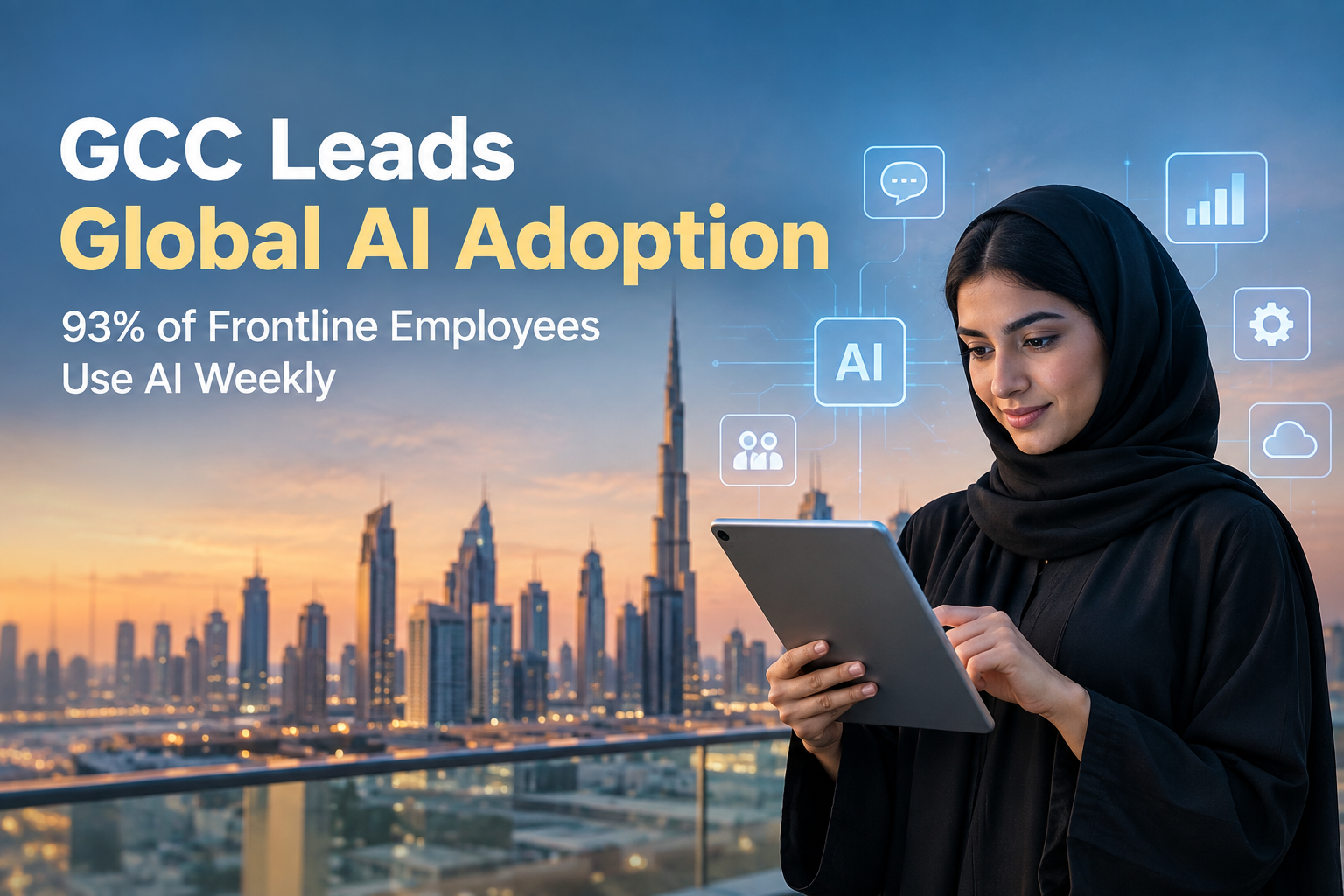
According to Boston Consulting Group’s latest AI at Work report, 93% of frontline employees across the GCC use AI at least several times a week. Adoption among managers and leaders is even higher, at 95%. Covering respondents in the UAE, Saudi Arabia, Kuwait and Qatar, the findings place the region well ahead of the global frontline adoption average of 74%. (Source: adgully)
That gap is significant. It suggests that AI in the GCC is moving beyond boardroom presentations, innovation labs and experimental pilots. It is increasingly becoming part of how employees write, analyse, research, communicate and make decisions.
But widespread usage is only the beginning. The real business story is whether organisations can turn millions of individual productivity gains into a collective competitive advantage.
AI Is Becoming Embedded in How We Work
For many organisations globally, AI adoption has followed a predictable pattern: employees discover tools on their own, experiment with them and gradually incorporate them into their daily routines.
The GCC appears to have moved faster through this phase.
When more than nine in ten frontline employees are using AI regularly, the technology stops being a specialist capability. It begins to influence the operating rhythm of the organisation itself.
This matters because competitive advantage rarely comes from access to technology alone. Most companies can buy similar tools. The differentiator is how deeply those tools become embedded into everyday workflows.
For a marketer, AI can compress the time required to analyse audiences and develop campaign ideas. For a sales team, it can reduce preparation time and improve access to information. For managers, it can speed up reporting and decision-making. Across functions, these individual improvements can gradually change the speed at which an organisation operates.
The companies that benefit most, therefore, may not necessarily be the ones using the most sophisticated AI tools. They may be the ones redesigning work around them.
The Eight-Hour Opportunity
The productivity numbers reveal just how large that opportunity could be.
Findings show that 58% of frontline employees in the GCC and 67% of managers and leaders say AI is saving them at least eight hours a week. (Source: Gulf News)
Eight hours is not simply a productivity statistic. It is effectively an additional working day.
The strategic question for business leaders is what happens to that time.
If the hours saved by AI are simply absorbed by more meetings, more emails, and more administrative work, the technology may improve efficiency without changing the business. But if organisations deliberately redirect that capacity towards customer understanding, innovation, strategic planning and relationship-building, AI can create a very different kind of value.
This is where the next phase of AI leadership will be defined.
The strongest organisations will not measure success only by how many hours employees save. They will ask what higher-value work those hours now make possible.
The Skills Equation Is Changing Faster Than Job Titles
AI’s impact is also beginning to reshape what companies expect from their workforce.
According to the report, 85% of frontline employees and 92% of managers and leaders in the GCC believe AI has fundamentally changed the skills expected in their roles.
That shift is particularly important for senior leadership.
The future workforce may not simply need more technical specialists. Increasingly, employees across departments will need the ability to work effectively with AI: asking better questions, evaluating outputs, identifying useful insights and combining machine-generated intelligence with human judgement.
For business leaders, this could also change the composition of high-performing teams. The most valuable employee may no longer be the person who can complete a task fastest manually. It may be the person who knows how to use AI to accelerate routine work while applying creativity, context, and judgement where machines add less value. In other words, AI fluency is gradually becoming a business skill, not just a technology skill. (Source: adgully)
From Individual Productivity to Organisational Advantage
One of the biggest risks in the current AI boom is confusing employee adoption with organisational transformation.
A company can have thousands of employees using AI and still fail to create meaningful business value.
The difference lies in coordination.
If every employee uses AI differently, productivity gains remain fragmented. But when organisations identify high-value use cases and redesign processes around them, the impact can move from individual efficiency to organisation-wide performance.
This is particularly relevant in the GCC, where rapid AI adoption gives companies an opportunity to move quickly. The next challenge is building operating models that ensure the technology supports larger business priorities rather than becoming another layer of disconnected tools.
As Robert Xu, Managing Director and Partner at BCG X, noted, the region’s leading organisations are distinguished not simply by deploying AI, but by investing in their people’s AI capabilities and translating technological adoption into productivity and competitive advantage.
That distinction could become increasingly important as AI tools become more accessible to everyone.
A More Human Case for AI
Perhaps one of the more interesting findings from the GCC is that AI is not only being associated with efficiency.
Around 69% of frontline employees and 77% of managers and leaders said AI had increased their enjoyment at work. (Source: thepeninsulaqatar)
For businesses, this presents an opportunity that is often overlooked.
The best use of AI may not be to make people work faster every minute of the day. It may be to remove some of the repetitive work that prevents them from doing their most valuable work.
Less time spent formatting reports, searching for information, or completing routine tasks can mean more time for creativity, problem-solving, and customer interaction.
For leaders concerned about productivity and talent at the same time, that combination could be particularly powerful.
The Next Race Is About Strategy, Not Access
The GCC’s 93% frontline AI adoption rate is an impressive marker, but it should not be mistaken for the finish line.
As AI becomes increasingly available, simply using it will no longer be a differentiator. The competitive divide will increasingly emerge between companies that use AI to do existing work faster and those that use it to rethink how work should be done in the first place.
For brands and business leaders, the opportunity is clear. Don’t make AI another productivity tool that sits alongside existing processes. Identify where time is being lost, where customer experiences can improve and where teams are spending energy on work that does not require their highest level of judgement.
The GCC has already demonstrated that its workforce is ready to adopt AI at scale. The next challenge for business leaders is more strategic: turn that adoption into better decisions, stronger customer experiences and entirely new ways of creating value.
Because in the next phase of the AI economy, the winners may not be the businesses with the most AI tools. They will be the ones with the clearest idea of what their people should do once AI gives them more time to think.