

Every year, thousands of entrepreneurs begin their journey convinced that success requires a revolutionary invention, an extraordinary background, or unlimited funding. The startup ecosystem often reinforces this belief, celebrating billion-dollar valuations, funding announcements, and disruptive technologies as the ultimate measures of entrepreneurial success.
Startup success has never been about having the loudest idea. Recent data shows that the average startup success rate stands at 20.7%, highlighting that enduring businesses are typically built on a clear understanding of customer problems rather than market hype. (Source: Zeni)
Melanie Perkins’ journey offers a compelling example of this principle in action.
A Simple Observation That Changed an Industry
Before Canva became one of the world’s most influential technology companies, Perkins was simply a 19-year-old university student teaching graphic design software in Australia. While most people around her accepted that professional design software was naturally difficult to learn, she questioned the assumption. Why should creating a simple presentation or poster require weeks of training? Why was good design reserved for professionals?
That question became far more valuable than any business plan.
Her first venture, Fusion Books, digitised school yearbook creation using an intuitive drag-and-drop interface. What looked like a niche solution was actually the first validation of a much larger insight: millions of people wanted to design, but existing tools made the process unnecessarily complex. Canva, launched in 2013 after years of investor rejection, simply expanded that idea to the global market.
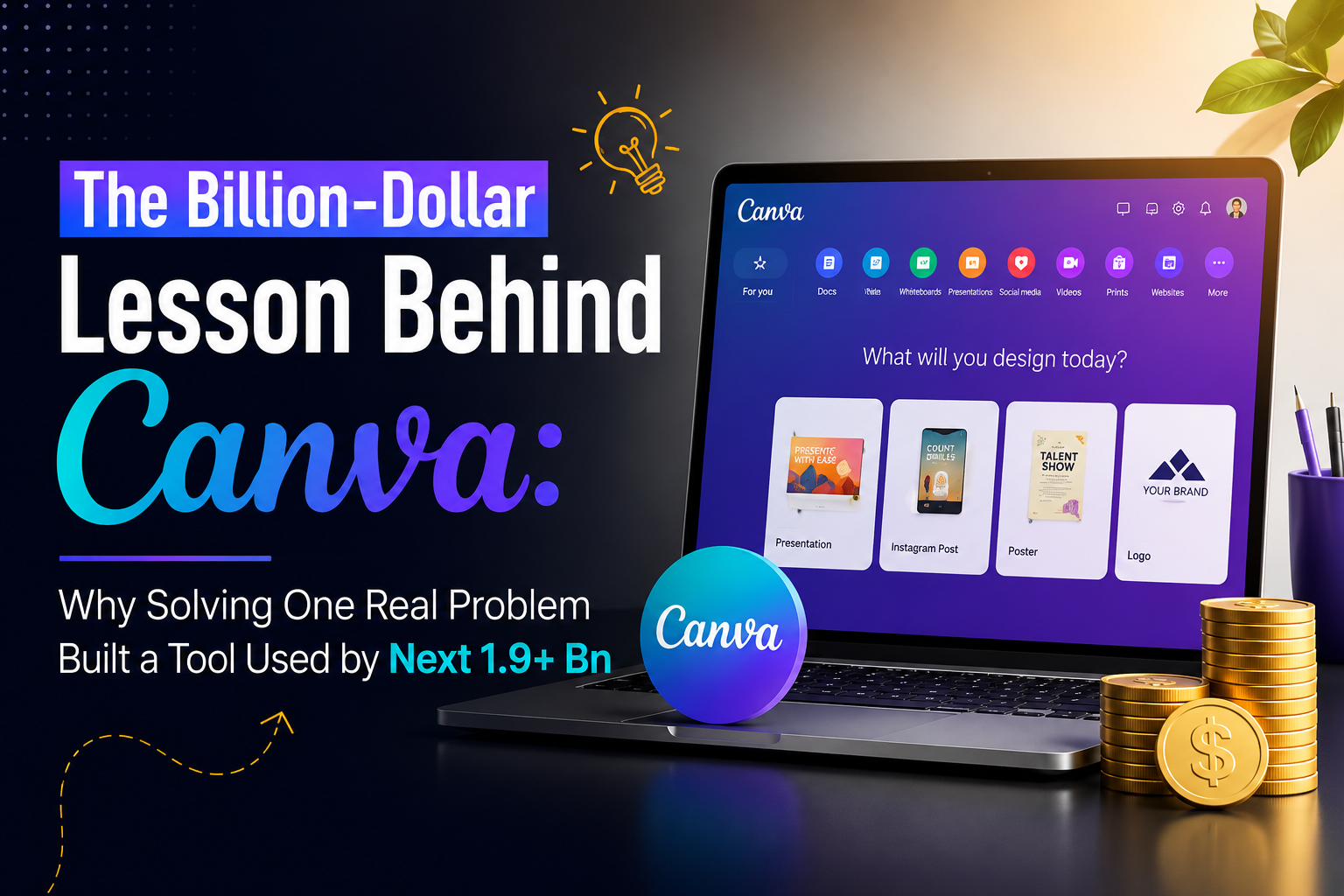
Today, Canva has evolved into one of Adobe’s strongest competitors, serving more than 260 million monthly active users worldwide. Even more tellingly, 95% of Fortune 500 companies now use Canva, demonstrating how a platform built to simplify design for everyday users has become an essential creative tool for some of the world’s largest organisations. (Source: Demand Sage)
The Best Businesses Don’t Build Better Products. They Solve Better Problems.
Yet Canva’s remarkable growth is only part of the story. Reducing its journey to a classic startup success misses the lesson that matters most for today’s founders and brand leaders.
Its real competitive advantage was never the software itself. It was identifying a problem worth solving.
For decades, businesses have been taught to compete by building better products. Increasingly, however, markets reward businesses that remove friction rather than add features. Consumers rarely wake up wishing for more functionality. They simply want tasks to become easier, faster, and less intimidating.
That philosophy has become even more relevant in 2026, as AI makes creating products easier than ever before.
According to Canva’s 2026 State of Marketing and AI Report, AI has dramatically accelerated creative production, with 97% of marketing leaders now using AI in their daily work. Yet despite the growing investment in AI, 87% believe the best advertising still requires a human touch. The finding reinforces a broader truth: while technology can make businesses faster and more efficient, it cannot replace a deep understanding of human needs and behaviour. (Source: Business Wire)
Technology Can Accelerate Growth. It Can’t Replace Customer Understanding.
Perkins recognised this long before artificial intelligence transformed business. She did not try to build software with more capabilities than Adobe. Instead, she removed the intimidation that prevented millions from using design tools in the first place. The innovation was psychological as much as technological.
Many startups still make the opposite mistake. They begin by asking, “What can we build?” Successful businesses usually begin by asking, “What frustrates people every single day?”
That difference appears subtle but fundamentally changes how companies innovate.
It also explains why investor rejection is rarely the final verdict on an idea. Canva reportedly faced years of unsuccessful fundraising before eventually securing support.
Had Perkins viewed those rejections as evidence that the opportunity didn’t exist, one of today’s largest creative platforms might never have launched. Instead, she continued refining the solution because the customer problem remained real regardless of investor opinion.
For business leaders, this highlights another overlooked principle.
Validation should come from customer behaviour before investor enthusiasm. Capital can accelerate growth, but genuine customer demand is what builds businesses that endure. That lesson is becoming even more important today.
The Next Competitive Advantage Is Hidden in Everyday Frustrations
The entrepreneurial landscape in 2026 reinforces this reality. Intuit QuickBooks’ latest Entrepreneurship Trends report finds a surge in “business intent,” with more people exploring or planning to start companies in search of greater independence and financial control. Yet the same research shows that money barriers and low confidence—concerns about savings, income stability and economic uncertainty—are the primary reasons many prospective founders hold back, rather than a shortage of ideas. (Source: QuickBooks)
Perhaps the greater challenge is not generating ideas but identifying problems worth solving.
As AI makes building products easier than ever, barriers to creation are falling rapidly. That means originality increasingly depends less on invention and more on observation. The next billion-dollar opportunity may not emerge from cutting-edge technology alone but from recognising an everyday frustration that millions have quietly accepted as normal.
Interestingly, Canva’s own research reinforces this shift. In its 2026 Design Trends report, Canva describes 2026 as the year of “Imperfect by Design,” finding that 80% of creators want to “regain creative control” by using AI on their own terms and 77% now see AI as an “essential partner”—all while audiences crave visuals that feel personal, authentic and unmistakably human, not technically perfect. In other words, even as AI raises the baseline of what’s possible, Canva argues that visual authenticity and human imagination remain the real differentiators. (Source: Canva)
The Biggest Businesses Often Begin with the Simplest Questions
That may ultimately be the most enduring lesson from Melanie Perkins’ journey.
Great businesses rarely begin with extraordinary ideas or extraordinary founders. More often, they begin with ordinary observations that everyone else overlooks.
For aspiring entrepreneurs, the next breakthrough may not require inventing an entirely new category. It may simply require paying closer attention to the frustrations people have stopped complaining about. Those overlooked inconveniences often represent the largest opportunities.
Ultimately, billion-dollar companies are rarely built on the biggest ideas. More often, they are built by finding the simplest answer to a problem millions have already learned to live with.