

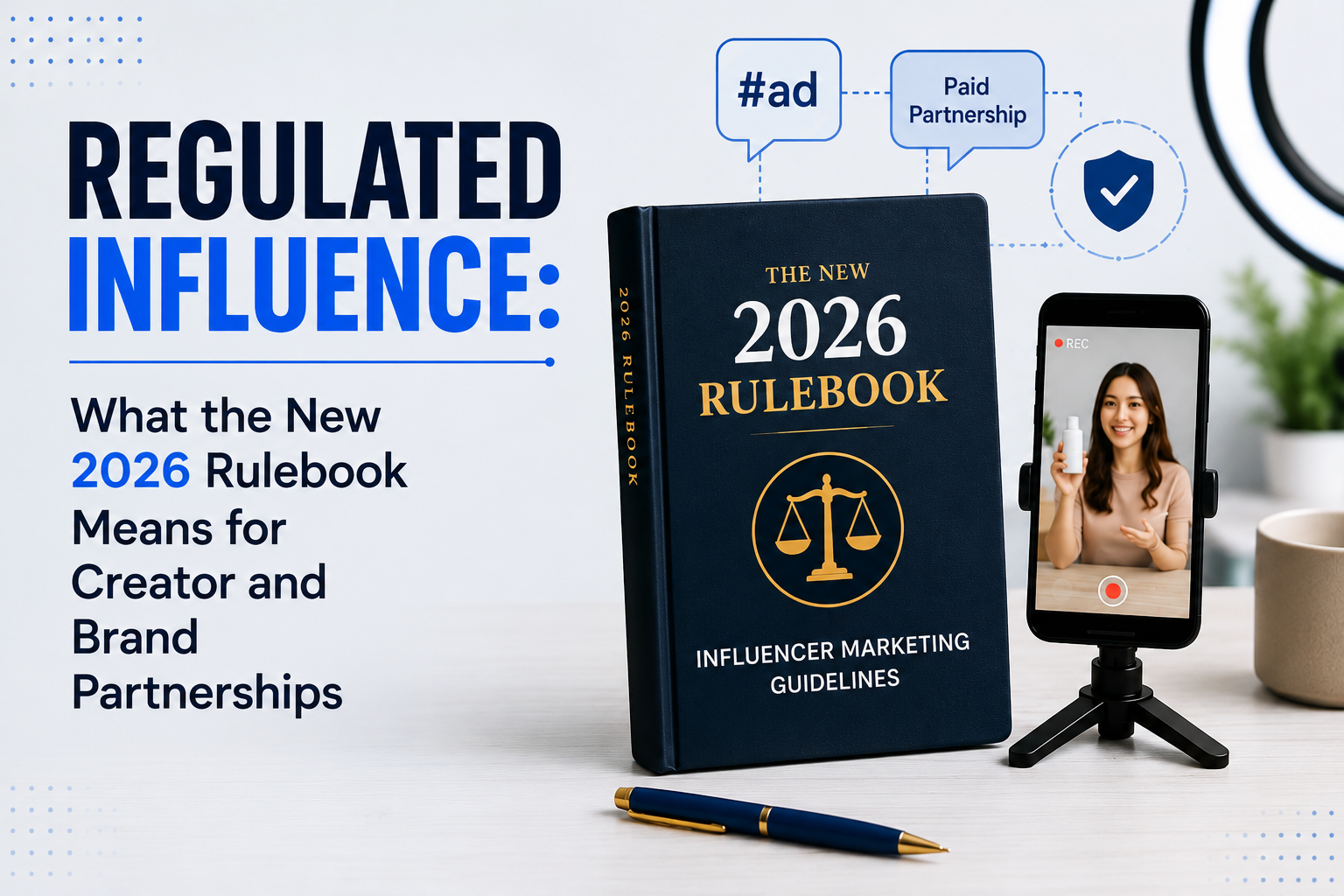
Influencer marketing was built on trust long before it was built on regulation. For years, the industry operated on a simple equation: the larger the audience, the greater the opportunity. Brands prioritised reach, engagement, and virality, while creators built communities that often rivalled traditional media in both influence and cultural relevance. As investment in the creator economy accelerated, partnerships became a core component of modern marketing strategies rather than experimental campaigns.
Today, that model is beginning to change.
The regulatory developments emerging in 2026 are not simply introducing new compliance requirements. They signal a broader shift in how influence itself is being governed. Around the world, regulators are increasing scrutiny over paid endorsements, AI-generated content, misleading claims, and disclosure practices. Consumers, too, are becoming more discerning about the content they engage with, expecting greater transparency from both creators and the brands behind sponsored collaborations.
For marketers, this is more than a legal conversation. It is a strategic one.
That shift becomes easier to understand when viewed alongside the scale of the creator economy itself. The global influencer marketing industry is projected to grow from $19.69 billion in 2026 to $44.35 billion by 2030, expanding at a CAGR of more than 22%. As brands continue to invest larger shares of their marketing budgets into creator partnerships, increased regulatory oversight is less a surprise than a natural consequence of the channel’s growing economic and cultural influence. (Source: Research and Markets)
The numbers tell only part of the story. More importantly, the influence creators now hold over consumer decisions has reached a scale that inevitably attracts greater scrutiny.
Influence Has Become Too Powerful to Remain Lightly Regulated
The creator economy has matured into one of the most influential advertising channels available today. Consumers increasingly discover products through creators before they encounter traditional advertising. Purchase decisions, brand perceptions, and even financial or health-related choices are often shaped by personalities on social platforms.
As creator influence expands, expectations around accountability inevitably rise alongside it.
Over the past few years, several controversies involving undisclosed sponsorships, misleading product claims, and insufficient advertising disclosures have highlighted the risks of an ecosystem built largely on trust rather than oversight. Regulators are responding by establishing clearer expectations for brands, creators, and digital platforms alike.
This should not be viewed as an attempt to restrict creativity. Rather, it reflects the natural evolution of a marketing channel that has become too economically and culturally significant to operate without stronger standards.
The strongest marketing channels eventually become the most accountable ones. Creator marketing is following the same trajectory—not because its influence is fading, but because its impact has become too significant to remain lightly governed.
Compliance Is No Longer a Legal Checklist
Many organisations still view creator compliance as the responsibility of legal teams at the final stage of campaign approval. That mindset is becoming increasingly outdated.
Every creator partnership now carries reputational implications. A poorly disclosed advertisement or an exaggerated product claim rarely affects only the individual creator. It also raises questions about the judgement, governance, and credibility of the sponsoring brand.
As a result, compliance is moving upstream. It is influencing creator selection, campaign planning, briefing processes, contract structures, content reviews, and ongoing relationship management.
This shift is already changing how leading brands structure their creator programmes. Rather than treating disclosures as a legal formality addressed during contract negotiations, many are now embedding mandatory disclosure language directly into campaign briefs. Industry data suggests that when disclosure requirements are introduced at the briefing stage, compliance rates can increase from around 60% to 90%, while also reducing delays later in the campaign approval process. (Source: Influencer Advisory)
Governance, in other words, is no longer an afterthought—it is becoming part of how creator programmes are designed, managed, and scaled. This reflects a broader organisational shift. Influencer marketing is no longer being treated as an experimental, campaign-by-campaign channel. Increasingly, brands are bringing creator programmes in-house, establishing dedicated workflows, and relying on specialised platforms to manage creator discovery, approvals, reporting, and compliance at scale. As creator marketing becomes an institutional capability rather than an occasional tactic, governance naturally becomes part of everyday marketing operations rather than a legal safeguard applied at the end.
The Strongest Creator Programmes Will Prioritise Trust Over Reach
One of the most significant outcomes of tighter regulations may be a shift in how brands evaluate creators.
Historically, campaign success often revolved around follower counts and engagement metrics. While these indicators remain valuable, they no longer provide a complete picture of partnership quality.
Brands are increasingly likely to favour creators who consistently disclose commercial relationships, maintain authentic engagement with their communities, and demonstrate long-term credibility. In many cases, a creator with a smaller but highly trusted audience may offer greater long-term value than one with significantly larger reach but inconsistent transparency. This is one reason micro-creators continue to play an increasingly important role in modern creator strategies. Higher engagement and stronger community relationships often translate into greater credibility, reinforcing the idea that influence is becoming less about audience size and more about audience trust.
Ultimately, this is changing how influence itself is valued. Reach may still capture attention, but trust increasingly determines commercial value. For brands, credibility is no longer an intangible quality—it is becoming a measurable business asset.
Transparency Is Becoming Part of the Brand Experience
Consumers today are remarkably skilled at recognising sponsored content. What influences their perception is often not the existence of sponsorship itself, but whether the relationship feels honest.
Consumers are increasingly rewarding brands that are transparent about commercial relationships instead of disguising sponsored content as organic recommendations.
In an environment where consumers can quickly identify promotional content, honesty is becoming a stronger differentiator than subtlety.
Similarly, brands that openly communicate the nature of their partnerships demonstrate confidence in both their products and their marketing practices. Transparency is increasingly being interpreted as evidence of credibility rather than a compromise to creativity.
This is particularly important as AI-generated content becomes more prevalent. Distinguishing authentic recommendations from synthetic or manipulated content will become another critical dimension of consumer trust.
The Future Belongs to Governed Creator Ecosystems
The biggest misconception surrounding the 2026 regulatory landscape is that it introduces barriers to influencer marketing.
In reality, it introduces maturity.
Just as digital advertising evolved through privacy regulations and data governance, creator marketing is entering its own phase of professionalisation. Successful brands will move beyond one-off influencer collaborations towards structured creator ecosystems built on shared values, transparent processes, and long-term accountability.
This shift is also changing the nature of brand-creator relationships. Rather than commissioning isolated sponsored posts, marketers are increasingly investing in long-term partnerships that reward consistency over short-term reach. Industry research suggests that many creators are willing to offer more favourable commercial terms for ongoing collaborations, reflecting a wider recognition that enduring partnerships create stronger audience trust, clearer accountability, and more authentic brand storytelling than one-off campaigns.
The conversation is no longer simply about finding influential voices. It is about identifying partners who strengthen brand reputation as much as campaign performance.
That distinction will increasingly separate market leaders from those still treating creator marketing as a purely tactical channel.
Influence Will Continue to Grow—But So Will Accountability
The creator economy is far from slowing down. If anything, its influence across commerce, media, and culture will only continue to expand.
The difference is that influence is no longer measured solely by visibility. It is increasingly measured by responsibility.
For brands and marketers, the real significance of the evolving 2026 regulatory landscape is not that it introduces new rules—it is that it redefines what sustainable influence looks like.
Those that embrace transparency, governance, and trust as strategic priorities will be better positioned to build creator partnerships that endure beyond the next campaign—and earn something far more valuable than engagement: lasting credibility.
In the next chapter of the creator economy, influence will still win attention—but accountability will determine who deserves it.