


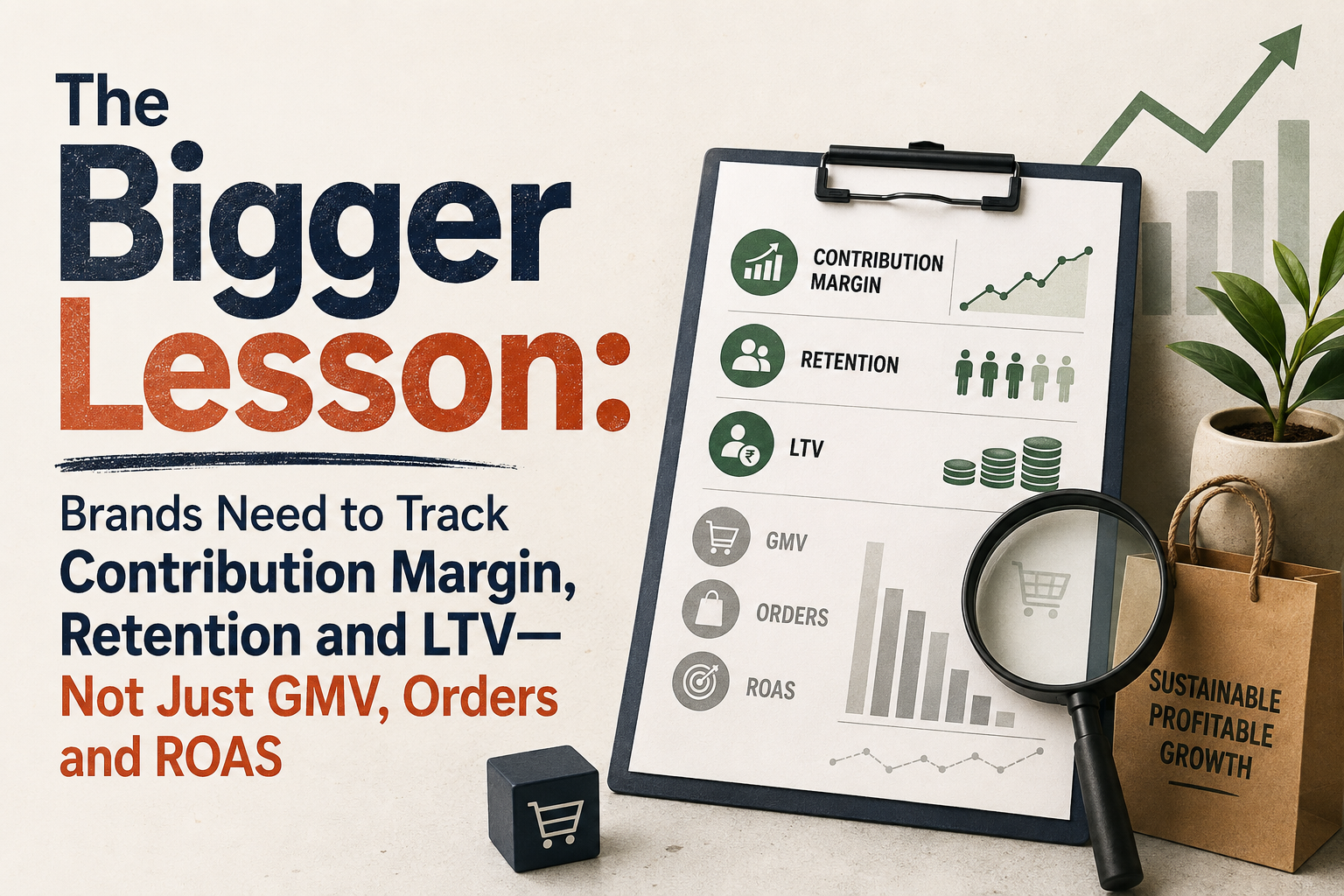
Growth can look impressive on a dashboard while quietly weakening the business underneath. For brands entering their next phase, the real question is no longer how much they sell, but how much value each customer and each order actually creates.
For years, three numbers have dominated the D2C growth conversation: GMV, orders and ROAS. They are easy to understand, easy to report, and, importantly, easy to celebrate. A brand crosses a revenue milestone, order volumes rise, or an advertising campaign delivers a strong return, and the business appears to be moving in the right direction.
But these numbers can tell only half the story.
A brand can grow GMV while spending heavily to acquire customers, offering deep discounts and absorbing high fulfilment costs. It can generate a strong ROAS from an existing customer base while struggling to bring those customers back. It can add thousands of orders and still create little economic value.
That is why the next stage of D2C growth needs a different scorecard.
Revenue is not the same as value
GMV tells a brand how much merchandise has been sold. It does not tell the brand how much money it actually keeps.
Consider two brands generating the same ₹10 crore in GMV. One has healthy gross margins, controlled logistics costs, and a strong repeat customer base. The other depends heavily on discounts, paid acquisition, and expensive fulfilment. On the surface, they look identical. Economically, they are not even close.
This is where contribution margin becomes important. It is the amount left from net revenue after accounting for the variable costs directly tied to a transaction, such as COGS, shipping, payment fees, and packaging. In other words, it answers a more useful question than revenue alone: how much economic value does each sale actually leave behind?
A positive contribution margin does not guarantee a profitable business, but it establishes whether the underlying transaction has enough economic value to support acquisition, retention, and the fixed costs that come with scaling. (Source: Glencoyne)
ROAS can hide an expensive growth engine
ROAS is useful, but it becomes dangerous when treated as the final measure of marketing effectiveness.
A campaign generating a 4x ROAS may appear highly successful. But if the products being promoted have thin margins, the actual contribution after discounts, fulfilment, and other variable costs may be modest. The picture becomes even weaker when the campaign is acquiring customers who make only one purchase.
This does not make ROAS irrelevant. It makes it incomplete.
Brands need to understand what happens after the first transaction. Did the customer return? How much did they spend over time? Did the brand have to keep paying to acquire them? Did the first order create a relationship or merely produce a one-time sale?
The answers determine whether marketing is creating sustainable growth or simply buying revenue.
Retention turns transactions into a business
The economics of a brand change significantly when customers return without requiring the same level of acquisition spending.
A first purchase is often expensive because the brand has to earn attention, overcome hesitation, and convince a new customer to try it. The second and third purchases can be far more valuable because the customer already knows the product, understands the brand, and requires less persuasion.
This makes retention one of the strongest indicators of whether a brand has built something durable.
But retention should not be reduced to a single percentage. Brands should examine when customers return, what they buy, how frequently they purchase, and whether their spending increases or declines over time.
A skincare customer buying once every six months represents a very different economic opportunity from one purchasing every month. Both are technically repeat customers, but their value to the business is fundamentally different.
LTV Is Only Useful When It Reflects Real Economics
LTV becomes more meaningful when brands calculate it on contribution rather than revenue alone. A simple way to think about contribution LTV is AOV × contribution margin × purchase frequency × customer lifespan.
This separates the value of a customer from the costs attached to serving them. For example, a customer generating ₹10,000 in lifetime revenue at a 40% contribution margin creates ₹4,000 in contribution, not ₹10,000 available to fund future acquisition. That distinction can materially change how much CAC a brand can afford. (Source: digitalheroesco)
It also gives leadership teams clearer levers for growth: increasing basket size, improving margins, driving repeat purchases, or extending customer lifespan can each increase the economic value of the same customer.
The dashboard needs to change
For leadership teams, this means moving beyond monthly sales reports and building a more complete view of business health.
GMV should show the scale of demand. Orders should show transaction activity. ROAS should help evaluate media efficiency. But alongside them, brands should track contribution margin per order, repeat purchase behaviour, retention cohorts, LTV and the relationship between customer acquisition cost and long-term customer value.
Cohort analysis makes these metrics far more useful because it shows how customer value changes over time. Instead of relying on one blended retention or LTV number, brands can group customers by when they were acquired and track how their spending, repeat purchases, and contribution develop across subsequent months. This can reveal whether newer cohorts are becoming more or less valuable, whether retention is strengthening, and whether a particular acquisition channel is bringing in customers who continue to contribute beyond the first purchase. (Source: Glencoyne)
It gives brands a clearer view of whether growth is actually improving the quality of the customer base, rather than simply increasing its size.
The real growth question
The D2C market is entering a phase where simply selling more will not be enough. Capital is more closely scrutinised, customer acquisition is becoming harder, and consumers have more choices than ever.
In this environment, sustainable growth will belong to brands that understand the economics behind every customer and every order.
The bigger lesson is simple: GMV tells you how big the business is becoming. Contribution margin tells you whether the growth is economically useful. Retention tells you whether customers want to stay. LTV tells you what those relationships can ultimately be worth.
The strongest brands will not abandon the old metrics. They will put them in their proper place.
Because the future of D2C growth is not about winning the dashboard.
It is about building a business that becomes more valuable as it grows.