

India’s consumer brands are increasingly moving beyond product-led marketing to build deeper cultural relevance and consumer affinity. In categories like fitness and nutrition, where functional differentiation is becoming harder to sustain, brands are now leaning into storytelling, fandom, and identity to create stronger emotional connections with audiences.
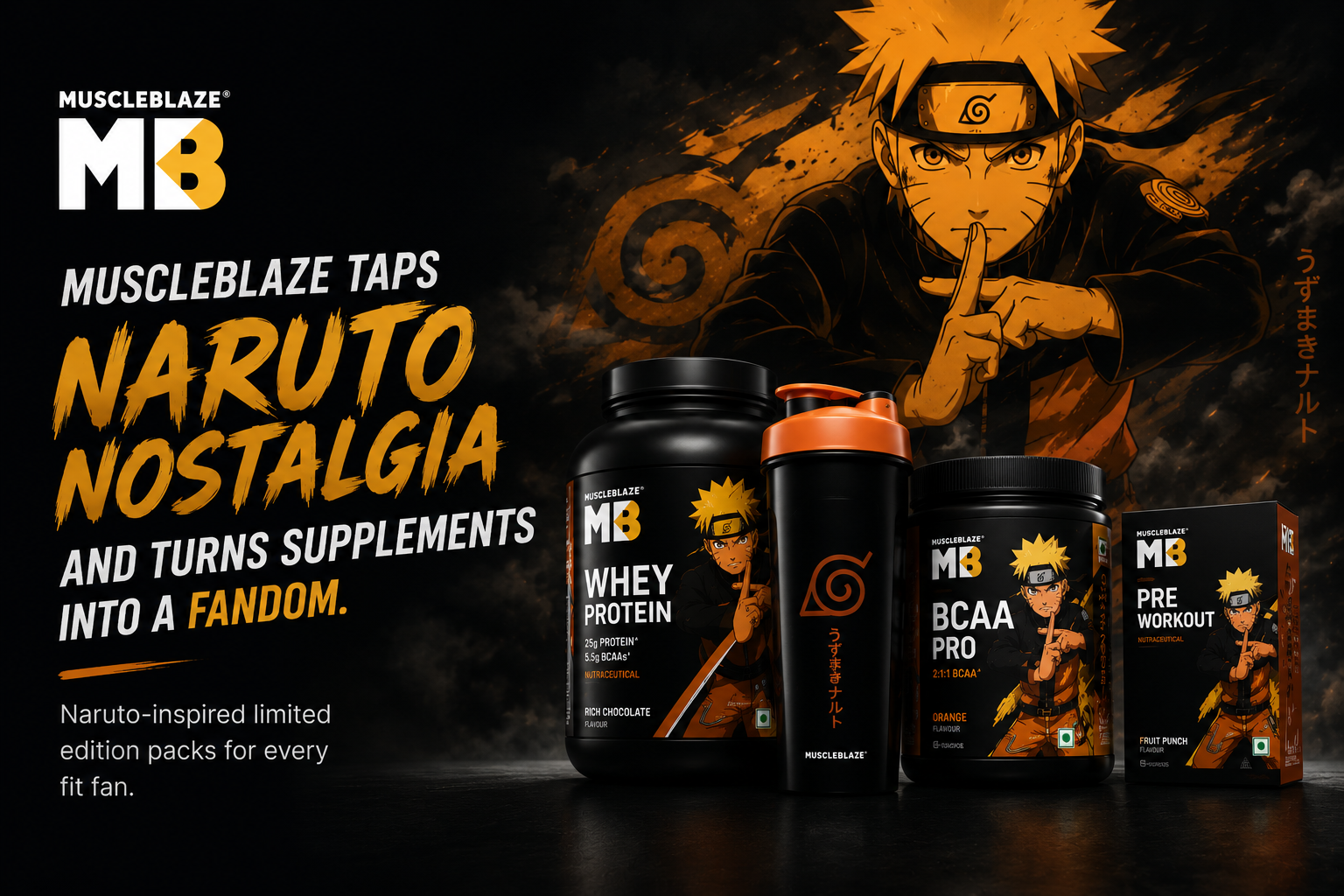
That shift is reflected in MuscleBlaze’s latest collaboration with Naruto — a partnership that goes beyond a conventional licensing exercise. Rather than relying purely on nostalgia, the collaboration is positioned around a shared philosophy of discipline, resilience, and earned progress, aligning the world of fitness with Naruto’s larger narrative of perseverance and self-made greatness.
At the centre of the collaboration is a simple but commercially powerful idea: greatness is built, not inherited.
That philosophy has long shaped Naruto Uzumaki’s journey — a character defined not by privilege or destiny, but by relentless effort and refusal to quit. MuscleBlaze is tapping directly into that narrative, positioning the collaboration less as an anime crossover and more as a reflection of the values it wants associated with fitness itself.
The campaign builds heavily around this overlap. Naruto did not begin as the strongest character in his world; he became one through consistency, training, and perseverance. MuscleBlaze is framing fitness in much the same way — not as shortcuts, hacks, or overnight transformations, but as the result of discipline repeated daily.
That positioning becomes especially relevant in India’s sports nutrition market, where brands are increasingly competing not only on performance claims, but on identity and belief systems. The collaboration attempts to move the conversation from “what the product does” to “what the product stands for.”
The rollout includes Naruto-themed editions of Biozyme Performance Whey, CreAMP Creatine, and WrathX Pre-Workout, alongside collectibles and fan merchandise designed to deepen immersion within the fandom ecosystem. But unlike many pop-culture collaborations that rely purely on visual nostalgia, MB X Naruto appears to be built around philosophical compatibility.
The brand’s messaging reinforces this repeatedly:
Science over shortcuts.
Proof over promises.
Consistency over convenience.
That mirrors the central Naruto narrative — the idea that progress comes from repetition, struggle, and showing up long after motivation fades. In that sense, the partnership works because both worlds fundamentally celebrate the grind.
The collaboration also reflects a wider shift in modern consumer marketing, where brands are borrowing cues from entertainment, fandom, and creator culture to build communities rather than simply push products. Increasingly, consumers — especially younger audiences — are drawn toward brands that represent a mindset or worldview, not just utility.
For MuscleBlaze, the move also makes strategic sense from a category standpoint. Fitness itself has become deeply content-driven and community-led, shaped by creators, online fandoms, and identity-based consumption. Anime culture, particularly franchises like Naruto, naturally overlaps with audiences that already value self-improvement arcs, discipline, and transformation narratives.
That overlap gives the collaboration authenticity — something many culture-led partnerships struggle to achieve.
Importantly, the campaign avoids making Naruto feel like a superficial branding device. Instead, it positions the franchise as a symbolic extension of the brand’s larger philosophy around earned performance. The message is not “buy this because it’s anime.” It is closer to: if fitness is built through repetition, effort, and consistency, then Naruto already represents the mindset that fitness culture celebrates.
For marketers, the larger takeaway lies in how cultural collaborations are evolving. Successful partnerships today are no longer driven by visibility alone; they require ideological alignment. Consumers can quickly recognise when collaborations feel manufactured purely for attention. What gives MB X Naruto credibility is that the underlying philosophy feels coherent across both worlds.
In that sense, the campaign signals something larger about where branding is headed. The next phase of consumer marketing may belong less to brands that shout the loudest about performance, and more to those that successfully attach meaning, mindset, and identity to everyday products.
MuscleBlaze’s Naruto collaboration works because it understands a simple truth both fitness and anime fans already believe: you do not wait for destiny. You outwork it.