

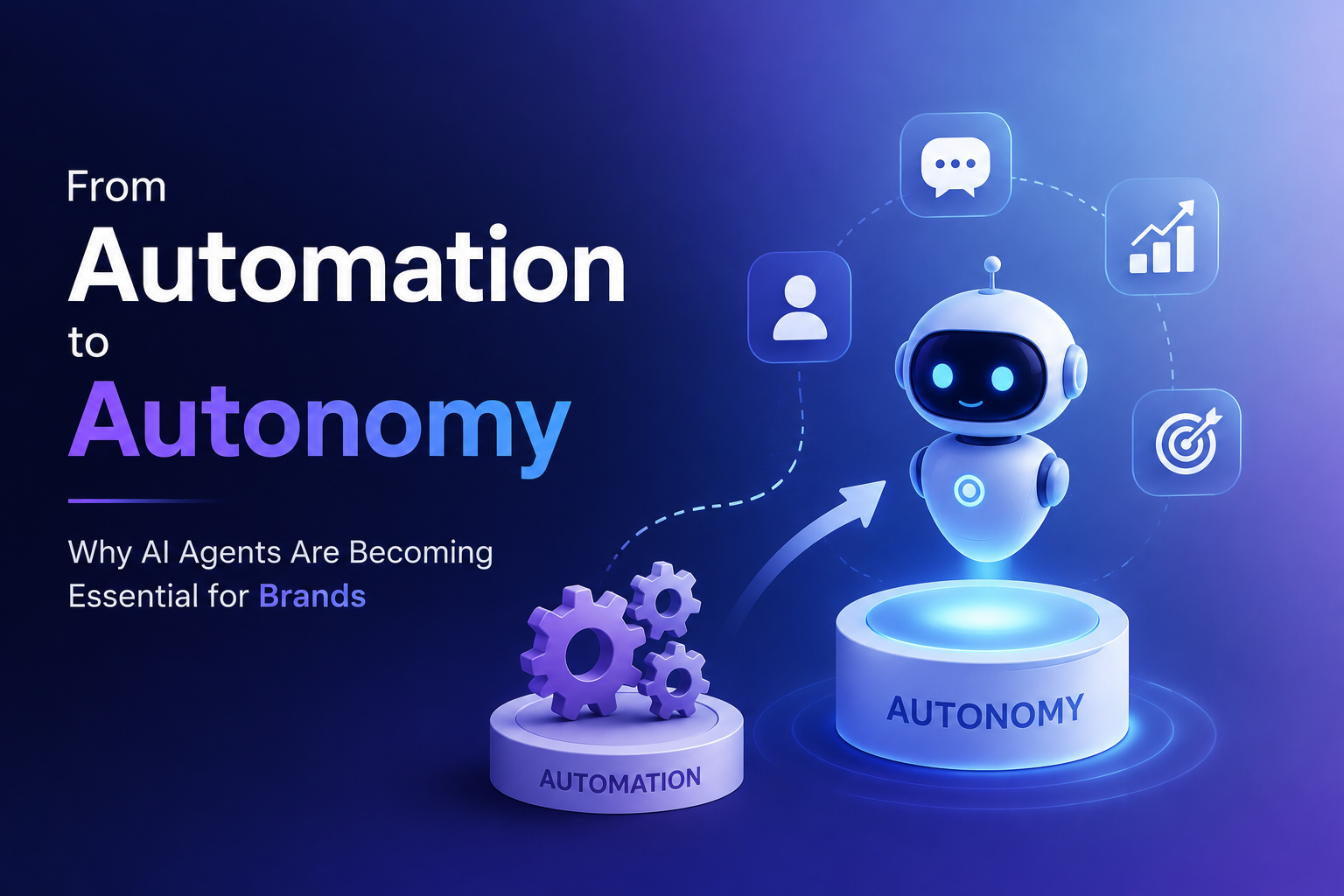
What began as a tool to speed up marketing operations is now evolving into something far more transformative. For years, automation platforms helped brands streamline campaigns, while AI largely played a supporting role, assisting teams with isolated tasks such as content generation, analytics, and customer support.
But the next phase of AI is not about assistance. It is about autonomy.
A new generation of autonomous AI agents is beginning to reshape how businesses operate. Unlike conventional AI assistants that wait for prompts and execute singular tasks, these agents are built to think and act across workflows. They can analyse data, make decisions, coordinate between systems, and continuously optimise outcomes — often with minimal human intervention.
The shift signals a larger transition for enterprises: from using AI as a productivity layer to deploying it as an active operational engine.
The market surrounding these autonomous systems is also expanding rapidly. The global agentic AI market, valued at USD 7.29 billion in 2025, is projected to reach USD 139.19 billion by 2034, growing at a CAGR of 40.50%. Asia Pacific accounted for 25.5% of the global agentic AI market in 2025, driven by rapid digitalisation and expanding enterprise AI adoption. China and India are projected to reach market values of USD 0.66 billion and USD 0.59 billion, respectively, as businesses and public-sector institutions increasingly adopt autonomous AI agents to improve productivity and streamline operations. (Source: Fortune Business Insights)
The transition is already accelerating across the marketing industry.
Major enterprise technology companies such as Salesforce, Adobe, Microsoft, Google, and HubSpot are heavily investing in what is increasingly being described as “agentic AI.” Platforms such as Salesforce Agentforce, Adobe CX Enterprise, Microsoft Copilot agents, and Google’s enterprise AI ecosystem all point toward the same future: marketing systems that can increasingly operate autonomously.
The financial momentum behind this shift is growing rapidly. Salesforce recently revealed that Agentforce and its related AI offerings generated nearly $1.4 billion in annual recurring revenue, while AI agents alone surpassed $500 million ARR within a single quarter. At the same time, enterprise surveys across industries indicate that organisations are accelerating their adoption of AI agents over the next 12 to 24 months. (Source: Exchange4Media)
Why the Shift Is Accelerating
The growing interest in autonomous AI agents is not being driven by hype alone. Modern marketing ecosystems have become too fragmented, fast-moving, and data-heavy for manual execution alone to keep pace.
Today’s brands are expected to manage campaigns across multiple platforms, personalise customer experiences in real time, respond instantly to behavioural signals, optimise media spending continuously, and produce content at scale. Traditional automation tools simplified parts of these workflows, but they still relied heavily on human coordination and decision-making.
Autonomous AI agents are emerging as the next layer of operational intelligence because they can analyse data, make decisions, execute workflows, and continuously optimise outcomes simultaneously. For brands operating in highly competitive digital environments, this offers what businesses increasingly prioritise: speed, scalability, and real-time adaptability.
The shift is also being accelerated by rising customer expectations. Consumers now expect faster responses, personalised interactions, seamless cross-channel experiences, and always-on engagement–all without increasing operational complexity for businesses.
Recent industry data highlights how rapidly these expectations are reshaping business priorities. According to Insider One, 67% of consumers expect brands to automatically adjust content based on context, 87% expect fraud alerts within five minutes, and 88% say experience is as important as products. Yet 84% of businesses believe they deliver good personalisation, while only 54% of consumers agree. (Source: Insider One) With 63% of marketers already using generative AI and sales teams seeing 83% revenue growth with AI (vs. 66% without), brands are turning to autonomous agents to close this gap. (Source: Salesforce)
Here are seven AI agents poised to become essential components of modern marketing stacks in the coming years.
1. The Autonomous Campaign Agent
One of the clearest applications of AI agents is campaign management. Traditionally, campaigns require coordination across creative, analytics, CRM, media buying, and optimisation teams. Autonomous campaign agents are increasingly bringing these workflows into continuous automated systems.
For example, an e-commerce brand running a festive campaign could use AI agents to generate ad variations, optimise targeting, adjust budgets in real time, and pause underperforming creatives automatically.
This is especially valuable in performance marketing environments where rapid testing and constant optimisation are critical. As a result, marketing is gradually shifting from fixed campaign cycles toward “always-on optimisation,” where systems continuously test, learn, and improve performance with minimal manual intervention.
The shift is also changing the role of marketers themselves. Instead of managing every operational task, teams increasingly focus on strategy and creative direction while AI handles execution.
A concrete example is HubSpot’s AI-powered nurture flow, which transformed from segment-based to intent-based personalization. Instead of grouping leads into broad categories, AI predicts what each individual is trying to accomplish based on behavior and automatically matches them to relevant content. The system achieved an 82% increase in conversion rates, +30% open rates, and +50% click-through rates compared to traditional segmentation. (Source: Visme)
2. Customer Experience Agents
Customer service is quickly becoming one of the most important areas for AI-agent adoption.
Unlike older chatbots that relied on scripted responses, newer AI agents can understand context, remember past interactions, integrate with enterprise systems, and perform real-time actions. They can resolve complaints, recommend products, track deliveries, trigger retention workflows, escalate sensitive cases, and personalise conversations using customer history.
A major example recently emerged at Heathrow Airport, which deployed an AI-powered customer support system integrated with WhatsApp and internal customer-data systems to automate traveller support at scale. (Source: Business Insider)
For brands, this capability is becoming increasingly important as customer expectations continue to rise while support operations become more expensive and complex.
3. Personalisation Agents
Personalisation has been discussed in marketing for years, but AI agents are making it far more scalable and dynamic.
Traditional personalisation systems often relied on static audience segments and predefined rules. AI agents work differently. They continuously analyse customer behaviour, browsing activity, purchase history, engagement patterns, and contextual signals to adapt experiences in real time.
These systems can personalise website experiences, product recommendations, messaging frequency, ad creatives, loyalty offers, and even pricing strategies. As large language models become more advanced, personalisation is also becoming increasingly conversational, allowing brands to engage customers in more natural and adaptive ways.
This links to Adobe’s Brand Concierge, an AI agent that delivers personalised, conversational shopping experiences directly on a brand’s website or app. It uses real-time browsing, purchase history, and contextual signals to adapt product recommendations, messaging, and offers for each shopper, moving far beyond static segments into dynamic, AI-driven personalisation. (Source: Experience League)
4. AI Media Buying Agentse
Programmatic advertising introduced automation into media buying, but AI agents are now pushing automation into autonomous decision-making.
Instead of marketers manually adjusting bids, placements, and audience targeting, AI agents can analyse audience behaviour, shift ad spend dynamically, optimise creatives, predict conversion likelihood, and run large-scale performance experiments simultaneously.
The biggest advantage is not only speed, but also scale. Human teams cannot realistically process the enormous volume of behavioural and contextual signals generated across today’s digital ecosystem. AI systems can.
A very strong example is Scope3’s Agentic Media Platform, where brands deploy their own AI agents to evaluate every ad impression in real time. These agents combine brand-safety, sustainability, and performance goals with contextual and audience signals to make autonomous buy/skip decisions across DSPs, SSPs, and even Meta, shifting media buying from manual rules to adaptive, AI-driven decision-making at scale. (Source: Scope3)
5. Content Supply Chain Agents
Generative AI significantly accelerated content creation. AI agents are now extending that transformation into full-scale content operations.
Rather than generating isolated blog posts or captions, content agents are increasingly being developed to manage the entire content lifecycle. This includes topic research, SEO optimisation, draft creation, content adaptation, distribution, performance tracking, and content refresh cycles.
The rise of AI-powered search and conversational interfaces is also changing how brands approach discoverability. Increasingly, companies are optimising content not only for search engines, but also for AI systems that interpret and recommend information to users.
Bynder’s AI agents for the content supply chain are another example of how brands are automating large-scale content operations. These agents act as digital teammates, automating metadata tagging, format adaptation, and brand compliance while humans retain approval control. (Source: Bynder)
6. Analytics and Decision-Making Agents
One of the most overlooked applications of AI agents may ultimately be analytics and decision-making.
Modern businesses already collect massive amounts of customer and operational data. The challenge is no longer data collection, but interpretation and execution.
AI decision-making agents are being designed to detect anomalies, identify emerging trends, forecast demand, recommend actions, and generate insights automatically. Instead of relying on static weekly reports, marketers may increasingly receive continuous AI-generated recommendations tied directly to execution systems.
A strong example is Demandbase’s AI agents for account-based marketing (ABM), which track account behaviour across multiple signals and identify high-intent activity in real time. If a decision-maker downloads a guide, attends a webinar, and revisits a pricing page, the system can automatically alert the sales team with behavioural insights, suggested talking points, and relevant content recommendations, turning analytics into continuous, real-time decision-making. (Source: Demandbase)
For CMOs facing growing pressure to demonstrate ROI more quickly, this kind of real-time operational intelligence could become highly valuable.
7. Multi-Agent Marketing Systems
Perhaps the most important shift is that future marketing systems may not rely on a single AI agent at all. Instead, companies are moving toward interconnected ecosystems where specialised agents collaborate across workflows.
A campaign agent, for example, may work alongside media-buying agents, customer-support agents, analytics agents, forecasting agents, and content agents simultaneously. Together, these systems form what many technology companies now describe as an “agentic enterprise.”
This is already visible in Glean’s multi-agent campaign system, where specialised AI agents work together to automate performance marketing. A campaign agent sets goals, a bidding agent adjusts bids in real time, a creative agent optimises ad variations, and an analytics agent tracks performance—all coordinating autonomously across channels. This shifts marketing from manual optimisation to an always-on, collaborative AI team. (Source: Glean)
This is the direction many enterprise platforms are now pursuing. The long-term vision is clear: marketing environments where AI agents continuously coordinate across channels, systems, and customer touchpoints while human teams focus more on strategy, governance, and creativity.
That future still faces challenges, including compliance risks, brand-safety concerns, governance requirements, and integration complexity. But the broader direction of the industry is becoming increasingly difficult to ignore.
The marketing industry spent the last decade building digital infrastructure. The next decade may be defined by autonomous systems operating on top of it.