

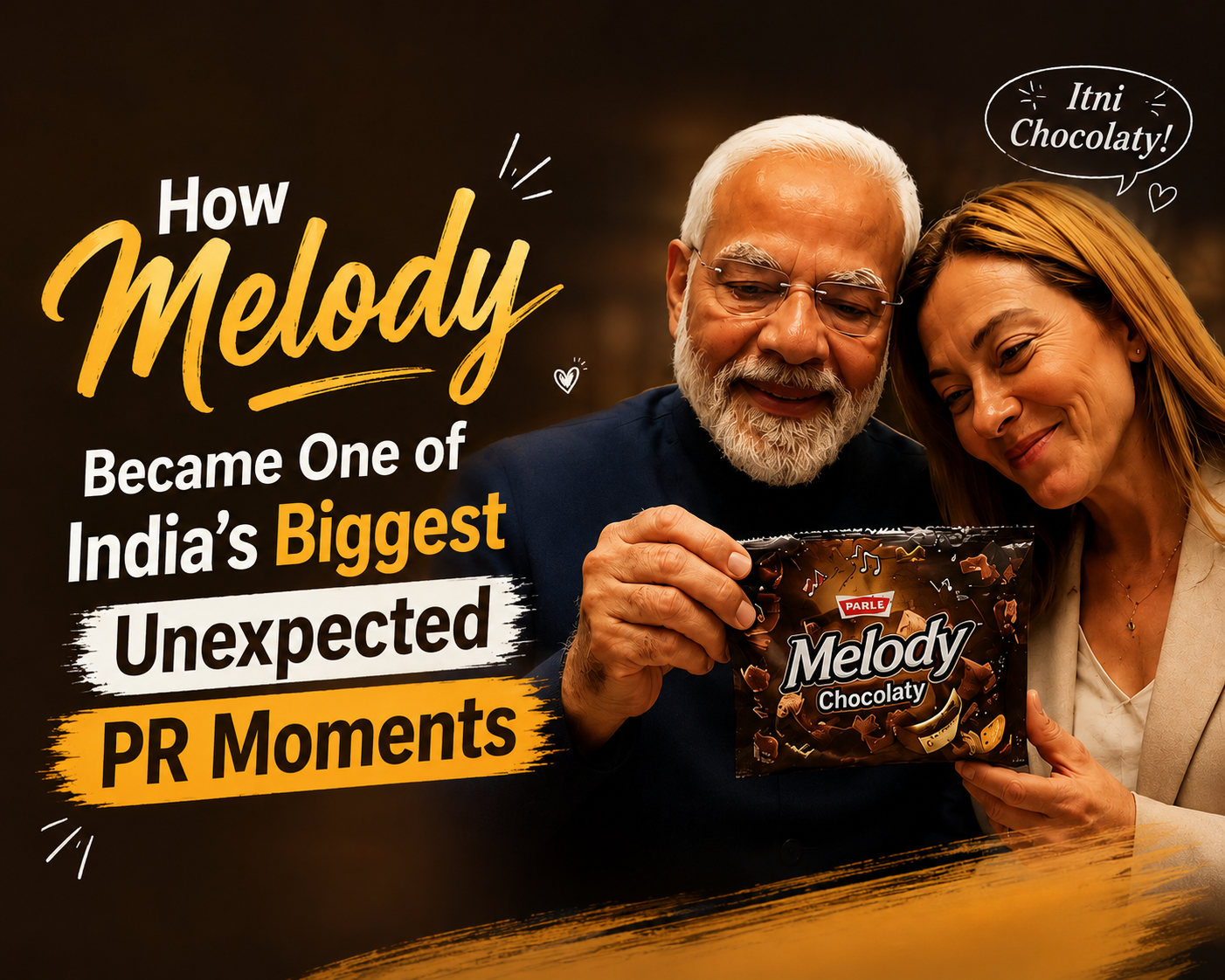
A ₹1 candy rarely becomes the centre of a national marketing conversation. But when Prime Minister Narendra Modi handed Italian Prime Minister Giorgia Meloni a pack of Melody toffees after their Rome meeting on 19 May 2026, the moment quickly escaped diplomacy and entered India’s internet‑culture‑economy. Within hours, meme pages, marketing professionals, brand accounts, and newsrooms had transformed Melody into one of the country’s biggest organic‑PR stories of the year, with the 27‑second clip crossing close to a million social media views in under an hour. (Source: ET Brand Equity)
A product that had quietly occupied Indian retail shelves for decades suddenly became culturally visible again, not through a planned advertising campaign, but through a spontaneous, internet‑amplified diplomatic clip that the internet chose to believe in.
Reflecting on the viral moment, Union Minister Piyush Goyal shared that exports of Indian toffees, caramels, and similar confectionery products have grown by nearly 166 per cent since 2013–14, with the value rising from ₹49.68 crore in FY 2013–14 to ₹132 crore in FY 2025–26. Calling it a ‘sweet success’ story, Goyal wrote, ‘Sweetness of “Made in India” toffees wows the world,’ adding that India’s ‘toffee tale’ would ‘surely be melody to the ears’, a line that now doubles as a poetic summary of how a ₹1 candy became a culture‑and‑commerce moment at once. (Source: NDTV Food)
That distinction matters.
In many ways, Melody received the kind of nationwide visibility that brands typically spend months and massive media budgets attempting to engineer. Yet the attention arrived organically, without celebrity endorsements, performance-led advertising, or a carefully staged digital rollout.
The moment worked because it achieved something modern advertising increasingly struggles to manufacture: authenticity.
And in today’s fragmented attention economy, authenticity has quietly become one of the most powerful drivers of visibility. Emotional marketing has become central to modern consumer engagement, with research from Harvard University suggesting that nearly 95% of purchasing decisions are influenced by emotions. A Nielsen study further found that emotionally driven advertisements generate 23% stronger consumer recall than purely rational messaging. (Source: Drew)
The challenge for brands today is not just visibility — it is emotional resonance. A 2026 review of emotional resonance in digital marketing shows that emotionally resonant content produces significantly higher engagement and recall, and that authenticity, storytelling, and context, not just reach, are now the core drivers of attention. Consumers are increasingly looking for authenticity, not just promotion, and traditional advertising alone is no longer enough to hold attention in an overcrowded digital environment.
For years, marketers have debated shrinking consumer attention spans, with digital behaviour studies frequently suggesting that audiences decide within seconds whether to continue watching a reel, open an article, or engage with branded content. But the bigger issue is not that people cannot pay attention anymore. It is that they no longer tolerate content that feels emotionally disconnected from them.
Consumers still spend hours consuming podcasts, commentary videos, long-form explainers, and 90-second reels. The difference is that modern audiences engage only when something instantly triggers recognition, curiosity, nostalgia, humour, or emotional familiarity.
That is precisely why Melody travelled so quickly online.
Unlike newer digital-first brands that require context-building, Melody already existed in India’s collective memory. Consumers recognised the wrapper instantly. They remembered the iconic “Melody itni chocolaty kyun hai?” line, childhood purchases from neighbourhood kirana stores, school canteens, and the emotional familiarity attached to low-cost legacy FMCG brands.
That emotional recall is not incidental. A study on nostalgia marketing in FMCG found that nostalgic cues increased brand recall by 37% and purchase intention by 29%, while consumers also reported stronger emotional attachment toward brands associated with childhood memories and family rituals. (Source: IJETMR)
The internet did not “discover” Melody. It remembered it.
That distinction is crucial for marketers trying to understand how attention works today. Legacy consumer brands often possess an advantage many modern brands struggle to build from scratch: inherited cultural memory. In an overcrowded digital ecosystem where audiences scroll past thousands of messages daily, familiarity itself has become a competitive advantage.
Nostalgia marketing, in this context, is no longer just a sentimental branding tactic. It has evolved into a serious consumer-engagement strategy. Brands such as Paper Boat, Saregama Carvaan, and Parle-G have successfully transformed childhood memories, retro aesthetics, and cultural familiarity into long-term emotional equity. (Source: Dev Opus) Globally, companies like Nike, Levi’s, Apple, Nintendo, and Netflix continue reviving legacy products, vintage storytelling, and iconic design cues to reconnect consumers with emotionally recognisable experiences. (Source: Seriosity)
When familiar products appear in unexpected cultural contexts, audiences instinctively participate because the emotional groundwork already exists. The Melody moment demonstrated exactly that, and also revealed how dramatically the balance between paid visibility and earned attention has shifted.
Traditionally, advertising operated through interruption. Brands purchased visibility through television slots, print campaigns, sponsorships, celebrity endorsements, or digital ads and attempted to insert themselves into consumer attention. But social platforms have fundamentally changed how relevance works. Today, people share what feels culturally alive, not simply what is professionally produced.
The Melody episode succeeded because it did not feel engineered or meticulously planned.
There was no visible campaign intent, no influencer strategy, and no attempt to aggressively “act relatable.” In fact, the absence of overt marketing became the reason audiences embraced the moment so naturally. Memes, reposts, nostalgic commentary, and internet humour collectively turned the interaction into a nationwide cultural conversation.
The audience effectively became the media engine.
This is where many brands continue to struggle.
A large portion of modern marketing still mistakes exposure for engagement. Brands chase impressions, algorithmic reach, and short-term virality while overlooking the deeper reason people participate in content in the first place: relatability.
Consumers today are exceptionally skilled at detecting manufactured internet behaviour. According to Forbes, particularly Gen Zs are highly sensitive to authenticity and can quickly recognise when a persona or brand voice is crafted purely to drive engagement. In many cases, that performative approach weakens trust rather than strengthening it. At its foundation, both personal and corporate branding have always relied on authenticity, credibility, and genuine connection. (Source: Forbes)
Merely using memes, trending audio, or social-media slang does not automatically create authenticity. In many cases, excessive attempts at relatability make campaigns feel even more artificial. (Source: Mark We Trust)
Cultural participation cannot be fully reverse-engineered.
What brands can do, however, is build emotional familiarity strong enough that when an organic cultural moment appears, audiences willingly amplify the brand themselves. That requires long-term recognisability, emotional consistency, and a clear cultural identity rather than constant trend-chasing. (Source: Kantar)
The Melody moment became powerful not because the brand aggressively inserted itself into culture, but because culture unexpectedly picked the brand.
Globally, too, brands have benefited from similar unscripted moments. From J.Crew receiving attention after Michelle Obama publicly wore the label to Fiat gaining visibility through Pope Francis’ famously modest Fiat 500 appearance, some of the most memorable brand moments in public culture have emerged organically rather than through planned advertising campaigns. (Source: The New York Times)
That larger shift is increasingly reshaping advertising and PR worldwide.
The campaigns that resonate most today are often the ones that feel closest to real human behaviour, conversational, imperfect, spontaneous, and emotionally recognisable. Audiences are gradually moving away from polished corporate messaging and toward moments that feel culturally believable.
Authenticity, therefore, is no longer just a branding buzzword. It has become a distribution mechanism.
When consumers emotionally relate to a moment, they circulate it voluntarily. They transform it into memes, commentary, conversations, and internet culture. At that point, audiences stop behaving like passive viewers and start functioning like media channels themselves.
For Parle Products, the visibility generated by Melody’s resurgence was enormous. But the larger takeaway extends far beyond confectionery or nostalgia marketing. The real lesson for brands is that attention today cannot simply be bought at scale. It has to be emotionally earned.
And in a digital ecosystem flooded with content every second, relatability may now be one of the last genuinely scalable forms of consumer attention.
Melody did not launch a campaign.
The internet launched one for it.