


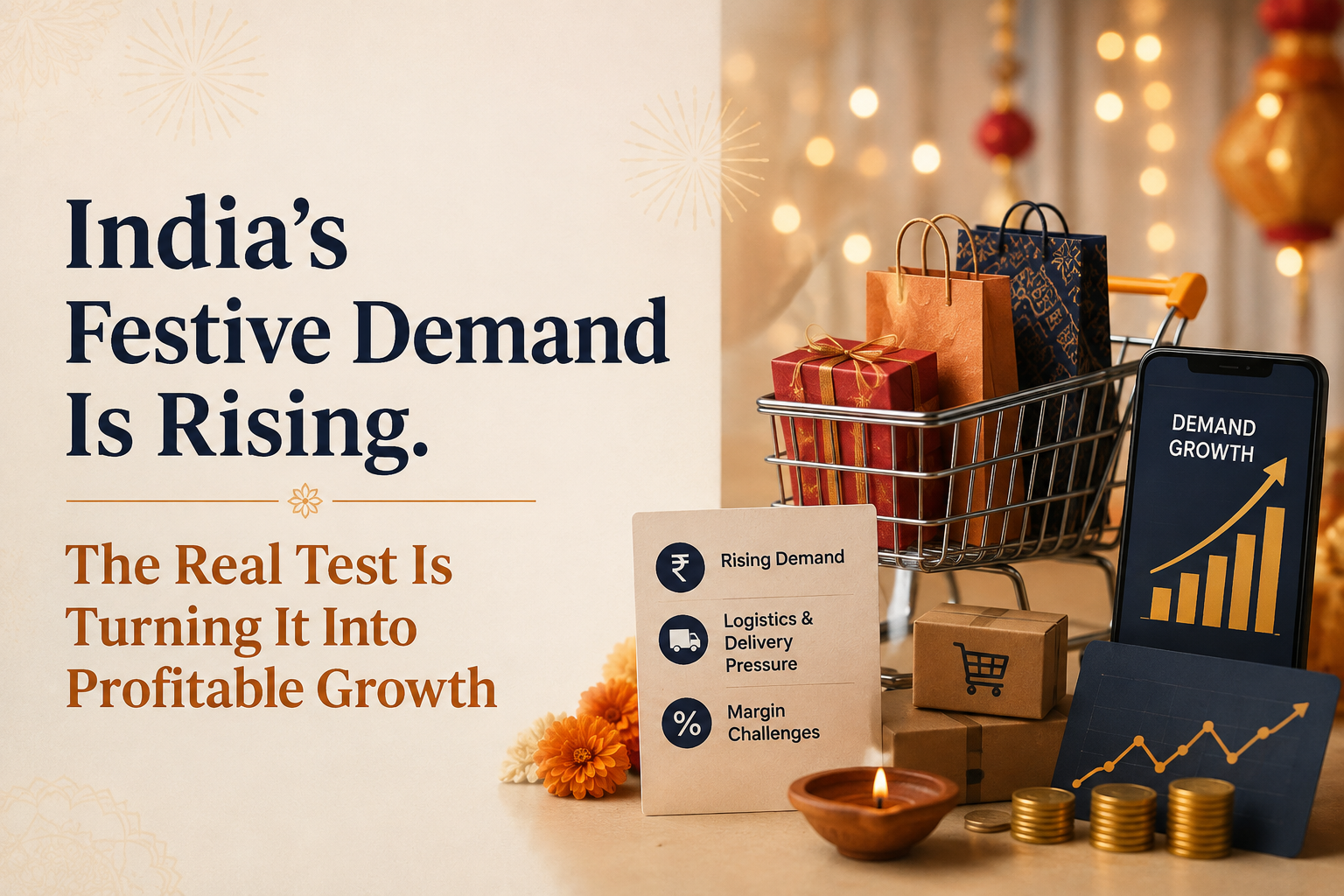
India’s 2026 festive season is shaping up to be a stronger one for consumer businesses. Forty-five per cent of surveyed shoppers say they expect to spend more than they did in 2025, while FMCG demand is projected to rise 9–11% between August and November. Yet the opportunity comes with a complication: stronger demand does not automatically translate into stronger economics. (Source: Fortune India)
For brands, the festive question is therefore changing. It is no longer simply about how much demand can be generated, but how effectively that demand can be discovered, converted, fulfilled, and monetised. That makes profitable growth less a question of sales volume and more a question of how well the entire commercial system works together.
Festive spending is becoming more considered
The spending outlook points to renewed consumer confidence, but that confidence does not necessarily mean indiscriminate consumption. The survey indicates stronger intent around categories such as jewellery, home appliances and gadgets, suggesting that festive purchases are increasingly tied to considered, higher-value decisions rather than simply impulse buying.
That distinction matters for brands because stronger spending does not mean consumers are becoming less selective. As competition intensifies across categories and channels, brands need to offer a clearer value proposition beyond the discount. Product relevance, pricing, availability, and quality increasingly determine which brands make it through the consideration process.
For brands that have already earned consumer trust, this creates an opportunity beyond acquisition. Familiarity, reliability, and positive previous experiences can make the decision easier for consumers, allowing brands to turn existing preference into repeat business during the festive season.
The shopfront is no longer a single destination
Before a purchase reaches checkout, the consumer journey is becoming increasingly fluid. Consumers may discover a product online, compare options digitally and still choose to complete the purchase in a physical store for immediate availability or greater reassurance. Advertising, marketplaces, social platforms and AI-powered search are therefore not competing destinations, but interconnected points in a longer decision journey. (Source: Indian Retailer)
MiQ’s survey found that 43% of festive shoppers use AI-powered search for brand discovery, compared with 30% using e-commerce platforms and 27% using social media. (Source: Fortune India)
The significance of this goes beyond the emergence of another digital channel. AI can introduce a new layer between consumer intent and the brand itself, helping shoppers compare products, interpret information and narrow their choices before they ever reach a brand-owned property.
That makes digital shelf quality a commercial issue, not merely a content-marketing concern. Accurate specifications, consistent pricing, credible reviews, current availability and clear differentiation increasingly determine whether a brand survives the consideration process. Media can create awareness, but unreliable product information can still prevent conversion.
More demand does not guarantee more profit
But winning the consideration battle is only one part of the equation. The other challenge is what happens to profitability once that demand arrives.
The FMCG outlook forecasts stronger seasonal demand, but simultaneously warns that palm oil, crude and packaging costs could put pressure on margin recovery.
The pressure is emerging even as business volumes recover. Hindustan Unilever recorded its fastest volume growth in 13 quarters, while Nestlé India reported revenue growth of around 25%. Yet higher palm oil, crude and packaging costs continue to put pressure on margins. The contrast illustrates why stronger sales alone cannot be treated as proof of healthier growth: higher input costs can absorb part of the benefit of stronger volumes and revenue. (Source: New Kerala)
This creates a familiar but dangerous trap: pursuing volume while assuming scale will automatically repair profitability. It may not. A sales spike can coexist with weaker contribution margins if higher input costs, excessive promotions or inefficient inventory absorb the additional revenue.
The smarter response is therefore not simply to raise prices or cut costs. Brands need to examine where value can be created through a better product mix, selective promotions, differentiated packs and tighter operational planning.
Four areas that will determine festive performance
First, brands need to plan demand around why customers are buying. A premium purchase, a gifting occasion, household replenishment and a last-minute convenience need are fundamentally different consumption moments. They require different assortments, price points, inventory positions and communication strategies.
Second, brands need to make themselves easy to discover and evaluate. Product descriptions, specifications, prices, availability, reviews, and proof of value should remain consistent across the places where consumers encounter the brand. In an AI-assisted discovery environment, information quality becomes part of distribution.
Third, brands need to protect margin through the quality of the sale rather than the size of the discount. Premium variants, bundles, channel-specific assortments, and targeted offers can create value without turning every customer into a discount-dependent buyer. Better forecasting can also reduce the twin costs of stock-outs and excess inventory.
Finally, brands need to measure whether festive growth is actually healthy. Revenue and GMV tell only part of the story. Leaders should also watch contribution margin, sell-through, stock-outs, discount dependency, acquisition cost, conversion efficiency, cancellations, returns, and the rate at which festive customers return for a second purchase.
The real prize is growth that survives the season
The opportunity this festive season is larger than simply capturing more demand. It is about building a commercial system that can turn that demand into profitable customer relationships.
The 2026 consumer is entering the season with stronger spending intent, but is also navigating more fragmented discovery and making increasingly deliberate choices. At the same time, input-cost pressure makes a volume-at-any-cost strategy increasingly fragile.
The strategic advantage will therefore belong to brands that connect consumer understanding with discoverability, availability, pricing, and margin discipline rather than managing each as a separate function.
In 2026, festive success will not be defined by the largest sales spike. It will be defined by how much of that demand a brand can convert into profitable, repeatable growth.