


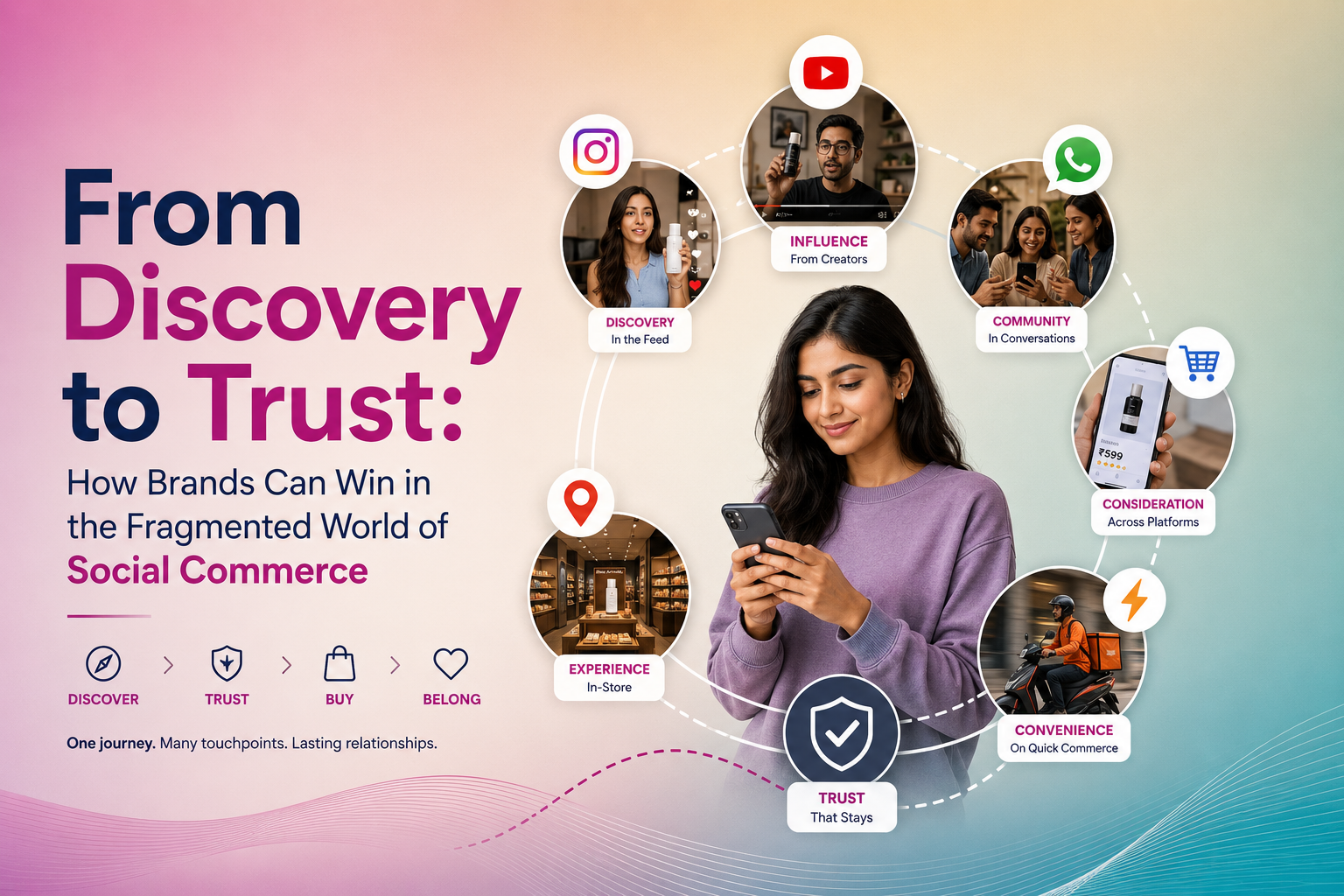
A customer can discover a product on Instagram, watch a creator talk about it on YouTube, ask about it in a WhatsApp group, compare it on a marketplace, buy it through a quick-commerce app, and encounter the same brand again in a physical store.
The journey is no longer linear. It is fragmented across platforms, people, communities, and moments.
Yet many brands still measure and manage these touchpoints as if they were separate destinations. Social media is treated as the place for discovery, marketplaces as the place for conversion, communities as an engagement channel, and stores as the final point of purchase.
The bigger opportunity lies in connecting all of them.
The brands that will win in this environment will not simply be the ones that appear everywhere. They will be the ones that remain recognisable, credible, and culturally relevant wherever the customer encounters them.
Discovery Happens in the Feed. Trust Is Built Somewhere Deeper.
Social commerce has changed how products enter consideration. A customer may not search for a product at all. A reel, creator recommendation, customer review, or conversation can introduce something before a purchase need has even been consciously defined.
But discovery and conversion are fundamentally different jobs.
Social platforms are designed to create curiosity and momentum, but the journey to purchase is no longer as linear as the traditional funnel suggests. A consumer can discover a product through a creator, compare it on a marketplace, encounter another commerce-related touchpoint later, and make a purchase within the same journey. As discovery and conversion move closer together, brands need to think beyond generating awareness and ensure that the path from interest to action is equally easy, credible, and connected. (Source: mikmak)
A consumer who discovers a product through a creator may still leave the platform to check reviews, compare prices, investigate ingredients, look at delivery timelines, or ask someone they trust. Every additional step introduces the possibility of friction.
This is why brands should stop asking only, “How do we convert social traffic?” A more important question is: “What happens to trust after discovery?”
If the answer changes dramatically from the creator’s content to the brand website, marketplace listing, WhatsApp conversation, or store experience, the customer is forced to rebuild confidence at every stage.
The real challenge is therefore not moving customers from one platform to another. It is carrying trust with them.
Communities Are Becoming the New Layer of Consideration
As discovery becomes more fragmented, consumers are increasingly turning to smaller circles where conversations feel more credible than mass advertising. A skincare enthusiast may trust a niche beauty community more than a celebrity endorsement, while a technology enthusiast may value a specialist forum over a broad influencer campaign.
For brands, the instinct is often to create their own community. But ownership is not always the objective. Existing niche communities already have something that brands cannot manufacture overnight: shared interests, social identity, trust, and established influence. Participating meaningfully in these spaces can allow brands to understand what matters to consumers and earn credibility through contribution rather than simply inserting another promotional message. (Source: prmomentindia)
Sometimes the smarter strategy is to earn a place inside communities that already exist.
But participation requires restraint. A sales pitch can weaken the trust that makes these spaces valuable. Brands need to contribute before they promote—to answer questions, solve problems, share expertise, and genuinely listen.
Over time, this creates something advertising cannot easily manufacture: relevance earned through participation. Brand-owned communities can eventually grow from these relationships, but they should be built around shared values and genuine utility, not simply another promotional channel.
The New Competitive Advantage Is Continuity
This makes the modern customer journey less about channels and more about continuity.
A customer should be able to discover a brand through a creator and recognise its point of view on Instagram. They should find the same promise on a marketplace, receive the same confidence through customer support, and experience that promise when the product arrives.
That continuity is particularly important as commerce becomes faster and more distributed. Quick-commerce platforms can compress the distance between consideration and purchase, while creators and communities can compress the distance between awareness and trust.
But speed without consistency can create confusion. Visibility without credibility can create curiosity without conversion.
Brands therefore need to think beyond the traditional funnel. Consistency does not mean repeating the same message everywhere; it means ensuring that different channels reinforce the same brand identity. A creator may tell the story differently from a marketplace or store, but the underlying promise, voice, and positioning should remain recognisable. This allows brands to adapt to each environment without creating a fragmented customer experience. (Source: Sideshift)
From Being Present Everywhere to Belonging Everywhere
The next phase of social commerce will not be won simply by increasing the number of platforms a brand occupies.
It will be won by understanding why customers move between them.
The most resilient brands will know when to speak, when to listen, when to participate, and when to step back. They will build communities without trying to control every conversation. They will adapt their expression without diluting their identity. And they will recognise that the transaction is only one moment in a much longer relationship.
Because customers do not experience brands as marketing departments organise them.
They experience one brand—across feeds, creators, conversations, marketplaces, apps, messages, deliveries, and stores.
The brands that understand this will stop optimising isolated touchpoints and start designing connected experiences.
And that may be the real evolution of social commerce: not simply making products easier to discover or buy, but making the journey from discovery to trust to purchase feel like one continuous relationship.