

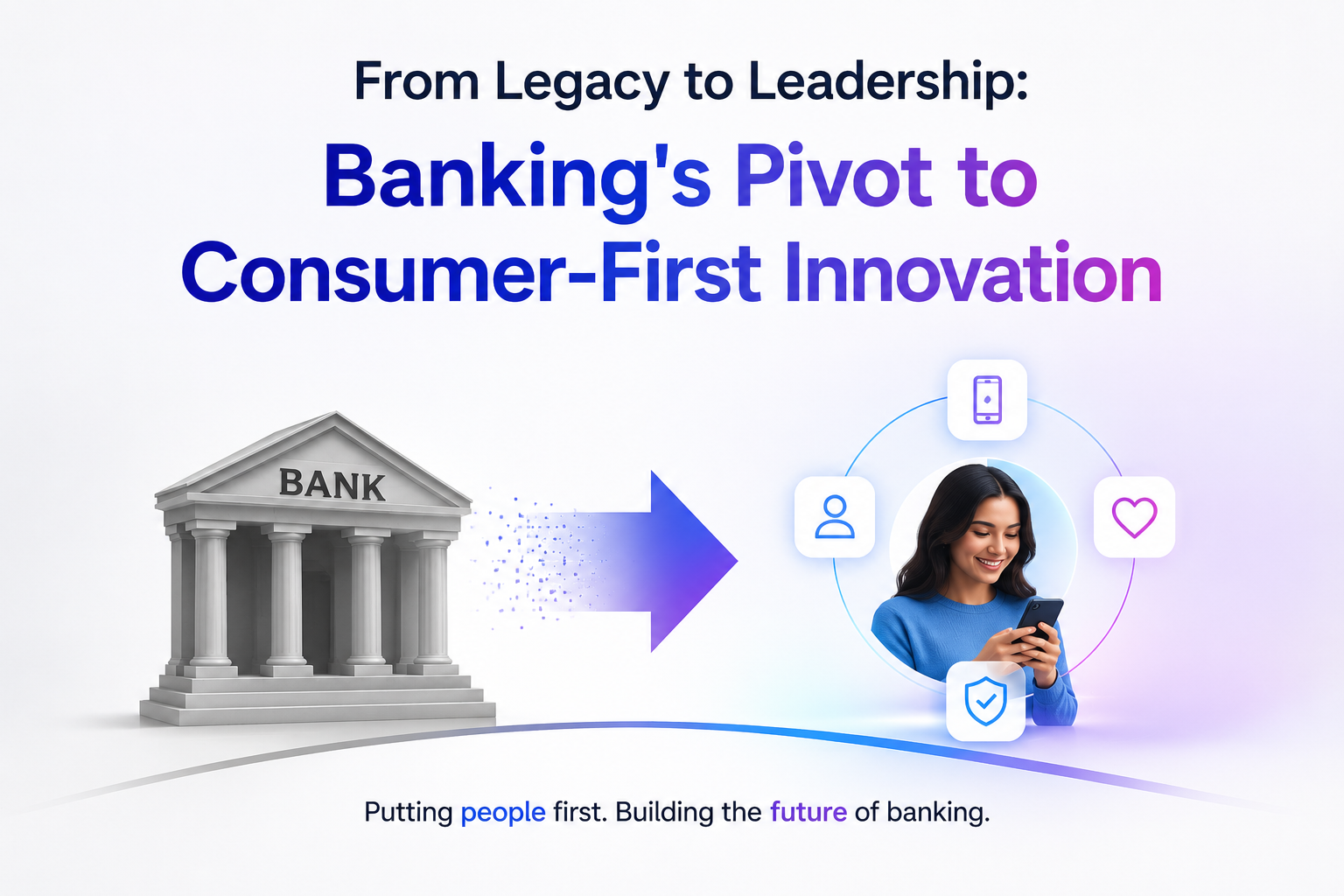
Legacy banks once defined stability, grand marble halls, and personal tellers built trust over generations. Today, they face a digital reckoning in which consumers demand seamless, intuitive experiences that prioritize their needs over institutional inertia. This pivot from product-centric to consumer-first innovation isn’t just survival; it’s how banks reclaim leadership in 2026’s hyper-competitive landscape. (Source: KPMG)
The Wake-Up Call for Traditional Banking
For decades, banks operated on a “one-size-fits-most” model, pushing standardized loans and accounts through rigid branches. But digital natives, millennials, and Gen Z demand intuitive, on-demand services, with over 70% preferring digital loans and 65% favoring mobile access globally. (Source: Global Growth Insights) Reports show 96% of institutions are sharpening online channels and 95% mobile experiences, while 52% prioritize modernization to compete effectively with agile challengers. (Source: KPMG)
Outdated systems breed inefficiency: banks allocate nearly 70% of IT budgets to legacy maintenance, per a report, stifling innovation. (Source: LinkedIn) The result? Fintech lending hit $588 billion globally in 2026, up from $505 billion in 2025, capturing significant market share among consumers and SMEs and forcing incumbents to accelerate digital pivots. (Source: Global Growth Insights)
Revised Strategies for Digital Transformation
Legacy banks are countering fintech threats through targeted modernization. They prioritize cloud migration and API integration to dismantle silos, enabling real-time data flows for personalized services. Reports indicate 96% of institutions are sharpening online channels and 95% mobile experiences, with 52% prioritizing core modernization to compete with agile challengers. (Source: KPMG) In India, the fintech market is projected to reach $148.1 billion in 2026, driven by digital natives demanding seamless lending. (Source: Persistence Market Research)
Fintech Innovators Driving Change
BillCut is pioneering AI-driven debt refinancing, merging multiple high-interest credit card bills and loans into single, low-rate EMIs; reducing effective costs from 36-50% p.a. to 13-15% while accelerating payoffs. Leveraging alternative credit scoring from UPI data and digital footprints, via partnerships with Tata Capital and L&T Finance, bypassing legacy banking’s paperwork and branch dependencies. (Source: VCCricle)
This empowers middle-class borrowers nationwide amid RBI’s digital lending norms, humanizing credit with predictive analytics for 60%+ of retail loans, fostering inclusion in Tier II+ cities, and aligning with banking’s consumer-first transformation.
PaisaBazaar is India’s leading digital lending marketplace, leveraging its proprietary Paisabazaar Stack, built on Microsoft Azure AI, for end-to-end digital disbursals of unsecured loans in just 3-5 hours via video KYC, e-mandates, and predictive “Chance of Approval” algorithms that match user profiles to pre-qualified offers. This empowers consumers and MSMEs with contactless access to personalized credit up to ₹50 lakh, reducing documentation requirements and boosting approval rates by 25% through scalability enabled by big data and machine learning. (Source: Microsoft)
Serving over 50 million users across 1,100+ cities (Source: Times of India), it enhances financial literacy with free CIBIL reports and trail revenue models, driving 76% loan growth in FY23 via optimized, presence-less processes. (Source: Times of India)
Conclusion
What’s becoming clear is that the future of banking isn’t about adding more features; it’s about becoming less visible and more intuitive. Banks are steadily evolving into integrated ecosystems, where payments, credit, and services come together seamlessly within everyday journeys. The real advantage lies in reducing friction, anticipating needs, and delivering value exactly when it’s required.
At the same time, growth is no longer metro-centric. The next wave is being shaped by users in Tier II and III markets, pushing institutions to rethink accessibility, speed, and experience at scale. The shift is already underway. The question is no longer whether banks should transform, but how quickly they can move.
Because in this new landscape, leadership won’t come from scale alone; it will come from how effortlessly finance fits into people’s lives.