


Advertising has spent years trying to get closer to the moment when a consumer is ready to make a decision. Search engines captured intent through keywords, social plAdvertising has spent years trying to get closer to the moment when a consumer is ready to make a decision. Search engines captured intent through keywords, social platforms captured interests through behaviour, and commerce platforms captured shoppers close to purchase. Now, AI is creating another layer: the conversation itself.
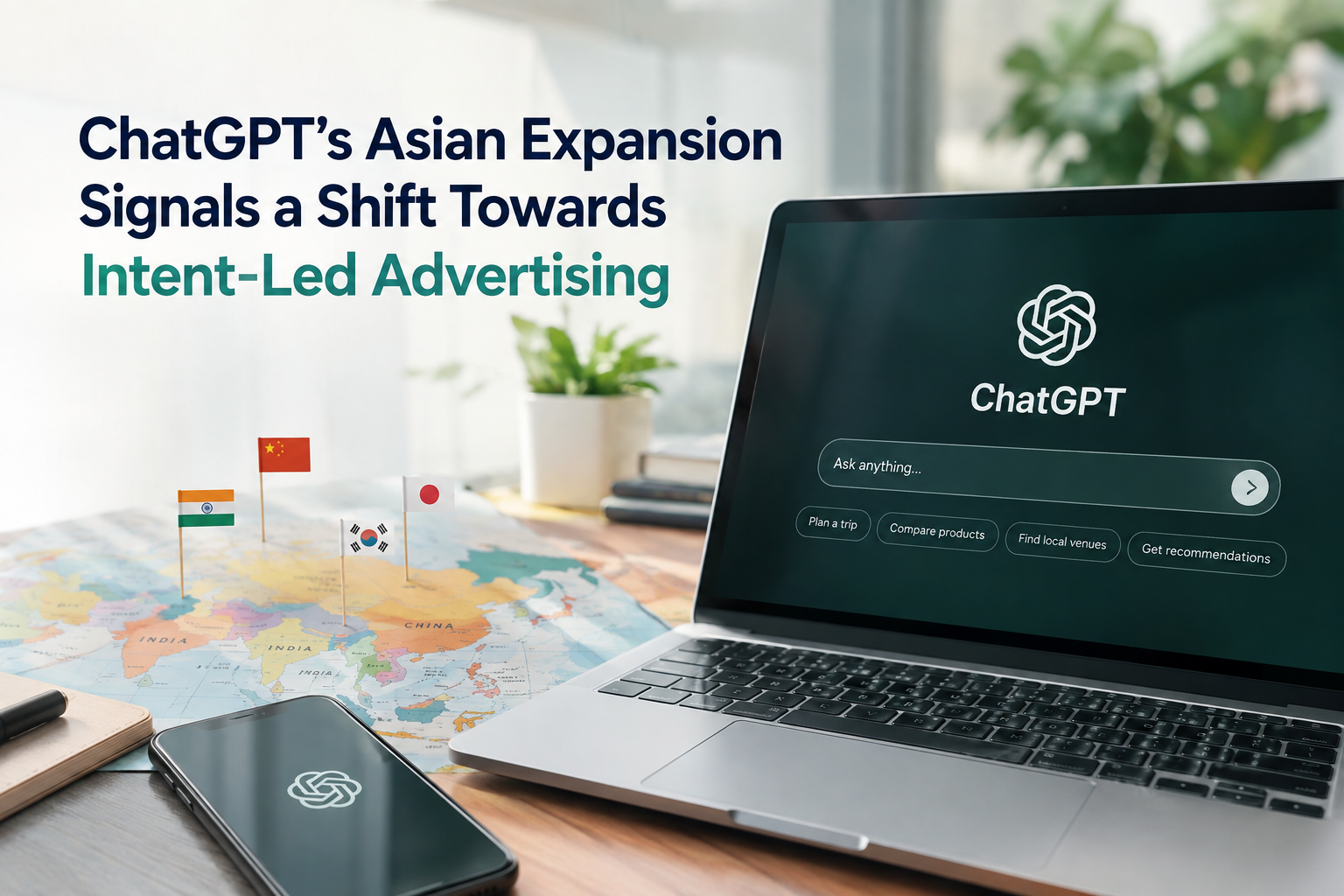
OpenAI’s latest expansion of ChatGPT Ads into seven Asian markets — Indonesia, Malaysia, the Philippines, Singapore, Thailand, Vietnam and Taiwan — takes the platform’s advertising presence to more than 60 countries. The rollout follows launches in markets including India, Japan, South Korea, Australia, and New Zealand. (Source: marketingmind)
For marketers, however, the bigger story is not the geographic expansion itself. It is what ChatGPT represents as an advertising environment: a place where consumers can explain what they want rather than simply type what they are looking for. atforms captured interests through behaviour, and commerce platforms captured shoppers close to purchase. Now, AI is creating another layer: the conversation itself.
OpenAI’s latest expansion of ChatGPT Ads into seven Asian markets — Indonesia, Malaysia, the Philippines, Singapore, Thailand, Vietnam and Taiwan — takes the platform’s advertising presence to more than 60 countries. The rollout follows launches in markets including India, Japan, South Korea, Australia, and New Zealand. (Source: marketingmind)
For marketers, however, the bigger story is not the geographic expansion itself. It is what ChatGPT represents as an advertising environment: a place where consumers can explain what they want rather than simply type what they are looking for.
From Keywords To Conversations
Traditional digital advertising often starts with a relatively narrow signal. A consumer searches for “running shoes,” clicks a category, or watches a fitness video. A conversation can contain richer signals than a conventional keyword: budget, preferences, constraints, intended use, and the questions shaping a decision.
OpenAI describes ChatGPT Ads as a way for brands to reach people while they explore options, compare alternatives, and make decisions. Ads can use conversational context to determine relevance, while remaining separate from ChatGPT’s answers.
For brands, this creates an important strategic shift. The opportunity is no longer limited to buying a keyword or targeting a demographic. It is to be relevant to a specific consumer need at the moment that the need is being explored.
That could matter particularly for categories where consideration takes time. Travel, financial products, electronics, automobiles, education, beauty, and business software are not always bought after one search. Consumers research, compare, and ask follow-up questions before committing.
The Ad Is Entering The Decision Journey
This changes what an effective advertisement may need to accomplish. On many existing platforms, advertising interrupts content or competes for attention around it. In a conversational environment, the consumer is already engaged in an active problem-solving process. That makes context more important than simply creating a visually attractive ad.
OpenAI’s own guidance for advertisers emphasises clear, specific and benefit-led messaging rather than generic copy. It also recommends developing multiple creative variations so the system can identify different opportunities for relevance. For marketers, this points towards a different creative discipline: write for intent, not just attention.
A skincare brand, for example, does not necessarily need to communicate the same message to someone asking about oily skin, someone comparing cleansers, and someone looking for a product within a particular budget. The underlying product may be identical, but the consumer problem is different.
India Offers An Early Look At The Opportunity
India is already part of this shift. ChatGPT Ads launched in the country in August, with OpenAI working with agency partners including WPP and Omnicom. More than 50 brands were reported to be planning campaigns around the Indian launch. (Source: TechCrunch)
Early Indian campaigns also offer a glimpse of where conversational advertising may find its strongest use cases. Tanishq has used ChatGPT Ads for Gold Exchange and Rivaah (Source: Impact On Net), while Sebamed has explored skincare-related discovery. (Source: BW Marketing World) The categories are different, but both involve questions that consumers may ask before they are ready to buy — what a product is worth, which option suits a particular need, or how one product compares with another.
That is the more interesting signal for marketers. ChatGPT Ads may be particularly valuable where the path to purchase is shaped by questions rather than a single search query.
Measurement Will Have To Catch Up
The biggest challenge for brands may not be buying the media. It may be understanding its incremental value. If a consumer sees an ad after discussing a product category with an AI assistant, the traditional metrics of impressions, clicks, and last-click conversions may not fully explain what happened. The platform could influence consideration before the eventual purchase occurs elsewhere.
That raises questions marketers will increasingly need to answer: Did the ad create awareness? Did it accelerate consideration? Did it influence the shortlist? Did it generate a direct conversion, or assist a conversion completed on another channel? OpenAI has already been expanding measurement capabilities alongside its advertising infrastructure, including CPC and cost-per-action bidding, as well as additional campaign measurement tools.
For CMOs, the implication is straightforward: ChatGPT Ads should be evaluated as part of the consumer journey, not only as another performance channel.
The Bigger Shift Is Already Underway
The scale of the expansion suggests that ChatGPT Ads is moving beyond an early-stage experiment and towards a more established advertising channel. OpenAI said in August that ChatGPT Ads had crossed a $1 billion annualised revenue run rate in less than 200 days, with tens of thousands of advertisers using the platform. (Source: Brand Equity)
OpenAI is also testing sponsored agents that allow consumers to begin a conversation with a business after clicking an advertisement, alongside new AI creative tools and integrations with platforms such as HubSpot and Shopify. That points to a future where the advertisement becomes less of a static message and more of an entry point into an interaction.
For marketers, this could require a shift from thinking primarily about audience targeting to thinking more about problem targeting. Traditional advertising often asks: Who is the consumer? What do they like? What have they searched for? What behaviour suggests they might buy? Conversational environments introduce another set of questions: What problem is the consumer trying to solve? What question are they asking? What constraint are they working around? What information could help them move closer to a decision?
That does not mean marketers should abandon audience, behavioural, or keyword targeting. It means intent can increasingly be understood through the context behind a consumer’s action, not just the audience they belong to or the behaviour they have displayed. For brands, the immediate priority is therefore not to move every advertising rupee into AI. Rather, the immediate priority is to understand how consumers describe their needs, which questions shape their decisions, and where conversational discovery fits into the existing media journey.
Because the next evolution of advertising may not be about finding consumers while they are scrolling or searching. It may be about showing up while they are thinking.