


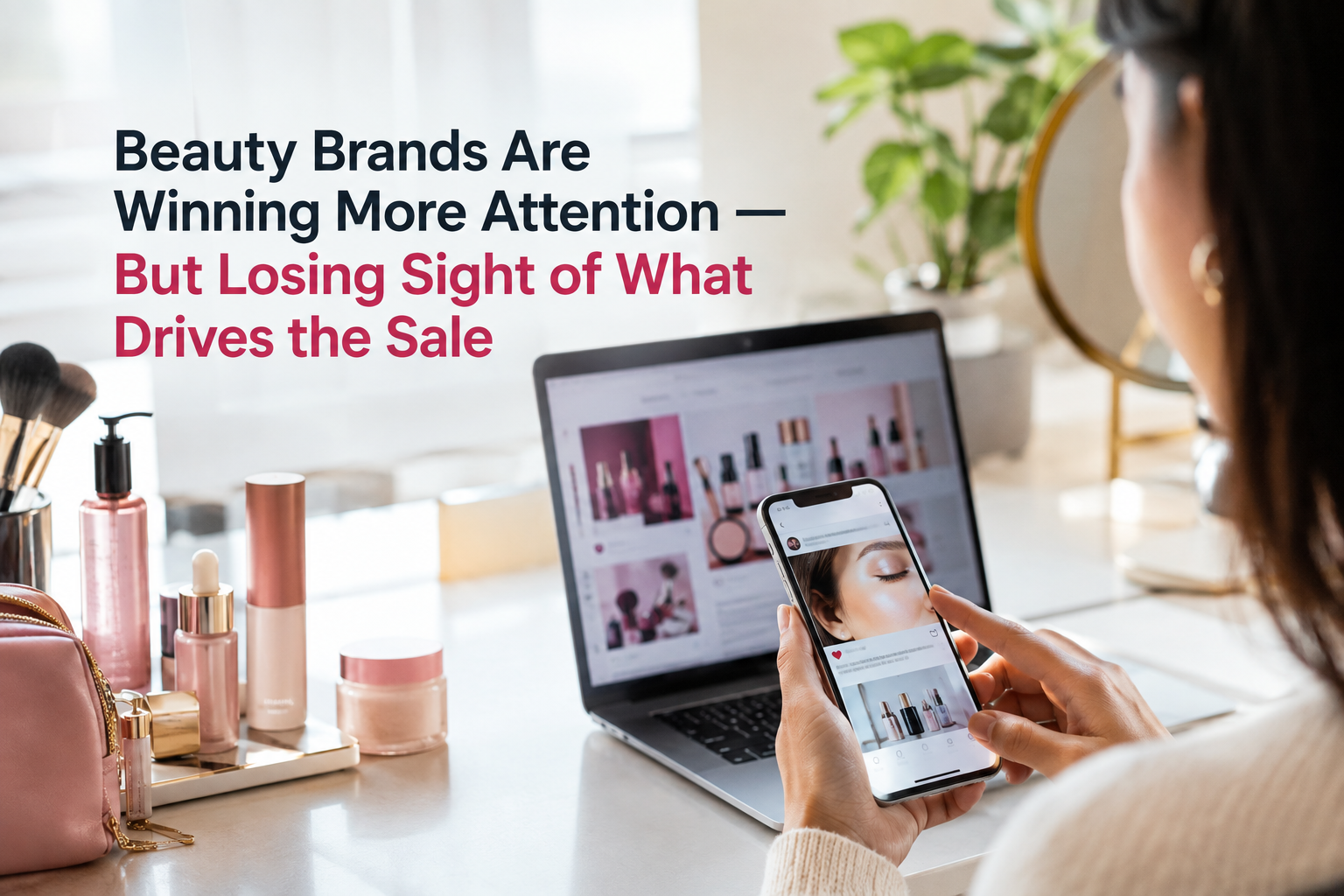
India’s festive season is becoming less of a single shopping moment and more of a long consumer journey. For beauty brands, that journey now begins with creators, continues through social feeds and search, moves into marketplaces or quick commerce, and can end in a physical store. The opportunity is larger than ever. So is the measurement problem.
The challenge is no longer simply generating visibility. It is understanding which interactions create demand, which capture existing intent, and how different channels work together to influence a purchase. As festive advertising expands across platforms, the ability to connect spending with business outcomes is becoming as important as the ability to generate attention.
The Last Click Is Losing Its Power
Beauty has traditionally been a category where discovery and consideration matter. A consumer may see a makeup tutorial from a creator, notice the same product in a social advertisement, compare reviews later and finally purchase it through a marketplace. A last-click model may credit the marketplace for the sale, even though the purchase decision was influenced much earlier.
This is why beauty marketers are increasingly looking beyond a single conversion point. MARS Cosmetics, for instance, said its festive investment is around 2.5 times its 2025 level, with nearly 40% going towards e-commerce and quick commerce. At the same time, its customer-acquisition costs are rising as brands compete for attention, creator inventory and high-intent placements. ( Source: exchange4media )
For advertisers, this changes the question from “Which channel delivered the sale?” to “Which combination of channels created the sale?”
Advertising Is Becoming Part Of The Shopping Experience
The traditional boundary between advertising and commerce is also becoming harder to maintain. A social platform can introduce a product, a creator can demonstrate it, a marketplace can reinforce the choice and quick commerce can fulfil the purchase within minutes.
That makes commerce platforms more than distribution channels. They are increasingly becoming media environments where consumers discover products while already being close to purchase. RENÉE Cosmetics, for example, reported that its business on quick commerce has expanded sharply, while a Blinkit campaign generated 11.5% incremental sales and a 48% lower CPA. ( Source: exchange4media )
The implication for brands is significant: media planning and commerce planning can no longer operate as completely separate functions. The advertisement may create the desire, but the digital shelf, search visibility, price and availability can determine whether that desire becomes a transaction.
Festive Advertising Is Getting More Expensive To Ignore
The growing complexity comes at a time when brands are putting more money into festive advertising. India’s 2026 festive advertising market is forecast to reach ₹60,000–62,000 crore, representing roughly 34–35% of the country’s total annual ad spend. Commerce advertising is also expected to grow considerably faster than the overall advertising market. (Source: Datum Intelligence)
That growth creates a measurement paradox. More investment means more touchpoints, but more touchpoints can make it harder to isolate individual contribution.
A creator campaign may generate search interest. Search may bring consumers to a marketplace. Marketplace advertising may convert them. Meanwhile, a consumer may have already encountered the brand through a store, YouTube video or recommendation. Treating any one of these interactions as the complete explanation for the sale risks misallocating the next rupee of media spend.
The New Question: Did The Ad Create Incremental Demand?
This is where incrementality becomes particularly important. A sale recorded during a festive campaign does not automatically mean the campaign caused that sale. Some consumers may already have intended to buy the product because of discounts, festival gifting, brand familiarity or seasonal demand.
For marketers, the more useful measurement framework therefore needs to combine ROAS and CAC with incremental sales, new-customer contribution, repeat purchase and profitability. MARS, RENÉE Cosmetics and Dot & Key are already looking beyond acquisition costs alone, while evaluating the quality and source of growth.
This does not make traditional metrics irrelevant. It makes them incomplete when used in isolation.
Beauty’s Funnel Is Becoming A Loop
The biggest structural change may be the collapse of the old beauty funnel. Discovery, consideration and purchase are no longer necessarily separated by days or weeks. Indian shoppers as increasingly moving through inspired browsing, immersive research, instant gratification and AI-assisted decision-making.
For beauty brands, this means creative strategy and performance strategy need to work closer together. A creator asset is not merely an awareness tool if it can trigger immediate product searches. Likewise, a performance advertisement should not be judged only by today’s conversion if it contributes to future brand familiarity.
What Brands Should Measure Next
For brands, the bigger opportunity lies in understanding how different media touchpoints work together to influence the customer journey.
That requires brands to map the journey across creators, social, search, marketplaces, quick commerce and physical retail, rather than analysing each channel inside its own reporting silo. It also means separating sales that would have happened anyway from genuinely incremental purchases wherever testing allows. The goal is not to find one channel to credit. It is to understand the system that creates demand.
As India’s festive shopping window expands and beauty becomes increasingly intertwined with digital commerce, advertising is moving closer to the transaction than ever before. But proximity to the checkout does not automatically equal influence. For marketers, the real competitive advantage will come from knowing the difference.