

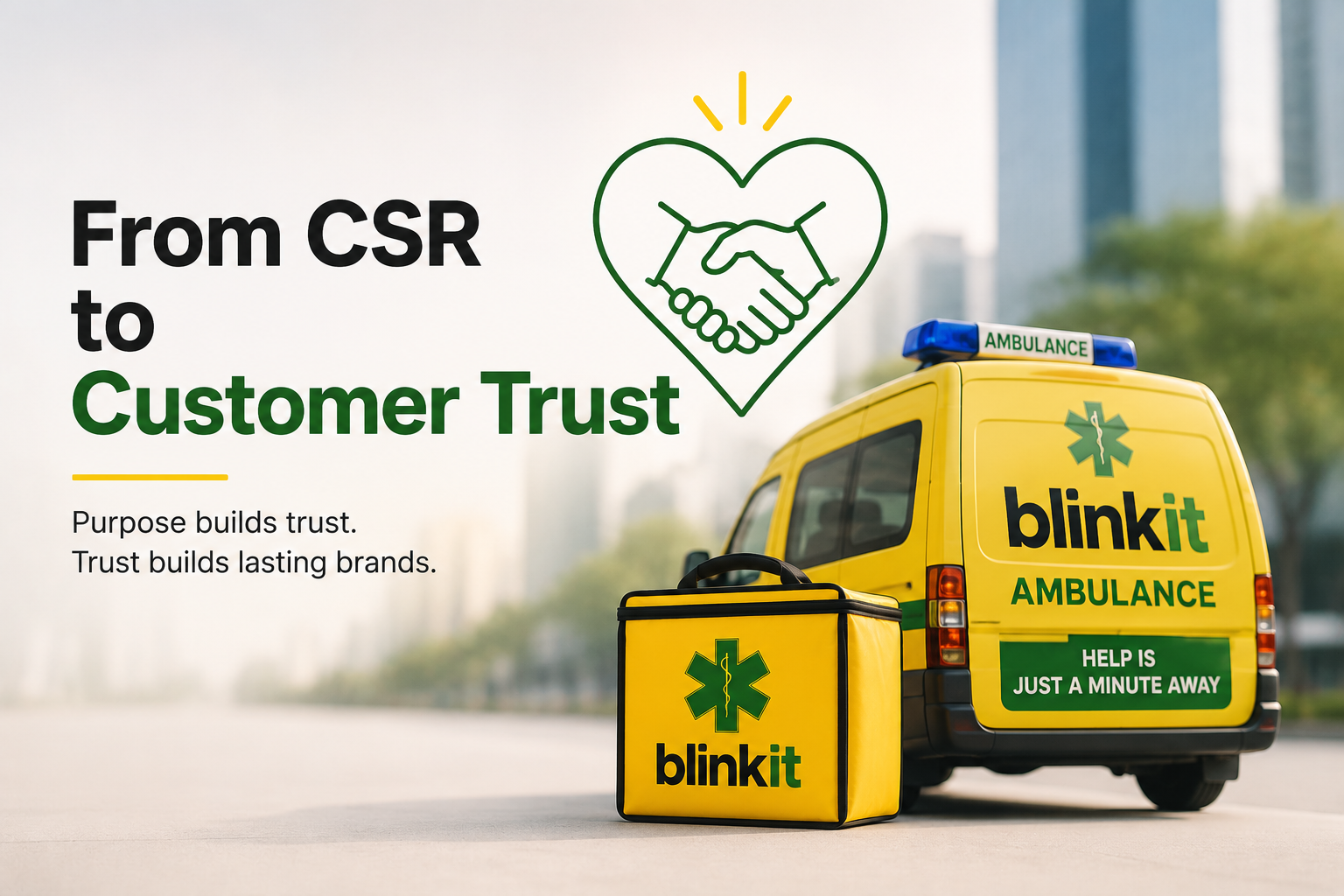
Blinkit's Ambulance Initiative Shows Why the Best Brand Marketing Starts with Community Impact Blinkit’s free 10-minute ambulance service is more than an expansion beyond groceries. It demonstrates how businesses can extend the spirit of corporate social responsibility beyond traditional CSR programmes by using their existing capabilities to create meaningful community impact while strengthening customer trust.
For most people, Blinkit is the app they open when they need groceries, medicines or household essentials delivered within minutes. Over the past few months, however, the Zomato-owned quick commerce platform has been quietly testing something very different: ambulances.
Its 10-minute ambulance service marks one of the company’s biggest moves beyond grocery deliveries, signalling that the same technology and logistics network built for convenience could also be used during medical emergencies. More importantly, it shows how infrastructure originally built for commerce can be repurposed to serve communities in moments when every minute matters.
The service is currently available across several parts of Gurugram, including Golf Course Road, South City II, Golf Course Extension Road, Cyber Hub, Huda City Centre, Badshahpur, Old Gurgaon, Palam Vihar, Manesar and Sector 12. It has also expanded to parts of Delhi, including Dwarka, Malviya Nagar, Lajpat Nagar, Patel Nagar, Greater Kailash-I and Rajouri Garden. (Source: Blinkit)
Each ambulance functions as a Basic Life Support (BLS) vehicle and can be booked directly through the Blinkit app. CEO Albinder Dhindsa has said the initiative was never launched with profit in mind, adding that Blinkit plans to expand the service to major Indian cities over the next two years.
While the initiative undoubtedly addresses a real community need, it also reflects a broader shift in modern marketing. Rather than relying solely on campaigns to communicate their values, brands are increasingly finding that meaningful services can build credibility, trust and long-term customer loyalty in ways that advertising alone often cannot. (Source: The Indian Express)
When Convenience Becomes Critical
The impact of the service became clear through a recent video shared by Gurgaon-based content creator Komal Khandelwal.
An elderly neighbour had suffered a heart attack. The family urgently needed an ambulance to reach a nearby hospital, but every option they found came with a price tag running into thousands of rupees. At a time when every minute mattered, they were forced to think not only about saving a life but also about how much the journey would cost.
Someone suggested trying Blinkit.
The ambulance arrived quickly. Inside were a stretcher, a wheelchair, trained medical staff, and essential equipment. More importantly, the family did not have to worry about paying for the ride.
Komal described it as a “five-star ambulance”—not because it was luxurious, but because it felt professional, respectful, and designed around the patient’s needs.
She summed up the experience with a point many viewers related to: during a medical emergency, people often say money shouldn’t matter. The reality is that it does. Hospital bills are already overwhelming for many families, and transport should not become another obstacle to receiving timely treatment. (Source: News18)
More Than Just a “10-Minute Ambulance Service”
Blinkit’s ambulance service has been designed to support patients beyond simply transporting them to a hospital. Every ambulance comes with a trained paramedic to provide immediate medical care, a dedicated pilot responsible for safe and timely transportation, and a duty assistant who helps move and support patients during emergencies. The crew can also connect with an on-call doctor, allowing paramedics to receive clinical guidance whenever required.
The ambulances are equipped with essentials such as a stretcher, wheelchair, scoop stretcher, oxygen cylinder, automated external defibrillator (AED), vital monitoring equipment, and emergency medicines. There is also seating for two accompanying family members, ensuring patients are not left to travel alone during a stressful situation.
At the same time, Blinkit is clear about what the service is—and isn’t. It currently operates as a Basic Life Support (BLS) ambulance, meaning it does not include facilities such as a portable ventilator, physical on-board doctors, specialised infant care for babies under 12 months, or hospital-to-hospital transfers.
By clearly defining its capabilities, Blinkit is positioning the service as a reliable first-response solution rather than a replacement for every type of emergency ambulance. (Source: Blinkit)
What Marketers Can Learn from Blinkit’s Ambulance Initiative
Blinkit’s ambulance service offers a lesson that extends far beyond healthcare. It demonstrates how brands can create stronger customer relationships by using their existing capabilities to solve meaningful problems rather than simply promoting products.
For years, conversations around corporate social responsibility have largely revolved around donations, awareness campaigns and one-off initiatives. While those efforts remain important, customers today increasingly recognise brands that embed social impact into the way they operate. Blinkit’s ambulance service does exactly that. Instead of creating a separate CSR programme, the company has applied the same logistics network, technology and operational expertise that powers its core business to address a genuine public need.
It also highlights an important shift in modern marketing. Consumers no longer evaluate brands only by the speed of delivery, pricing or product assortment. They increasingly remember how a company responds when people need help the most. Services that create real utility often leave a far stronger impression than campaigns designed purely to capture attention.
For marketers, the takeaway is equally clear. Purpose is most effective when it moves beyond messaging and becomes part of the customer experience. Rather than asking, “What campaign should we launch?” brands may find greater long-term value in asking, “What problem are we uniquely equipped to solve?”
Not every company needs to launch an ambulance service. But every business has assets—whether technology, distribution, expertise or infrastructure—that can be used in ways that create value beyond commercial transactions. Increasingly, those are the initiatives that build trust, strengthen brand reputation and differentiate businesses in markets where products and prices are becoming easier to replicate.