

Festive gifting used to be a planned purchase. Consumers would decide what to buy, visit a store or website, compare options, and place an order well ahead of the occasion. That behaviour is changing. Today, a forgotten gift can be ordered minutes before a family dinner, a dessert can arrive after a celebration has already begun, and a small stationery set can become a perfectly acceptable festive gesture.
This shift is bigger than a change in delivery speed. It is redefining the gifting opportunity itself.
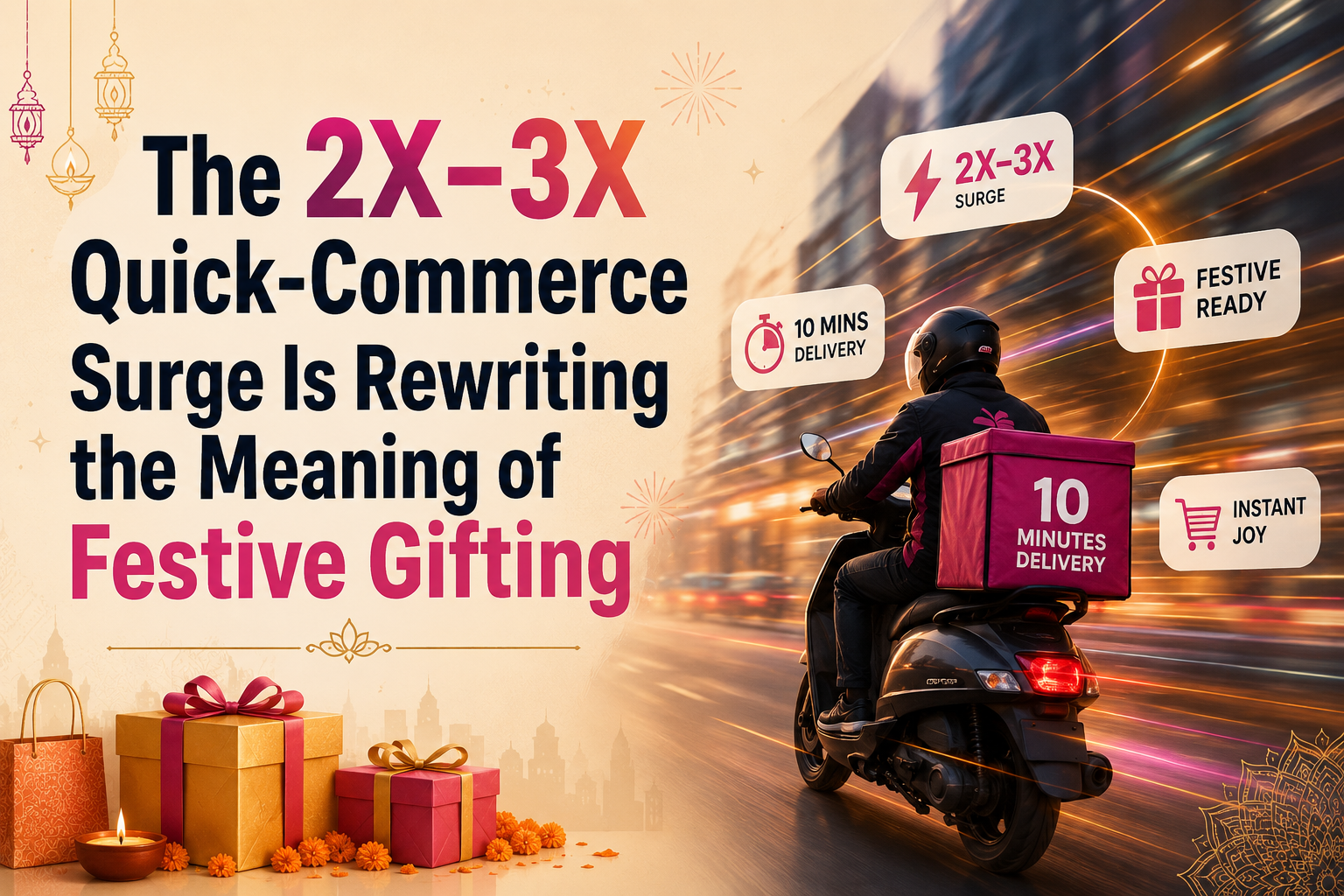
Recent observations from brands across beauty, food, flowers, stationery and gifting show that quick commerce can see festive demand jump 2X to 3X above expectations during occasions such as Raksha Bandhan, Diwali and other high-intent moments. The important question for brands, therefore, is not simply how to sell more during festivals, but how to design their products, marketing, and distribution around the new reality of instant gifting. (Source: marketingmind)
The festive consumer is no longer following one buying journey
The biggest mistake brands can make is to treat festive shopping as a single, predictable customer journey.
A consumer may discover a gift through Instagram, save it for later, forget about it, and then search for an alternative on a quick-commerce platform two hours before meeting someone. Another consumer may deliberately browse a brand’s website weeks in advance because they want personalisation, a wider assortment or scheduled delivery.
These are not competing behaviours. They are different moments of the same festive consumer.
The buying window is becoming more compressed as well. Ferrero India notes that gifting purchases are increasingly being made just a few days before the festival, reflecting a broader shift towards more immediate buying. For brands, this shorter decision window makes availability, discovery and fulfilment increasingly important. (Source: The Hindu Business Line)
That is why brands increasingly need a multi-channel gifting architecture rather than a single festive sales channel. Quick commerce can solve urgency, while a brand’s own website can offer customisation and deeper assortment. Physical stores can provide discovery and experience, while marketplaces can bring additional reach.
The strategic opportunity lies in understanding the role each channel is performing.
Quick Commerce is Turning Urgency into a Category Opportunity
The significance of quick commerce is not merely that products arrive faster. It has created a new consumption trigger: “I need that right now.”
That shift is already reflected in brand expectations. The Body Shop expects close to 15% growth in Rakhi hamper sales in 2026, with quick commerce emerging as a key driver of last-minute gifting. The brand has also expanded its gifting strategy around customisable gift boxes, suggesting that speed is increasingly being paired with personalisation rather than replacing it. (Source: The Hindu Business Line)
For certain categories, it is becoming an intent-capture channel.
A consumer who searches for chocolates, beauty products, flowers, cakes, or small gifts close to an occasion is already displaying a high degree of purchase intent. The brand’s challenge is no longer to create that intent from scratch. It is to be visible, available, and relevant at the exact moment it appears.
That changes the role of marketing. Instead of asking only, “How do we create demand?”, brands also need to ask, “How do we capture demand when it suddenly appears?”
Festive Gifting Is Spilling Beyond Traditional Gift Categories
Speed alone, however, cannot explain the transformation in gifting. Quick commerce is also expanding the broader festive consumption basket, bringing products beyond conventional gifts into festive purchases. According to Datum Intelligence, gifting-related purchases such as festival hampers and essentials helped drive a sharp rise in grocery sales during the first week of the festive season, with the category recording a 44% year-on-year increase. (Source: Rediff)
The significance for brands is that festive demand is no longer restricted to products that are explicitly positioned as gifts. Consumers are using quick-commerce platforms to pick up sweets, beverages, gifting packs, and other last-minute essentials alongside their celebrations. This creates a wider opportunity for brands to connect with festive consumption, even when their products do not traditionally sit within the gifting category.
For brands, the implication is important: the festive opportunity may not require an entirely new gifting portfolio. Products that are useful, presentable, occasion-relevant, or easy to bundle can become part of the festive basket when they are available at the right moment and presented in the right context.
The Festive Season Is Becoming a Longer Growth Calendar
The bigger shift for brands is not only what consumers buy, but how long festive demand now stays commercially active. Gifting is increasingly spread across multiple occasions rather than concentrated around a single Diwali peak, creating a longer cycle of demand that brands can plan around.
It is reported that FNP’s gifting calendar runs from Mother’s Day and Father’s Day through Rakhi, Ganpati, Navratri, Diwali, Christmas and New Year, before moving into wedding season and Valentine’s Day. FNP allocates roughly 60% of its annual marketing spend to the festive period, while The Body Shop puts around 60–65% of its annual marketing budget into the second half of the year. (Source: marketingmind)
For brands, this changes the question from “How do we win Diwali?” to “How do we build relevance across the entire gifting calendar?” Instead of treating each occasion as an isolated campaign, brands can use one occasion to acquire consumers, another to deepen engagement, and subsequent celebrations to drive repeat purchases.
That longer demand cycle also makes operational planning more important. Inventory, creative assets, creator partnerships, product launches and media budgets can be structured around successive demand peaks rather than being compressed into one expensive festive burst. The opportunity is not simply to sell more during festivals, but to turn a series of occasions into a longer customer relationship.
The Real Festive KPI Is What Happens After the Festival
There is another lesson brands should take seriously: festive success should not be measured only by sales spikes.
Revenue, conversion and ROAS remain important, but brands should also examine whether festive shoppers become repeat customers. Metrics such as new versus returning customers, customer acquisition cost, average order value, branded searches, organic traffic, and repeat purchases can reveal whether festive marketing created lasting value.
A customer who buys a cake for Diwali and returns for a birthday is more valuable than a one-time festive transaction. A consumer who discovers a beauty brand through a last-minute gift and later purchases for herself represents an even bigger opportunity.
That is where the real strategic shift lies.
Festive gifting is no longer simply about selling more gifts during a few important days. It is about being relevant across more occasions, more channels, and more moments of intent.
Quick commerce has accelerated this change by making urgency commercially viable. But the brands that benefit most will be those that go beyond faster delivery and rethink the entire gifting proposition—from discovery and assortment to personalisation, packaging, availability and retention.
The future festive winner may not be the brand with the biggest Diwali campaign. It could be the one that is ready when the consumer suddenly thinks, “I need a gift—and I need it now.”