


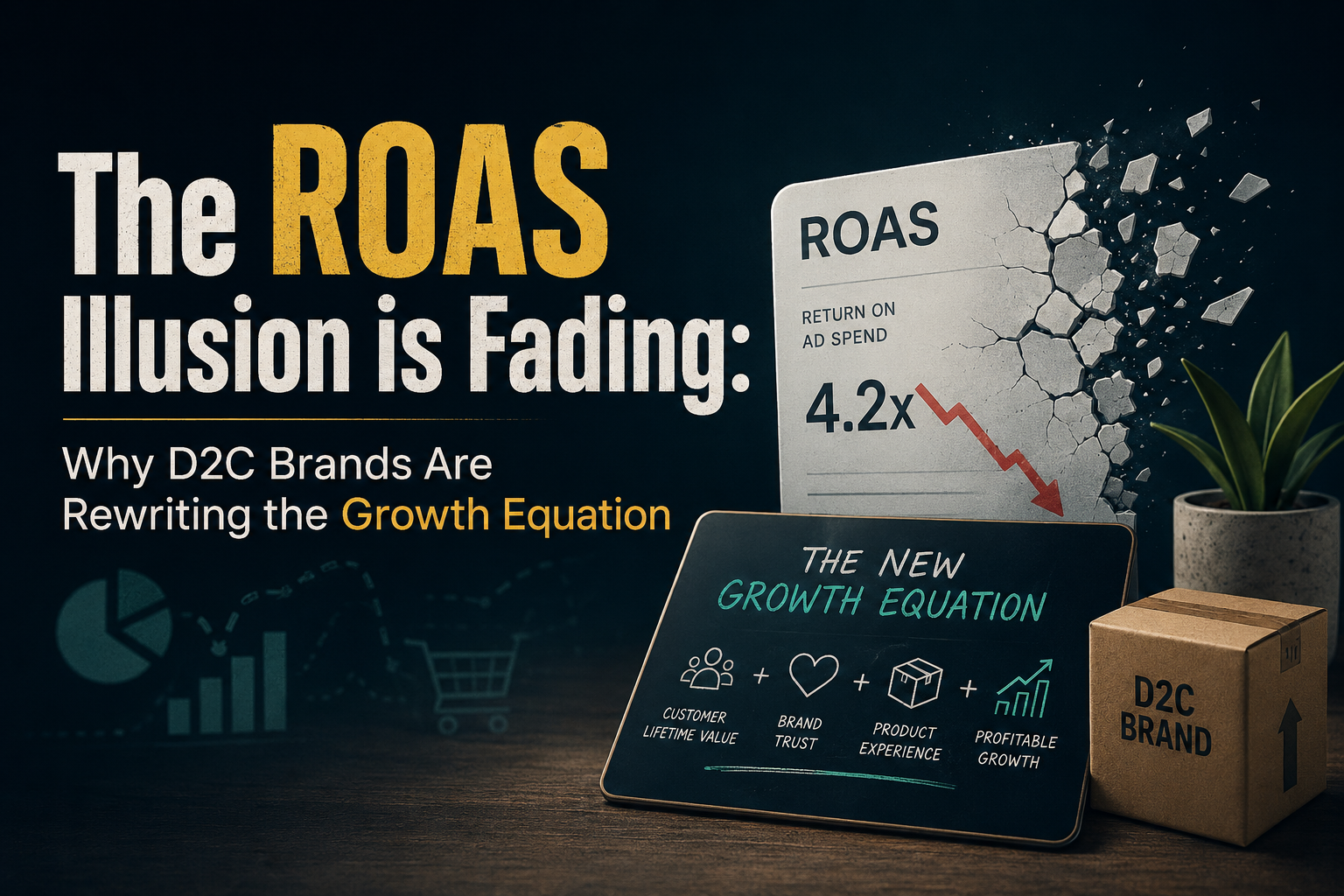
For years, ROAS was the number that could make a D2C marketing dashboard look healthy. A campaign delivering 3x or 4x returns appeared to justify higher budgets, more acquisition, and faster scale. But as customer acquisition costs rise and competition for digital attention becomes fiercer, that familiar equation is starting to lose its shine.
A strong ROAS may show that an ad is driving sales, but it does not necessarily show whether those sales are creating a healthy business. (Source: exchange4media)
Indian D2C brands are therefore beginning to ask a more consequential question: not just how much revenue did marketing generate, but how much of that revenue actually contributes to sustainable profit? The shift signals a larger change in how growth itself is being measured, with brands looking beyond short-term campaign returns towards the economics of acquiring, retaining and growing the value of each customer.
When a Good ROAS Can Still Hide a Bad Business
The problem is not that ROAS is a useless metric. It is that ROAS measures only one part of the business equation: the revenue generated against advertising spend. It does not account for costs such as product margins, shipping, returns, payment processing, discounts or other variable expenses. A campaign can therefore deliver an impressive platform-level ROAS while contributing very little to the company’s actual profitability.
That distinction becomes particularly important when acquisition costs rise. Recent D2C industry research points to a broader shift away from paid-acquisition-led growth towards unit economics, retention and sustainable scale.
A 2026 industry report, for instance, estimates that customer acquisition costs have risen 32% since 2024, reinforcing why brands can no longer treat every incremental sale as automatically valuable. (Source: PracticeiNext)
The consequence is a change in the role of marketing itself. Instead of treating the marketing team as a function responsible primarily for generating orders, brands are increasingly evaluating whether marketing is acquiring profitable customers.
The New Question: What Is the Customer Worth?
This is where metrics such as contribution margin, blended CAC, CAC payback and customer lifetime value (LTV) become more meaningful.
Contribution margin asks what remains after the variable costs associated with fulfilling an order. CAC shows how much it costs to acquire a customer, while CAC payback looks at how quickly that investment can be recovered. LTV then extends the calculation beyond the first transaction to understand the value a customer can generate over the relationship.
The shift is significant because the cheapest customer is not necessarily the most valuable one. A customer acquired at a higher CAC who purchases repeatedly can ultimately be far more profitable than one acquired cheaply but never heard from again.
This changes how marketing budgets should be interpreted. Acquisition is no longer simply an expense to minimise; it can be an investment whose return unfolds over several transactions.
The Second Purchase Is Becoming More Important Than the First
For categories such as skincare, wellness, food, and fragrance, the first purchase can be the beginning rather than the end of the customer journey. The economics become more attractive when customers reorder, experiment with another product, or move into a higher-value category.
Fixderma, for instance, is looking beyond immediate conversions towards contribution margins, repeat behaviour, CAC payback and lifetime value. Provogue is considering cross-category purchases across luggage, backpacks, and travel accessories because long replacement cycles make repeat purchases of the same product an incomplete measure of customer value.
The implication for marketers is broader than simply introducing a loyalty programme. The entire post-purchase journey becomes part of the growth strategy: personalised recommendations, relevant cross-sells, bundles, clienteling, CRM and communication designed around actual customer needs.
From Buying Traffic to Building Demand
The shift becomes even more important in categories where the purchase journey is longer and more relationship-driven.
Fine jewellery, for instance, involves multiple consumer touchpoints and a longer consideration period, making the quality of the customer and the strength of the relationship more important than the immediate revenue from a campaign. This suggests that brands need to evaluate marketing not just by what happens at the point of conversion, but by the value that relationship can create over time. (Source: exchange4media)
This is why retention, organic content, communities, referrals, and stronger brand preference are becoming increasingly important. India’s D2C ecosystem is also becoming more omnichannel, with offline retail and quick commerce emerging alongside marketplaces and owned digital channels. That broader distribution can improve visibility and conversion while reducing dependence on a single paid-acquisition engine.
The marketing question is therefore moving upstream. Instead of asking which ad platform delivers the highest ROAS, the more useful question is which combination of brand, product, channel, and customer experience creates the strongest economic engine?
ROAS Is Not Dead. The ROAS-Only Mindset Is.
The industry’s shift should not be interpreted as the death of ROAS. It remains useful for campaign optimisation and understanding channel performance. The mistake is allowing a platform metric to become a proxy for business profitability.
The more mature approach is to connect ROAS with the metrics that explain what happens after the click and after the first purchase: contribution margin, blended CAC, payback period, retention, and LTV.
That is ultimately the larger transition underway in D2C. The next phase of growth will not belong simply to brands that can acquire customers at scale. It will belong to brands that understand which customers are worth acquiring, how quickly they recover the cost of acquisition, and what the business does to keep them valuable over time.
In an environment where attention is becoming more expensive, sustainable growth may depend less on squeezing another decimal point out of ROAS and more on building a business where every acquired customer has a reason to stay.