

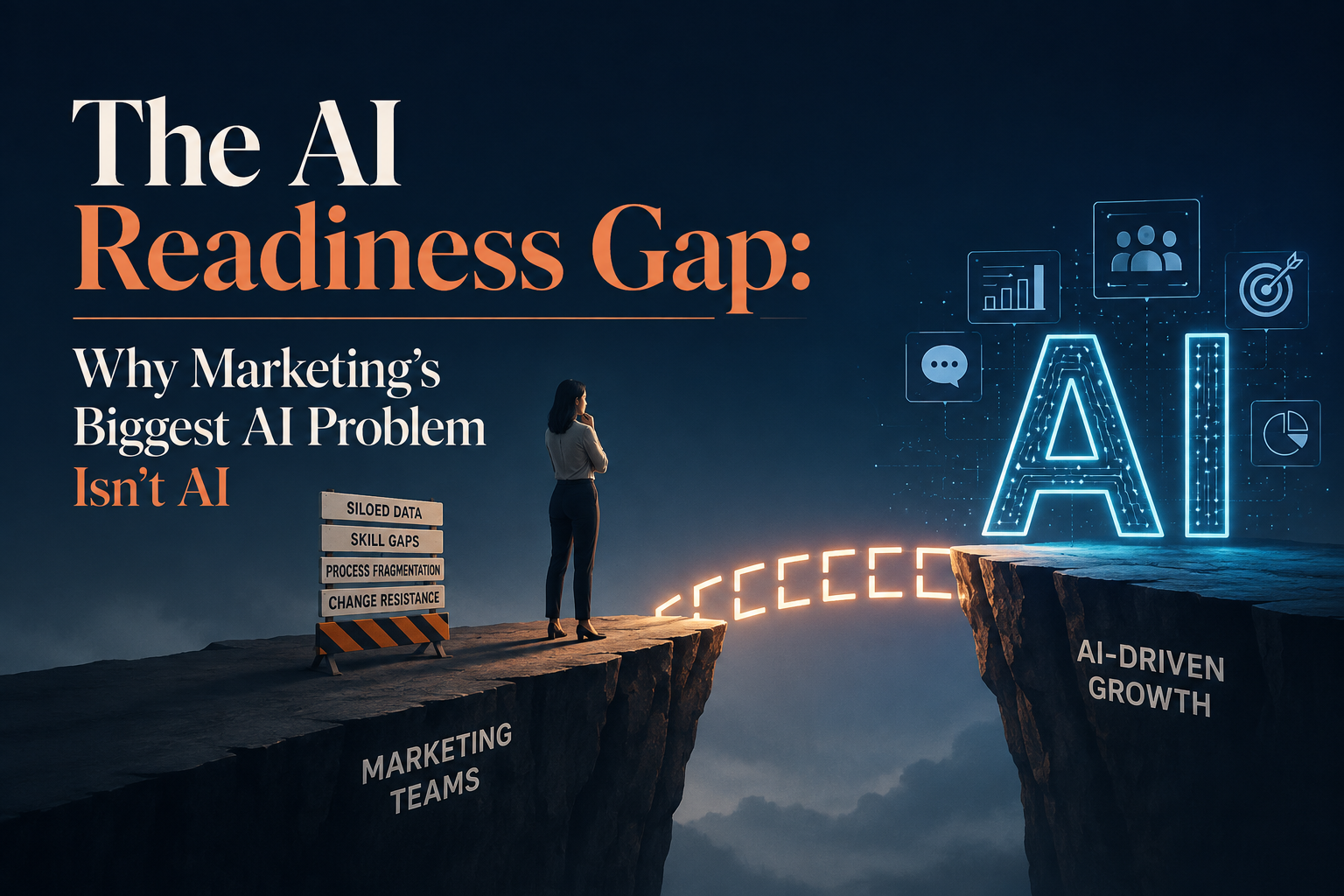
For the modern Chief Marketing Officer, artificial intelligence has moved from an experiment to a budget priority. The pressure is no longer simply to understand what AI can do, but to demonstrate why the organisation should be investing in it at all. That creates an uncomfortable contradiction. Gartner’s 2026 CMO Spend Survey found that marketing budgets remain constrained at 7.8% of company revenue, even as CMOs are allocating 15.3% of their marketing budgets to AI. At the same time, only 30% of CMOs say their organisations are ready to scale AI capabilities. (Source: Gartner)
The numbers point to a problem that is bigger than AI adoption. Companies are investing in AI faster than they are preparing the organisations that AI is expected to transform. That distinction is becoming increasingly important as marketing moves into the next phase of AI adoption. The first wave was largely about assistance: generating copy, summarising research, analysing information, and speeding up repetitive tasks. The next wave is about action.
Salesforce’s latest agentic marketing push illustrates that shift. Its platform brings together AI agents designed to build pipeline, create content, orchestrate campaigns, and optimise customer experiences, orchestrate campaigns, and optimise customer experiences, with agents working across shared customer and business context rather than operating as isolated assistants. (Source: Futurum)
That changes the infrastructure requirement entirely. An AI assistant can work with a narrow prompt and limited context. An AI agent expected to act on behalf of a business needs to understand the customer, access relevant data, interact with multiple systems, follow organisational rules, and know when it should stop and involve a human. The more autonomous AI becomes, the less forgiving it becomes of organisational dysfunction.
The Real AI Bottleneck Sits Underneath the Technology
For years, businesses have treated MarTech expansion as a proxy for marketing sophistication. The logic is understandable. A new platform promises better personalisation. A new analytics system promises greater visibility. Another automation layer promises efficiency. A customer data platform promises a more complete view of the consumer.
But technology accumulation and organisational maturity are not the same thing. AI is now arriving on top of an operational debt that marketing organisations have been accumulating for years: more systems, more integrations, more data, but not necessarily more coherence. Many marketing organisations now operate across CRM platforms, advertising systems, analytics tools, commerce infrastructure, customer service platforms, and communication channels. Each system may work perfectly well in isolation while the overall ecosystem remains fragmented.
Customer information can be duplicated across platforms. Different teams can operate from different versions of the same customer record. Campaign data may remain disconnected from commercial outcomes.
Adding AI to that environment does not automatically create intelligence. It can simply create a more sophisticated interface over an unsophisticated system. That is why the AI conversation needs to move beyond which model or platform a company should buy. The more important question is whether the organisation has built an environment in which those technologies can actually operate. AI is not creating every organisational problem. It is making the cost of those problems harder to ignore.
AI Does Not Fix Broken Processes. It Reveals Them.
There is a persistent assumption that automation naturally produces efficiency. It doesn’t. Automation makes a process faster. Whether that process is worth accelerating is a separate question. Consider a campaign workflow that requires multiple approvals because responsibilities are unclear. AI may dramatically reduce the time required to create the campaign assets, but it does not resolve the underlying decision-making structure.
The same applies to customer journeys. If a customer is treated differently across channels because the organisation lacks a unified view of that individual, personalisation technology can only go so far. It may make each interaction more sophisticated while leaving the overall experience fragmented. This creates an important distinction between automating work and redesigning work.
The first can produce immediate productivity gains. The second requires an organisation to reconsider how decisions are made, who owns them, how information moves, and where technology should intervene. Agentic AI makes that distinction particularly important because these systems are increasingly designed not just to assist employees but to execute against defined objectives.
If the objective is unclear, the agent can optimise towards the wrong outcome. If the data is unreliable, it can lead to decisions based on a flawed picture. If the process is poorly designed, it can simply execute that process at greater speed. AI therefore acts as something of an organisational mirror. The better the underlying system, the more valuable its autonomy can become. The more fragmented the system, the more visible its weaknesses become.
The Hidden Cost isn’t the AI Licence
The business case for AI is often framed around the cost of the technology versus the productivity it promises. That calculation is incomplete. The harder costs can sit underneath the purchase: integrating systems, restructuring data, redesigning workflows, training teams, establishing governance, and determining where human oversight remains necessary. None of this is particularly glamorous. It does not make for impressive product demonstrations. Yet these are the foundations that determine whether an AI investment becomes embedded in the organisation or remains another layer in an already crowded technology stack.
This is where the conversation about AI ROI needs to mature. The relevant question is not simply: “How much productivity can this tool create?” It is: “What does the organisation need to change before that productivity can actually be realised?”
As AI moves towards greater autonomy, that scrutiny is likely to increase. Businesses will increasingly expect AI investments to demonstrate measurable business outcomes rather than simply promise productivity gains.
That is a fundamentally different investment question. It also explains why two companies can purchase similar AI capabilities and achieve very different outcomes. The difference may have little to do with the underlying model. It can come down to the quality of their data, the maturity of their processes, and the ability of their teams and systems to work together.
Readiness Should Become a Business Discipline
None of this means companies should wait for perfect infrastructure before adopting AI. That would be equally counterproductive. The better approach is to make AI readiness an explicit part of the business strategy. Before scaling an AI use case, leaders need to establish what problem they are solving. “Using AI” is not an objective. Improving conversion, reducing campaign production time, increasing retention, or making customer engagement more relevant are objectives.
From there, the organisation needs to examine the foundations behind that use case. Is the required data reliable? Can the relevant systems communicate? Who owns the decision? What happens when the AI gets it wrong? Which actions can be automated and which require human approval? And, most importantly, can the outcome be connected to a meaningful business result? These questions may sound less exciting than choosing an AI platform. They are also much more consequential.
The companies that scale AI successfully will not necessarily be the ones that experiment the fastest. They will be the ones who understand where autonomy creates genuine value and where human judgement, process redesign, or better infrastructure still needs to come first.
The Next Competitive Advantage May Not Be Another AI Tool
The AI race is often presented as a competition between technology companies, models, and platforms. For business leaders, that is only one layer of the story. The more important competition may eventually be between organisations that can operationalise intelligence and those that can only purchase intelligence. That distinction will become increasingly visible as AI moves closer to execution.
When AI is simply generating content, an organisation can tolerate a surprising amount of fragmentation behind the scenes. When AI begins deciding which customer should receive an offer, which campaign should be adjusted, which audience should be prioritised, or which action should happen next, the quality of the underlying organisation becomes much harder to hide. That is why the next stage of AI adoption should not be viewed simply as another MarTech upgrade.
It is a test of organisational design. The winners will not necessarily be the businesses with the largest AI budgets, the most agents, or the longest list of AI-powered tools. They will be the organisations that have done the less visible work of connecting their data, simplifying their processes, clarifying accountability, and creating the conditions in which machines can act without creating more complexity than they remove.
AI may be the technology transformation of this decade. But the organisations capable of capturing its value will be shaped by something more fundamental: how well they are built to use it.