

For the past few years, the conversation around artificial intelligence has largely been driven by one question: How powerful can AI become?
Each new model has promised greater reasoning capabilities, faster responses and more sophisticated problem-solving. Organisations have raced to adopt AI, while technology companies have competed to build increasingly capable systems.
But two recent perspectives from Google DeepMind CEO Demis Hassabis and Microsoft CEO Satya Nadella suggest the conversation is beginning to shift.
The next chapter of AI will not be defined solely by who builds the smartest models. It will increasingly be shaped by who governs them responsibly, who owns the knowledge they generate, and who earns the trust of businesses and society in the process.
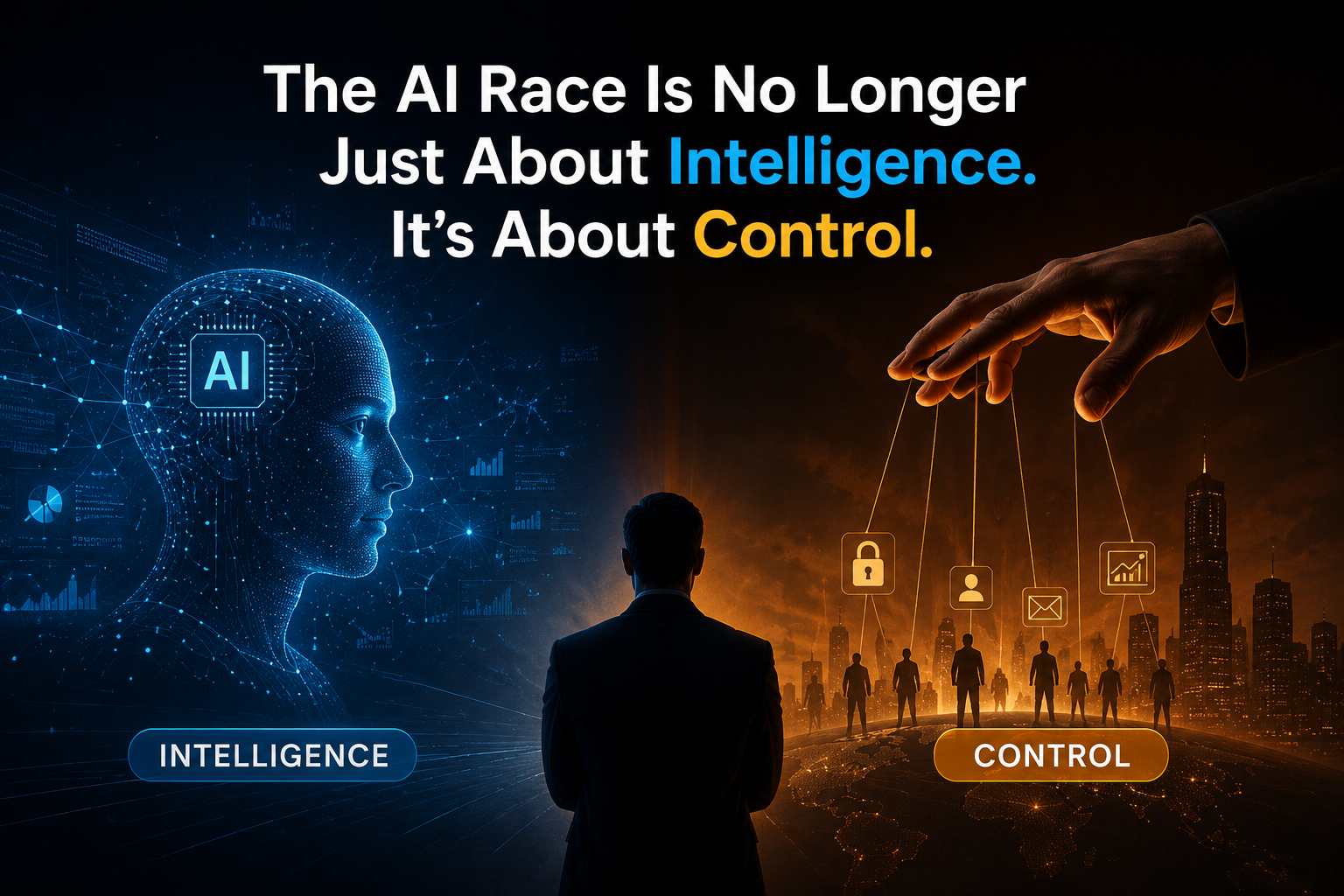
In many ways, the AI race is no longer just about intelligence. It is about control.
As AGI Moves Closer, the Stakes Are Rising
Few people are better positioned to comment on the future of AI than Demis Hassabis.
The Nobel Prize-winning CEO of Google DeepMind recently reiterated his belief that Artificial General Intelligence (AGI)—AI capable of matching or surpassing human abilities across virtually every cognitive task—could arrive within the next few years.
For Hassabis, however, the bigger story isn’t the timeline. It’s the preparation.
He argues that society remains overly focused on the competitive race to develop increasingly capable AI systems while giving far less attention to the safeguards needed to manage them. As frontier models continue to advance, concerns ranging from cybersecurity to biological risks and autonomous decision-making are becoming increasingly difficult to ignore.
His proposal is ambitious: a global AI watchdog, initially led by the United States and modelled on financial regulators, that would establish safety standards for frontier AI before the most advanced systems are released.
Whether such a framework eventually materialises remains uncertain. But the proposal reflects a broader reality.
The conversation around AI is beginning to move beyond capability and towards governance.
Building increasingly intelligent systems is no longer the only challenge. Ensuring they remain safe, accountable and aligned with human interests may prove equally important. (Source: NDTV)
While Governments Debate Safety, Businesses Face a Different AI Challenge
The governance debate is unfolding at a global level.
Inside organisations, however, a quieter but equally significant issue is emerging.
Microsoft CEO Satya Nadella recently argued that businesses are often paying for AI in ways they don’t fully recognise.
The financial cost of accessing AI models is obvious. Less obvious is the knowledge organisations contribute every time employees interact with those systems.
Every prompt, correction, workflow and refinement gradually teaches AI how an organisation operates. Over time, those interactions capture institutional expertise that businesses have spent years developing.
Nadella describes this as a “reverse information paradox.”
Historically, buyers worried about revealing too little information before making a purchase. In the AI era, organisations increasingly face the opposite concern: revealing too much simply to make the technology useful.
The more context businesses provide, the more effective AI becomes. But that same process also raises important questions about ownership, competitive advantage and long-term control over institutional knowledge.
For many organisations, the challenge is no longer whether to adopt AI. It is how to benefit from it without gradually giving away one of their most valuable assets. (Source: The Indian Express)
Intelligence Is Becoming Easier to Access. Knowledge Is Becoming More Valuable.
At first glance, Hassabis’ concerns about AGI and Nadella’s warnings about enterprise AI appear to address different issues.
In reality, they point towards the same underlying shift.
As AI models become increasingly accessible, intelligence itself is beginning to commoditise.
The competitive advantage will no longer come solely from using AI. It will come from everything surrounding it.
That includes proprietary data, institutional knowledge, customer relationships, governance frameworks, and the ability to deploy AI responsibly within specific business contexts.
An organisation’s internal expertise, accumulated through years of customer interactions, operational decisions and specialised workflows, is becoming increasingly valuable precisely because generic AI models cannot easily replicate it.
This helps explain why businesses are investing heavily in first-party data, enterprise knowledge management and AI governance alongside the technology itself.
The model may be available to everyone.
The knowledge that powers it is not.
Trust Is Emerging as AI’s New Competitive Advantage
Trust has always mattered in technology.
In the AI era, it may become the defining differentiator.
Hassabis argues that advanced AI systems require stronger external oversight before they become deeply embedded across society. Nadella, meanwhile, believes organisations need clearer boundaries that allow them to benefit from AI without surrendering ownership of the knowledge they generate.
Although their concerns operate at different levels—one societal, the other organisational—they converge around the same principle.
Powerful AI systems require equally powerful mechanisms for trust.
For governments, that means developing regulatory frameworks capable of evolving alongside increasingly capable AI.
For technology providers, it means building transparent systems that give customers greater visibility into how their data and institutional knowledge are used.
For businesses, it means ensuring AI adoption strengthens long-term competitive advantage rather than gradually eroding it.
As AI becomes more deeply integrated into everyday decision-making, trust will no longer be a compliance exercise. It will become a strategic capability. (Source: Times Now)
The Next AI Race Will Be About More Than Models
The first phase of the AI revolution rewarded organisations that built larger models, achieved higher benchmark scores and accelerated technological breakthroughs.
The next phase appears likely to reward something different.
The organisations that succeed will be those that can combine technological capability with responsible governance, protect the knowledge they create, and build systems that people are willing to trust.
Intelligence alone will not determine leadership.
Control over knowledge will matter.
Governance will matter.
Transparency will matter.
Trust will matter.
The future of AI will undoubtedly be shaped by increasingly powerful models. But their long-term impact will depend far less on what they can do than on how responsibly they are developed, how securely they are deployed, and how effectively organisations retain ownership of the knowledge that gives those systems their value.
The AI race is entering a new chapter.
It is no longer simply a race to build the smartest machines. It is becoming a race to build the strongest foundations around them.