

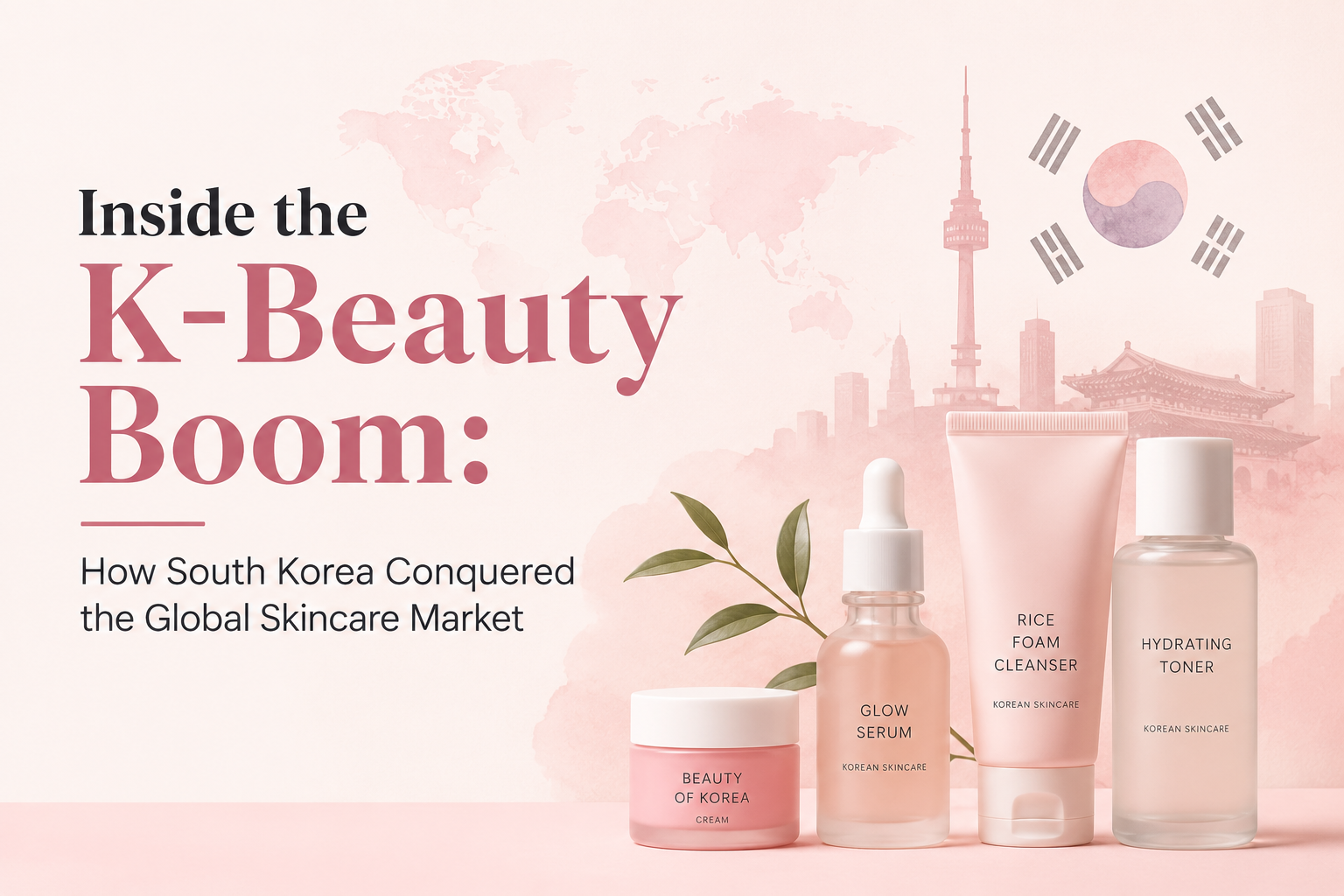
The global beauty industry has become increasingly borderless. Consumers today are more willing than ever to embrace products, routines, and trends originating far beyond their home markets, creating opportunities for countries to transform cultural influence into commercial success. Few nations have capitalised on this shift as effectively as South Korea, whose beauty industry has evolved from a regional phenomenon into a global powerhouse.
What was once a niche obsession among skincare enthusiasts has become one of the most consequential commercial forces in the global beauty industry. Valued at USD 11.9 billion in 2026, the K-beauty products market is projected to reach USD 38.29 billion by 2033, expanding at a compound annual growth rate of 11.3%. (Source: Future Market Insights) Those figures are not merely the story of lipsticks and serums crossing borders; they represent the monetization of an entire national identity. Understanding how that happened requires looking beyond beauty products themselves. The engine behind this expansion is cultural. (Source: Marketing Data Forecast)
The Korean Wave, or Hallyu, has carried K-pop acts, K-dramas, and Korean cinema into living rooms from Jakarta to São Paulo, converting audiences into consumers. As the BBC has reported, K-pop and K-dramas have become global phenomena that function simultaneously as entertainment and as soft-power commerce. (Source: BBC) The connection between cultural influence and purchasing behavior is direct and measurable: a study published in the UPNYK Journal found that 87% of Gen Z respondents said they began using K-beauty products after exposure to K-pop idols or Korean actors. Culture, in this case, is the distribution channel. (Source: UPNYK Journal)
What sustains the market beyond cultural novelty is a genuine philosophy of skincare innovation. Korean beauty brands pioneered multi-step routines, fermented ingredient formulations, and the ideal of “glass skin”, a translucent, deeply hydrated complexion that has reshaped global aesthetic standards. Far from being marketing trends, they reflect a domestic consumer culture that has long demanded rigorous product development, pushing brands toward multi-functional formulas and ingredient transparency decades before Western markets caught on. The result is a product ecosystem that earns loyalty on efficacy, not just aspiration.
The export numbers confirm the magnitude of this achievement. South Korea’s cosmetics exports reached a record USD 11.4 billion in 2025, growing 11.8% year-on-year and generating a trade surplus exceeding USD 10 billion for the first time. That performance elevated South Korea past the United States to become the world’s second-largest cosmetics exporter behind France, a country that had defined prestige beauty for over a century, as reported by BeautyMatter. (Source: Beauty Matter)
Skincare dominated the export mix, accounting for nearly 75% of total shipments at USD 8.54 billion, while body cleansing products surged 27.3% and fragrances grew 46.2% year-on-year. The strength of South Korea’s leading beauty companies reflects this broader momentum. Amorepacific Group recorded sales of KRW 4.26 trillion in 2024 before growing to KRW 4.62 trillion in 2025, its highest operating profit in six years. Overseas revenue rose 15%, international profitability doubled year-on-year, and the Americas overtook Greater China as the company’s largest international market, while revenue in Europe, the Middle East, and Africa increased 42%. Together, these figures illustrate how K-beauty’s growth is no longer concentrated in Asia but increasingly diversified across global markets. (Source: Amore Pacific, Personal Care Insights)
Among the emerging frontiers, India stands out for its long-term growth potential. The country records a 7.4% CAGR in K-beauty adoption, driven by young consumers responding to K-culture and influencer-led discovery. India’s per-capita K-beauty spending currently sits at USD 3.79 in 2024, a fraction of South Korea’s USD 193.38, a gap that signals enormous latent demand rather than disinterest. (Source: Future Market Insights) Social media analysis shows over 6.20 million posts in the past two years discussing K-drama, K-pop, and K-beauty trends in India, predominantly among users aged 19–24. (Source: Mintel) Crucially, 30% of Indian Gen Z consumers believe there should be more affordable K-beauty options, and platforms like Nykaa and Flipkart have responded by launching dedicated K-beauty sections. (Source: NMSC)
Brands are already positioning themselves to capture this opportunity. In early 2026, K-beauty tech company APR Corporation officially launched its Medicube brand in India through a strategic partnership with Nykaa, the country’s leading beauty platform, and Tira, making its products available both online and in select retail stores across the country, according to Global Cosmetics News. (Source: Global Cosmetics News)
Amorepacific is similarly deepening its India presence, introducing its dermocosmetic brand Illiyoon to Indian consumers through the same platform. (Source: Passionate in Marketing) These expansion efforts are being supported by a distribution ecosystem that has spent years cultivating demand for Korean beauty products. The Wire reports that Nykaa has spent over a decade building India’s largest Korean beauty ecosystem, spanning a dedicated Korean Beauty Store online and more than 280 retail stores pan-India, positioning the country not just as a consumer market but as a key growth engine for K-beauty’s next phase of global expansion. (Source: The Wire)
None of this brand-level momentum, however, emerged in isolation. Behind K-beauty’s global rise sits a deliberate state strategy that is still actively being executed. In April 2025, the Ministry of SMEs and Startups officially launched the K-Beauty Fund at a ceremony attended by over 400 beauty SMEs and startups, a KRW 40 billion public-private venture fund, the country’s first of its kind in beauty, co-invested by the government, COSMAX, and Kolmar Korea. By 2024, Korean cosmetics had already become the first single SME export item to exceed USD 6 billion, reaching USD 6.8 billion and cementing its status as the leading export item among South Korean SMEs. (Source: MSS)
Private capital has followed the state’s lead with equal conviction: South Korea saw 18 deals in personal care assets worth 2.3 trillion won (USD 1.6 billion), including Goodai Global’s acquisition of Seorin for USD 432 million and Morgan Stanley Private Equity’s purchase of K-beauty brand Skinidea for 100 billion won (USD 75 million), a level of investor activity that reflects not speculative enthusiasm but structural confidence in the industry’s long-term trajectory. (Source: GCI Magazine)
The global retail establishment has validated this trajectory in the most concrete terms possible. In January 2026, Sephora, operating approximately 3,400 stores across 35 countries, announced a landmark omnichannel partnership with CJ Olive Young, South Korea’s leading beauty retailer with over 1,390 stores, to create a dedicated Korean beauty destination across its global store network and digital platforms. The rollout begins across the US, Canada, Singapore, Malaysia, Thailand, and Hong Kong in autumn 2026, with further expansion into the Middle East, UK, and Australia in 2027. The move is particularly notable given that Sephora first introduced K-beauty to North American consumers as early as 2010. (Source: Premium Beauty News) “The present landscape of K-beauty in retail is just beginning,” said Sarah Chung Park, founder and CEO of K-Beauty World, in an interview with Vogue. “Anticipate both established and emerging retailers making significant investments to position K-beauty as a key growth focus.” (Source: Vogue)
The observation reflects a broader reality: what began as a cultural export has become a structural fixture of global beauty, one built on the convergence of soft power, ingredient science, institutional engineering, and a domestic consumer culture that refused to settle for anything less than results. South Korea did not merely create successful beauty brands; it built an ecosystem where culture, policy, innovation, and commerce reinforce one another, turning K-beauty from a trend into one of the defining forces in the global skincare industry. In doing so, it achieved something few countries have managed: transforming a domestic beauty philosophy into a global commercial empire.