

India’s toy industry is entering a new chapter. Traditional craft communities, established manufacturers, and emerging brands are contributing to a market increasingly shaped by product design, quality, educational play, and global demand. The opportunity is no longer limited to making toys for Indian households. Indian businesses are beginning to explore how products rooted in local creativity can find a place in international markets.
But this shift is about more than replacing imported toys with locally manufactured ones. For Indian toy brands to build a lasting presence overseas, manufacturing strength must be matched by original ideas, consistent quality, and a clear understanding of what consumers in different markets want.
The broader lesson for businesses is simple: a growing market creates an opportunity, but only strong products and strong brands can sustain it.
India’s Toy Story Has Deep Roots
Toy-making in India is not a recent phenomenon. Archaeological discoveries associated with the Indus Valley Civilisation include terracotta figurines, wheeled carts, and animal-shaped objects found at sites such as Chanhiyun Jo Daro and Nausharo. Over generations, regional communities developed their own toy-making traditions using materials such as wood, clay, fabric, and natural colours.
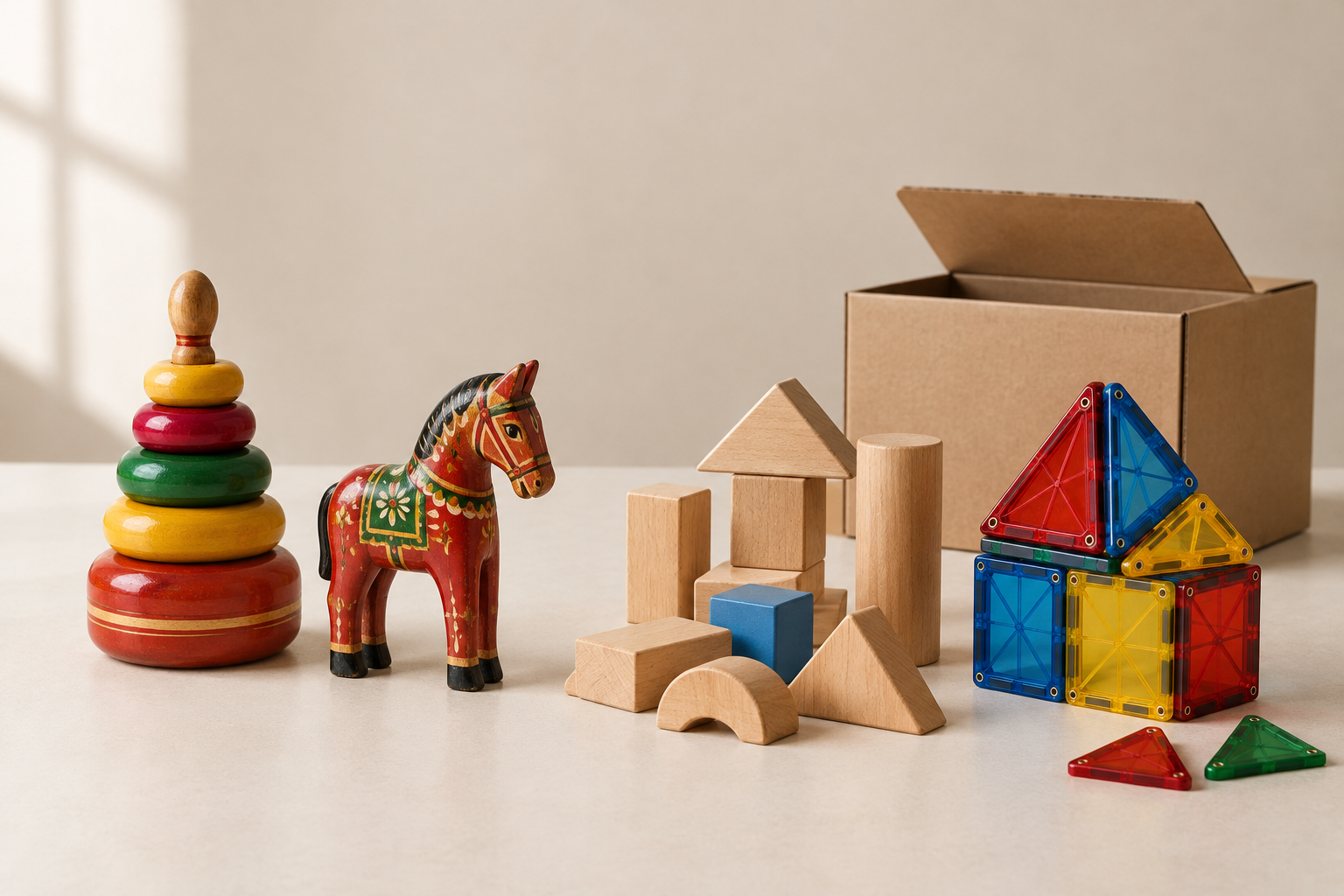
Those traditions remain visible in India’s regional toy clusters. Channapatna toys from Karnataka are known for their colourful wooden forms, while Kondapalli toys from Andhra Pradesh feature carved figures depicting people, animals and everyday life. Other regional traditions draw from local folklore, religious stories, festivals, and community customs.
These toys are more than cultural souvenirs. They represent generations of knowledge about materials, craftsmanship, design, and storytelling. They also support artisans and small businesses whose livelihoods are often connected to these traditions. However, cultural value alone does not guarantee commercial success.
Traditional toy makers can struggle with limited market access, small production capacities, changing consumer preferences, and competition from inexpensive mass-produced products. For these businesses to remain commercially viable, traditional craftsmanship needs to be connected with modern packaging, distribution, product development, and consumer awareness.
This is an important lesson for businesses built around heritage: preserving a tradition does not mean keeping the business model unchanged.
From Traditional Craft To Modern Toy Businesses
India’s toy sector has changed alongside its manufacturing and retail landscape. Handmade wooden and metal toys have increasingly been joined by plastic products, moulded components, branded ranges, and organised manufacturing. Retail expansion and e-commerce have also changed how consumers discover and buy toys. The result is a much broader market.
Traditional wooden toys now exist alongside puzzles, construction sets, board games, educational kits, plush toys, electronic products, and activity-based play systems. Some products draw from India’s cultural heritage, while others respond to growing interest in science, design, technology, creativity and hands-on learning.
Established manufacturers have helped build organised production and distribution, while newer brands have identified specific customer groups and categories. Companies such as Funskool, Shumee, and Skillmatics reflect the range of approaches emerging in India’s toy market, from established manufacturing to learning-focused and activity-based play. This diversity matters because there is no single formula for building an Indian toy brand.
One business may compete through regional craftsmanship. Another may focus on educational concepts, product design, or character-led play. Yet another may build its advantage through manufacturing expertise. The common challenge is turning a good product idea into a dependable brand that consumers can recognise and trust.
For marketers and business leaders, this is where the toy industry offers a broader lesson: a product may create the first purchase, but consistency and a clear identity are what help build a brand.
Also Read: Building a Niche Business: What It Takes to Create a Market for an Unfamiliar Idea – TrustCircle
India’s Toy Industry Is Moving Towards Global Markets
Recent trade figures indicate that India’s position in the global toy trade is strengthening. According to a July 2026 release from the Press Information Bureau, India’s exports across toy-related HS codes 9503, 9504 and 9505 increased from US$203.5 million in FY 2018–19 to US$384.7 million in FY 2025–26, an increase of 89.1%. Imports across the same categories declined from US 371.7 million to US 232.3 million during the period. (Source: Press Information Bureau)
These categories include conventional toys as well as certain games, recreational products, and festive or entertainment articles. They should therefore be viewed as a broader indicator of trade rather than a measure of children’s toys alone. Even so, the figures point to a meaningful change in India’s position as a producer and exporter. The United States has emerged as an important destination for Indian toy exports, alongside markets such as the United Kingdom, the Netherlands, and Germany.
But entering these markets brings a different set of expectations. International buyers expect consistent products, reliable delivery, suitable packaging, safety compliance, and responsive after-sales support. A product that performs well in the domestic market cannot simply be placed in an international catalogue and expected to succeed.
Export growth is a starting point, not the final measure of global competitiveness. The stronger test is whether Indian businesses can secure repeat orders, build long-term relationships with distributors, and remain commercially viable after accounting for logistics, certification, marketing, and other costs.
Quality Is Becoming A Business Advantage
For toy brands, quality is not simply a manufacturing concern. It directly affects consumer trust and access to markets. India introduced a Quality Control Order for toys in 2020, which came into effect in January 2021. The framework links applicable toy products to prescribed Indian safety standards and BIS certification requirements, with certain exemptions. (Source: TUV)
A 2026 government release reported that a Bureau of Indian Standards survey found 95% of sampled toys conforming to prescribed quality standards in 2025, compared with 33% in a 2019 exercise. While the survey does not represent every toy available in the market, the improvement points to the changing quality environment in the sector. (Source: DPIIT)
For manufacturers looking beyond India, the larger lesson is clear. Quality cannot be treated as a final inspection before a product reaches the market. It needs to be considered from the beginning, across product design, materials, manufacturing, testing, and documentation. This can be difficult for smaller businesses. Testing facilities, technical expertise, tooling, and the cost of meeting different countries’ requirements can create barriers to expansion.
That makes compliance more than a regulatory responsibility. For a growing brand, the ability to consistently meet quality and safety requirements can become part of its competitive advantage.
The Next Opportunity Lies In The Product Idea
The next phase of India’s toy industry will not be defined by manufacturing volume alone. It will also depend on the ideas behind the products. Parents are increasingly presented with toys built around creativity, problem-solving, construction, science, and hands-on exploration. This gives Indian brands an opportunity to respond to changing family needs while creating distinctive play experiences.
In the magnetic-building and creative-construction category, for example, Circus9 represents a newer generation of Indian toy labels exploring how children can build, experiment and imagine through play. This shift also raises a larger question: what makes a toy valuable?
A toy does not need to be electronic or technologically complex to create a meaningful experience. Building toys, puzzles, craft activities and traditional games can encourage children to experiment, make decisions and find different ways to play. The opportunity for brands is therefore not simply to attach an educational label to a product. It is to understand what the product actually enables children to do and communicate that value honestly.
Innovation can take many forms. A brand can rethink a familiar toy, adapt a traditional product for contemporary homes, develop an original design, improve durability or make a product easier to discover and buy online. The important point is that innovation should solve a real consumer need rather than follow a temporary trend.
Government Support Can Build The Foundation, But Businesses Must Build The Brands
The development of India’s toy sector is also being supported by government initiatives covering manufacturing, quality, design, skills and exports. The National Action Plan for Toys brings together multiple ministries and departments around areas such as indigenous toy clusters, product design, quality monitoring and the promotion of toys as learning resources.
In its July 2026 update, the government reported support for 18 toy clusters under the Scheme of Funds for Regeneration of Traditional Industries, along with design and tooling assistance for 40 clusters through the Ministry of Textiles. Initiatives such as Toycathon have also encouraged students, designers, educators and entrepreneurs to develop toy concepts inspired by Indian culture, history and local knowledge. International trade agreements can create additional opportunities by improving market access, while trade exhibitions can help manufacturers meet buyers and distributors. The Toy Biz International Exhibition held in New Delhi in July 2026 brought together 400 Indian toy brands and 100 international buyers from 40 countries, according to the government. (Source: DD News)
These initiatives can strengthen the industry’s foundations. But they cannot replace business execution. Manufacturers still need to invest in product development, reliable sourcing, production planning, market research and export readiness. The real measure of this support will be whether more businesses are able to build sustainable operations and compete successfully over time.
What Indian Toy Brands Must Do Here
The opportunity ahead is considerable, but a durable global position requires more than competitive production costs. Several priorities will shape the next stage of growth.
1. Build A Brand, Not Just A Product
Original characters, designs, culturally informed concepts and memorable play experiences can help brands move away from generic competition. A product may be copied. A distinctive brand is harder to replace. This makes intellectual property, original design and consistent brand building important parts of long-term growth.
2. Understand The Consumer Before Entering A Market
A toy that works in India may need to be presented differently in another country. Age expectations, packaging, instructions, design preferences and play patterns can vary across markets. Research and product testing can help businesses understand these differences before they commit to international expansion. The principle is straightforward: global expansion should begin with understanding the customer, not simply identifying a country to sell in.
3. Make Compliance Part Of Product Development
Safety standards and market regulations should not be treated as paperwork handled after a product has been created. Businesses entering international markets need to understand the relevant requirements early and build testing, documentation and quality assurance into the development process. This can reduce costly problems later and create greater confidence among buyers and distributors.
4. Use Digital Channels, But Build The Business Behind Them
E-commerce, social media and digital catalogues have made it easier for smaller brands to reach customers beyond their immediate geography. But visibility alone does not create a successful business. A brand that attracts an international customer must also be able to provide accurate product information, fulfil orders reliably, respond to customers and maintain the same quality over time. Digital discovery may create demand. Operational reliability is what converts that demand into a business.
5. Give Traditional Craftsmanship A Commercial Future
For artisan-led businesses, wider access to markets can help preserve traditional skills. But that requires more than simply placing handmade products online. Design support, appropriate production tools, fair market opportunities and authentic storytelling can help traditional businesses remain relevant while protecting the character of their craft. The goal should not be to turn every traditional toy into a mass-market product. It should be to find sustainable ways for the people who make these products to benefit from growing demand.
6. Focus On Repeat Business
The first export order can demonstrate potential. Repeat orders demonstrate that a business has built something sustainable. Consistent quality, realistic product claims, dependable delivery and responsiveness to feedback are therefore as important as securing the first international buyer. For any brand entering a new market, trust is built through repeated delivery on promises.
From India’s Toy Heritage To Global Brands
India’s toy industry brings together a long history of craftsmanship, growing manufacturers and emerging brands. As the D2C boom creates new ways for businesses to reach consumers, Indian toy brands have more opportunities to build recognition beyond traditional retail channels.
The next step is to turn this opportunity into lasting growth through original products, consistent quality and a clear understanding of consumers. India’s next toy opportunity lies in building global brands that consumers can recognise, trust and return to.