


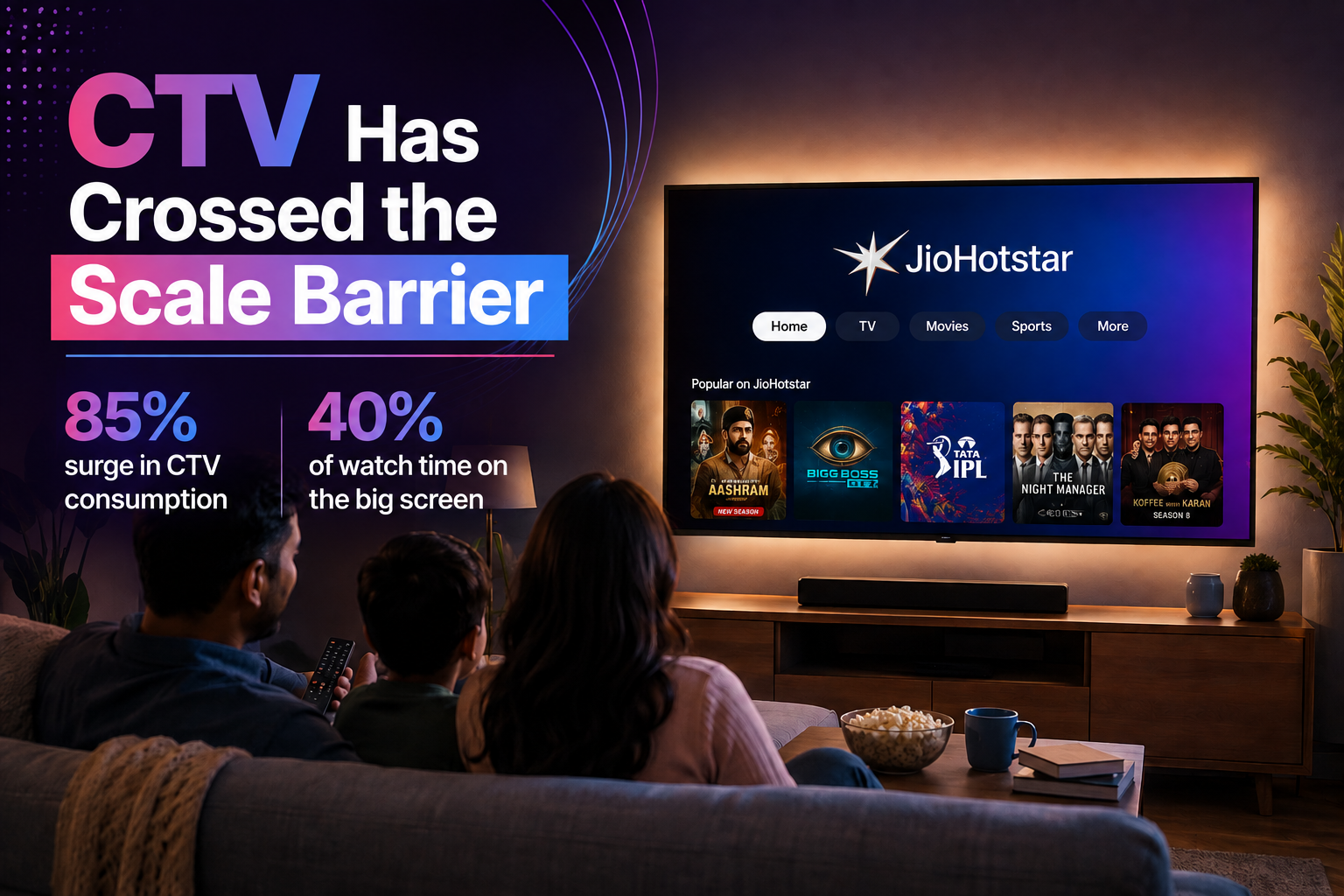
Connected TV (CTV) in India occupies an interesting position in the advertising ecosystem. It had the premium environment brands wanted, the big-screen impact television promised, and the data capabilities digital platforms offered, but its relatively limited scale kept it from becoming a central part of mainstream media planning. That equation is beginning to change. As connected devices move deeper into Indian households, CTV is no longer simply the sophisticated screen reserved for high-end branding campaigns. It is becoming a measurable, scalable gateway to affluent audiences—and JioHotstar is positioning itself at the centre of that shift.
The change is particularly significant because the value of CTV is not only about the number of people watching. It is about who is watching, how they are watching, and what happens after they see an advertisement.
JioHotstar currently reaches nearly 50 million connected TV devices across around 30 million households, giving advertisers a footprint large enough to think beyond experimental CTV budgets. The implication for marketers is clear: CTV is increasingly capable of delivering what advertisers have traditionally expected from television—scale and visibility—while bringing the targeting and measurement associated with digital media. (Source: Economic Times)
The Living Room Is Becoming a Media Advantage
The stronger business case for CTV is emerging from its growing consumption. JioHotstar’s Connected TV Playbook recorded an 85% surge in CTV consumption, with 40% of total watch time now coming from the big screen. For brands, this signals that CTV is moving beyond a niche premium format to become an increasingly important channel for reaching engaged audiences at scale. (Source: jiostar)
That combination changes the advertising proposition. A consumer watching content on a large screen is not simply another digital impression. The screen commands greater physical presence, while shared viewing can potentially expose a brand message to multiple members of a household at the same time. For categories such as automobiles, financial services, consumer electronics, premium personal care, and lifestyle products, this makes the living room particularly valuable because the audience is not only sizeable but commercially attractive.
This is where JioHotstar’s broader strategy becomes important. Rather than treating CTV as an isolated advertising product, the platform is bringing together entertainment, sports, mobile consumption, and connected television within one ecosystem. The merger of the former Disney Star and JioCinema ecosystems has given JioStar an unusually broad content and audience base, allowing advertisers to move between different viewing environments without treating each screen as a completely separate media property.
From Reach to “Right Reach”
For brands, this could mark a larger change in how media success is defined. Digital advertising has traditionally rewarded scale through impressions, clicks and performance metrics, while television has built its value around mass reach and high-impact visibility. CTV sits somewhere in between. It can provide the premium environment of television while allowing platforms to use viewing behaviour, audience signals and device-level insights for more precise targeting.
JioHotstar is explicitly leaning into this advantage. The platform says it has access to deterministic and real-time data, allowing advertisers to examine viewing behaviour at a granular level, including watch time, frequency and content consumption patterns. Its advertising platform also offers more than 1,000 pre-built audience cohorts, enabling advertisers to layer audience characteristics with content and platform targeting.
That matters because the next phase of digital advertising is unlikely to be about simply finding more consumers. It will increasingly be about finding the most commercially relevant consumers at sufficient scale.
JioHotstar Is Building More Than an Ad Slot
JioHotstar’s ambition becomes clearer when its CTV strategy is viewed alongside its wider advertising innovations. The platform is developing solutions that allow brands to occupy a larger share of the consumer’s viewing experience rather than simply appearing between pieces of content.
Launchpad, a platform-takeover proposition designed for major product and brand launches. The solution is intended to give advertisers prominent visibility across JioHotstar’s ecosystem, including CTV and mobile, for a defined period. JioStar estimates that a typical execution could reach around 50 million daily active users, generate roughly 250 million impressions, and deliver more than one lakh clicks. (Source: Economic Times)
The significance of such products goes beyond the numbers. A product launch requires attention before it requires conversion. By creating high-share-of-voice environments, JioHotstar is attempting to solve a problem that performance advertising alone cannot always address: how does a new brand, product, or proposition become difficult to ignore?
That same philosophy extends into content integrations and sponsorships. Rather than placing a standard advertisement around content, brands can become part of the content experience through customised executions. With JioHotstar spanning entertainment, sports, regional programming, and international content, such integrations allow advertisers to associate themselves with particular moments, genres, and audiences rather than buying audiences only through demographic definitions.
Why This Matters for the Next Brand Budget
The bigger business story is that CTV is no longer too niche to command a serious place in media planning. Industry data cited by Reliance Industries puts India’s CTV households at 68 million in 2025, while CTV advertising revenue grew 42% to ₹9,900 crore. The numbers point to a market that is gaining both household penetration and advertiser interest, making CTV increasingly difficult for brands to treat as merely an experimental or supplementary channel. (Source: ril)
For marketers, therefore, the question is shifting. It is no longer simply whether CTV deserves a place in the media mix. The more relevant question is what job should CTV perform within that mix?
For affluent household reach, it can provide a threshold scale. For digital-first brands, it can add the brand-building layer that performance marketing often lacks. For established advertisers, it can offer a way to secure a high share of voice around premium content and audiences. And for launches, it can create concentrated bursts of visibility across screens.
JioHotstar’s strategy reflects this broader transition. It is not attempting to sell CTV merely as a better television screen or a larger mobile screen. It is selling the combination of premium audiences, immersive attention, content context, data, and scale.
That may ultimately be the most important shift in India’s CTV story. The medium is moving beyond being a symbol of premium consumption and becoming an increasingly practical advertising infrastructure.