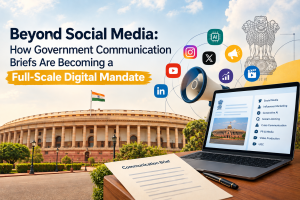


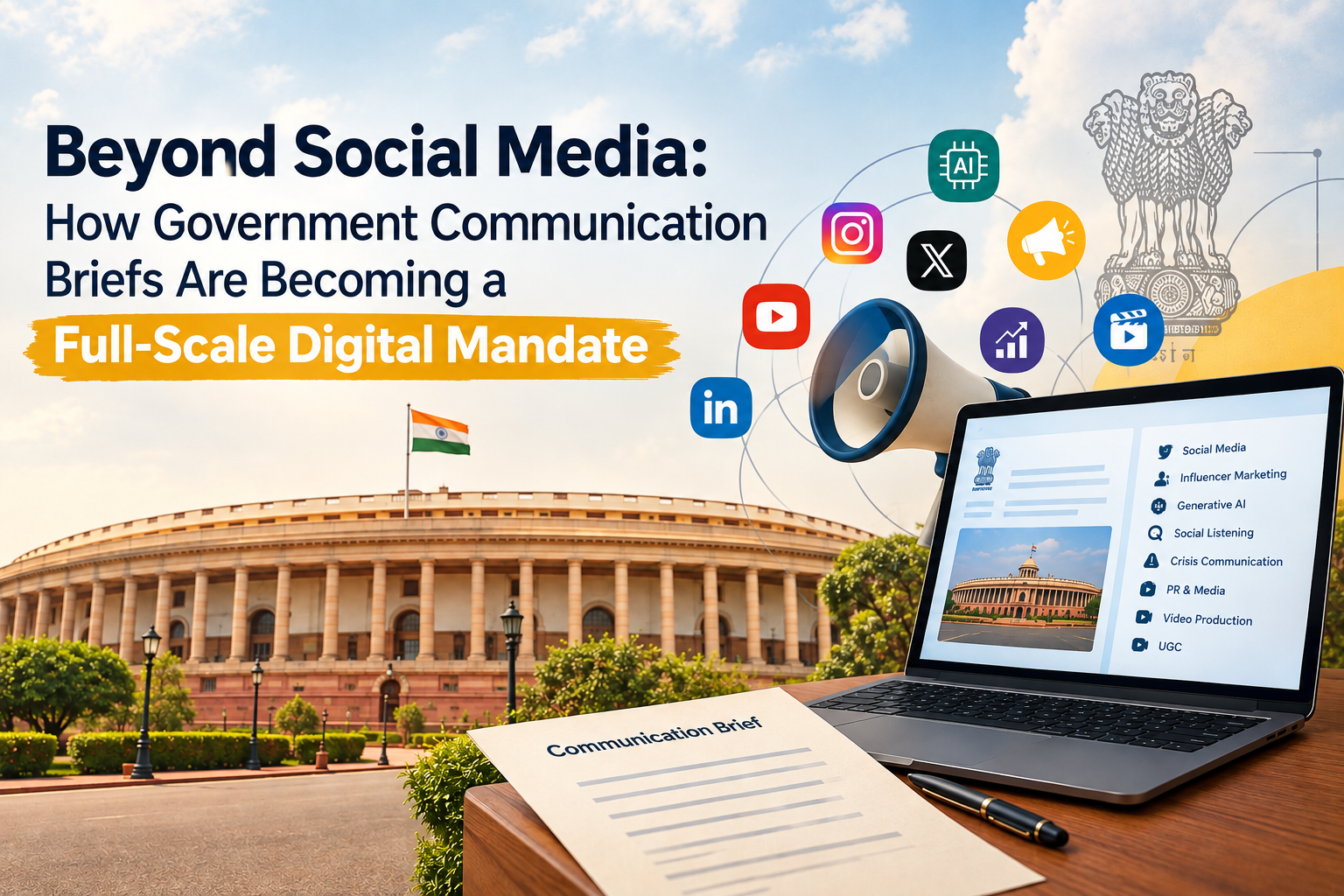
For years, social media mandates were often treated as an execution game: create posts, publish reels, manage platforms, and keep the content calendar moving. That definition is rapidly becoming outdated. Government communication briefs are now expanding into influencer marketing, generative AI, social listening, crisis communication, public relations, video production, and even user-generated content.
With more than ₹10 crore worth of identified government social media and digital communication mandates currently up for grabs across central and state government bodies, the bigger story is not simply the size of the opportunity. It is the changing expectation of what a digital communication agency is supposed to deliver. (Source: exchange4media)
The Social Media Brief Is Getting Bigger
The recent mandates show that social media is increasingly being viewed as one part of a much larger communication ecosystem. The ₹4 crore mandate from the Department for Promotion of Industry and Internal Trade (DPIIT), for instance, covers content creation, campaign management, moderation, video production, response management and analytics across major social platforms.
The Directorate of Education, Government of NCT of Delhi, has taken the scope even further. Its estimated ₹3 crore communication mandate brings together digital content, websites, social media, events, media campaigns, films, and outdoor communication. Its brief also includes AI-driven social listening, misinformation identification, multilingual content and UGC management.
For agencies, this signals a fundamental shift: clients are no longer simply buying content. They are buying an integrated communication system. (Source: exchange4media)
From Content Creators to Communication Architects
The inclusion of influencers in government briefs is particularly significant for the wider marketing ecosystem. The Delhi Education mandate calls for credible educational influencers, academicians and thought leaders, with agencies expected to execute collaborations and measure their impact.
This changes how agencies should think about creator marketing. Influencers cannot simply be added to a campaign at the last stage because a brief has a creator component. Their credibility, audience relevance and ability to communicate complex subjects need to be considered much earlier in the strategy.
The same principle applies to brands. As audiences become more fragmented, the strongest communication strategies will increasingly combine brand-owned content with trusted voices, community participation and platform-specific storytelling.
AI Will Strengthen the Brief, Not Replace the Strategy
Another important development is the growing presence of AI within these mandates. Government briefs are beginning to use AI not just for content generation but for social listening, sentiment tracking, misinformation detection, multilingual dubbing, subtitling, visualisation and UGC verification.
For businesses, there is an important lesson here. AI should not be treated merely as a faster way to produce more content. Its bigger value lies in helping organisations understand conversations, identify emerging narratives and respond more intelligently.
The agencies that build AI into research, monitoring and decision-making—not just production—will be better positioned for this changing environment.
The New Competitive Advantage Is Integration
As mandates expand, having separate teams for social media, PR, creators, video and analytics may no longer be enough. The competitive advantage will increasingly come from connecting these capabilities.
Imagine a public conversation beginning with a social post, gaining traction through creators, triggering misinformation, requiring a rapid response and eventually becoming a media story. Managing each stage independently can create delays and inconsistent messaging. An integrated team, on the other hand, can connect listening, content, creators, PR and crisis communication into one coordinated response.
That is equally relevant for consumer brands. The next generation of digital marketing will be less about choosing between social, influencers, PR or AI and more about making these functions work together.
Regional Communication Will Matter More
The expansion of mandates beyond major national campaigns also points towards another opportunity: regional expertise. The Gujarat Tribal Development Department’s approximately ₹1 crore mandate, for example, requires daily content in Gujarati, English and Hindi, alongside digital campaign development, audience targeting and monitoring of rumours and advisories.
For agencies, this creates space for regional specialists that understand local languages, cultural contexts and community behaviour. Scale alone may not be enough when communication needs to feel relevant at a local level.
For brands entering smaller cities and regional markets, the same lesson applies: translation can make content understandable, but cultural relevance makes it meaningful.
The Real Opportunity Is Bigger Than the Tender Value
The ₹10 crore-plus opportunity currently visible in government mandates is significant, but the more important signal is what these briefs reveal about the future of digital communication. The mandates span social media, creators, AI, analytics, PR, reputation management, crisis response, video and community participation.
That evolution is likely to influence the wider agency market too. As clients become accustomed to integrated communication partners, brands may increasingly expect agencies to move beyond platform management and take responsibility for the larger consumer conversation.
The question, therefore, is no longer whether an agency can manage social media. The more consequential question is whether it can understand an audience, anticipate conversations, create credible narratives, respond to disruption and measure what changed because of the communication.
Social media may have opened the door. The future of the business is being built around everything that comes after it.