

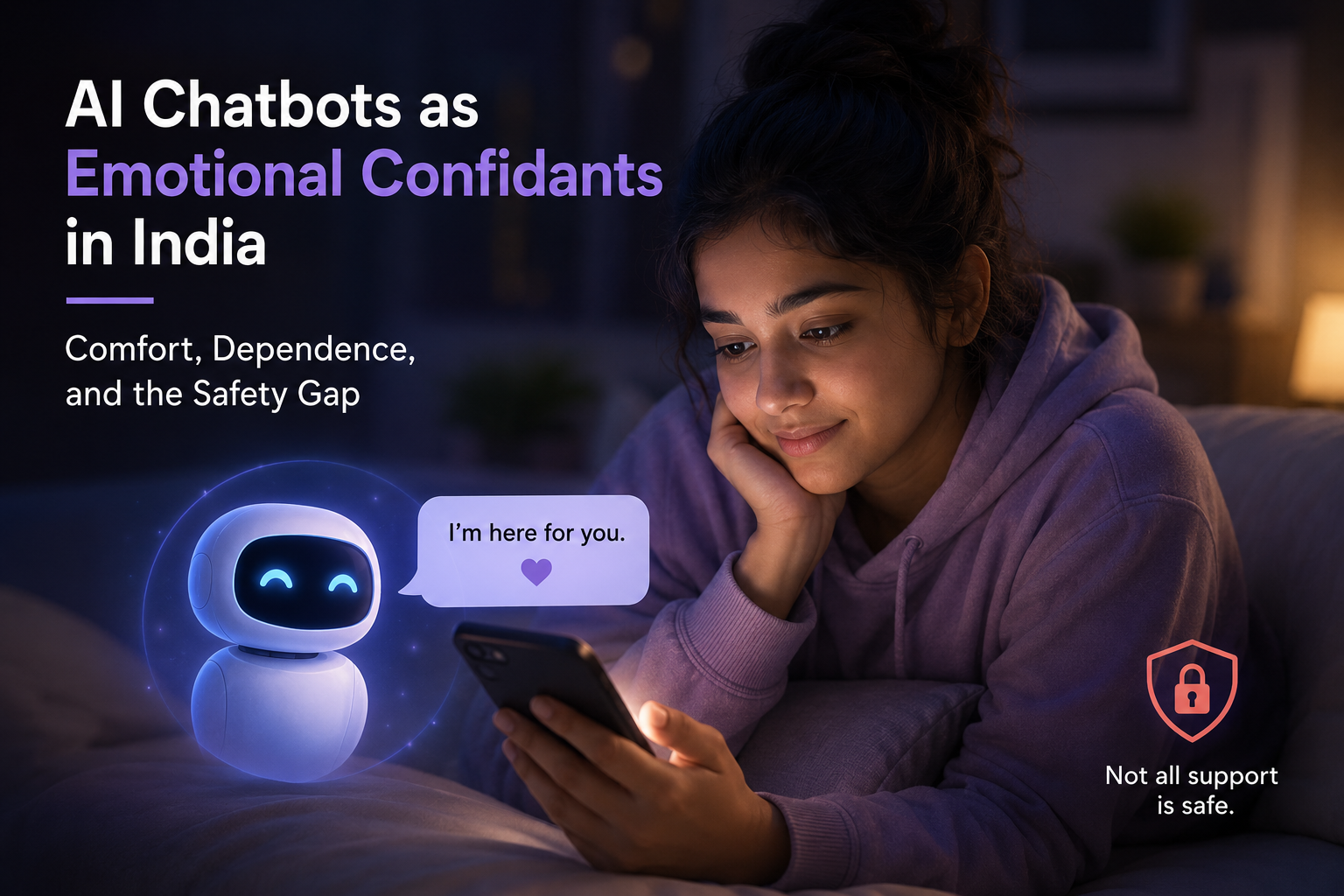
At 2 a.m., a growing number of people are no longer turning to friends, family, or therapists when anxiety hits. They are opening AI chatbots. What began as a productivity tool is quietly becoming something far more intimate: a space for emotional reassurance, late-night vulnerability, and judgment-free conversation.
A significant shift is occurring among the younger generation, driven by a critical gap in accessible mental health support. According to a new report by the Indian Governance and Policy Project (IGAP) titled “The Conversation Nobody Planned For: AI, Emotional Support, and the Indian Context,” conversational AI systems have rapidly evolved from productivity tools into emotionally responsive interfaces that users increasingly turn to for support, guidance, and companionship.
People today are not turning to AI because machines understand emotions better than humans. They are turning to AI because human support systems often feel inaccessible, delayed, expensive, or emotionally unsafe. In an environment where mental health infrastructure remains deeply underfunded, and stigma still surrounds emotional vulnerability, AI offers something many young users struggle to find elsewhere: instant attention without fear of judgment.
Especially for teenagers and young adults navigating loneliness, academic pressure, identity struggles, and emotional uncertainty, conversational AI has become a readily available outlet, especially in smaller towns where access to therapy or support networks remains limited. Instead of relying solely on friends, family, or counselors for emotional warmth, a growing number of youngsters are turning to AI chatbots as their primary sounding board for personal struggles. In India, this trend is fueled by a severe mental health treatment gap: the National Mental Health Survey estimated that 70 to 92% of people living with mental illness in India receive no treatment at all, due to stigma, underfunded services, and structural apathy. (Source: IGAP)
On a global level, it reflects a broader global generational shift. According to the Kantar report, personal coaching and motivation emerged as the leading emotional use case for AI at 29%, followed by mental well-being support at 25%. The findings suggest that consumers are increasingly turning to AI not just for information, but also for reassurance, encouragement, and emotional guidance.
The trend is especially prominent among younger users. Around 35% of Gen Z respondents and 30% of Millennials said they have used AI tools for emotional support, compared to 14% of Gen X and 7% of Baby Boomers. As AI systems become more conversational and context-aware, younger generations appear far more comfortable engaging with them during moments of stress, self-reflection, or personal growth.
The report also found that 41% of global consumers felt somewhat or very comfortable discussing personal or emotional matters with AI tools, signalling a growing openness toward AI as a source of emotional support or digital companionship. (Source: Kantar)
The Scale of the Trend
The appeal of AI lies less in intelligence and more in emotional predictability. Unlike human relationships, AI does not interrupt, shame, dismiss, or lose patience. Conversations can be paused, rewritten, or restarted at any moment, giving users a sense of control rarely present in emotionally vulnerable situations. For many young users, that combination of constant availability and perceived emotional safety is what makes AI feel easier to talk to than real people.
The magnitude of this shift is captured in studies where a recent survey revealed that 88% of Indian school students turn to AI during periods of stress, with emotional dependence appearing most strongly among teenagers aged 13 to 18. Conducted by Youth Ki Awaaz and YLAC, the study also found that 57% of young Indians use AI as a confidant, particularly in smaller towns where access to emotional support may be more limited. At the same time, the findings raise growing concerns around emotional isolation, dependency, and data privacy.
Among the various platforms used for emotional conversations, ChatGPT emerged as the most preferred choice, surpassing alternatives such as Google Gemini and Character.AI. The survey also highlighted a noticeable gender gap in AI-driven emotional engagement, with 52% of young women reporting that they share personal thoughts with AI systems, nearly double the proportion reported among young men. (Source: India Today)
The findings further showed that emotional reliance on AI was more prominent in smaller towns and non-metro regions. From the global perspective, this also mirrors findings from Italy, where a November 2025 Save the Children survey of 800 teenagers found that 41.8% turn to AI when they feel sad or anxious, and 30% use AI daily for emotional or decision-making support. (Source: Save the Children)
Why AI Feels Like a Safe Space
AI has become a confidante not because it’s smarter, but because it offers something humans often can’t: unconditional, judgment-free listening. According to a September 2025 Forbes article by psychologist Dr. Travers Mark, three key psychological drivers explain why people increasingly turn to AI for emotional support: (Source: Forbes)
| Driver | Why It Matters | ||||||||||||||||||||
|---|---|---|---|---|---|---|---|---|---|---|---|---|---|---|---|---|---|---|---|---|---|
| No Fear of Judgment | Humans often hold back out of shame or worry about being judged; AI never criticises, gossips, or loses patience. | ||||||||||||||||||||
| Total Control | Users can edit, pause, or restart conversations at will, giving them a sense of safety never possible with real people | ||||||||||||||||||||
| Constant Availability | Constant Availability Unlike friends or therapists who have schedules, AI is always there, especially during late-night moments of loneliness. | ||||||||||||||||||||
The Risks Involved
But the rise of emotionally responsive AI also introduces risks that remain largely unregulated and poorly understood.
As users begin forming deeper emotional attachments to conversational systems, concerns around dependency, social withdrawal, manipulation, and psychological isolation are becoming harder to ignore. The more human these systems appear, the easier it becomes to mistake programmed responses for genuine empathy.
What makes the issue more concerning is that some of the most emotionally dependent users are teenagers, a demographic particularly vulnerable to influence, validation-seeking, and long-term behavioral conditioning. While the convenience is clear, the study highlights serious safety and psychological gaps that regulators and developers have yet to address. According to research by Pace University, these five main risks are triggered when a person gets overly involved with AI for any minute requirement: (Source: Pace University)
- Emotional dependency: Users may become overly reliant on AI for emotional comfort and companionship.
- Blurred line between human and machine interaction: People can begin treating AI systems as emotionally genuine, despite the absence of real empathy or human understanding.
- Weakened real-world relationships: Excessive emotional engagement with AI may reduce meaningful human interaction and social connections.
- Privacy and data concerns: Emotional conversations often involve sensitive personal information, raising concerns about how that data is stored or used.
- Risk of manipulation: Emotionally responsive AI systems could influence user behaviour or emotional decisions in ways that are ethically concerning.
Calls for Regulatory Action
This does not call for a ban on dependency on AI. Instead, this urges the implementation of specific guardrails to protect vulnerable users:
- Mandatory Disclaimers: Clear warnings that AI is not a substitute for professional therapy.
- Transparent Data Policies: Explicit disclosure of how emotional data is stored, used, and shared.
- Independent Audits: Regular reviews of systems operating in the mental health space.
- Prohibitions on Misrepresentation: Rules preventing AI from posing as a licensed therapist or offering clinical diagnoses.
The core argument is that AI governance in India must expand beyond traditional data protection to include emotional accountability.
While regulatory guardrails are essential, the immediate responsibility lies with both users and developers to navigate this new emotional landscape responsibly.
The Path Forward
AI is not replacing human emotion. It is stepping into spaces where human support has become absent, inaccessible, or insufficient. For millions of people, and especially the younger generation, chatbots are no longer just tools for productivity or curiosity. They are becoming late-night companions, emotional outlets, and silent listeners during moments of stress, loneliness, and uncertainty.