


For decades, television distribution in India was relatively easy to understand: broadcasters created the content, DTH and cable operators delivered it, and advertisers bought audiences around programmes and channels. That structure is now being disrupted.
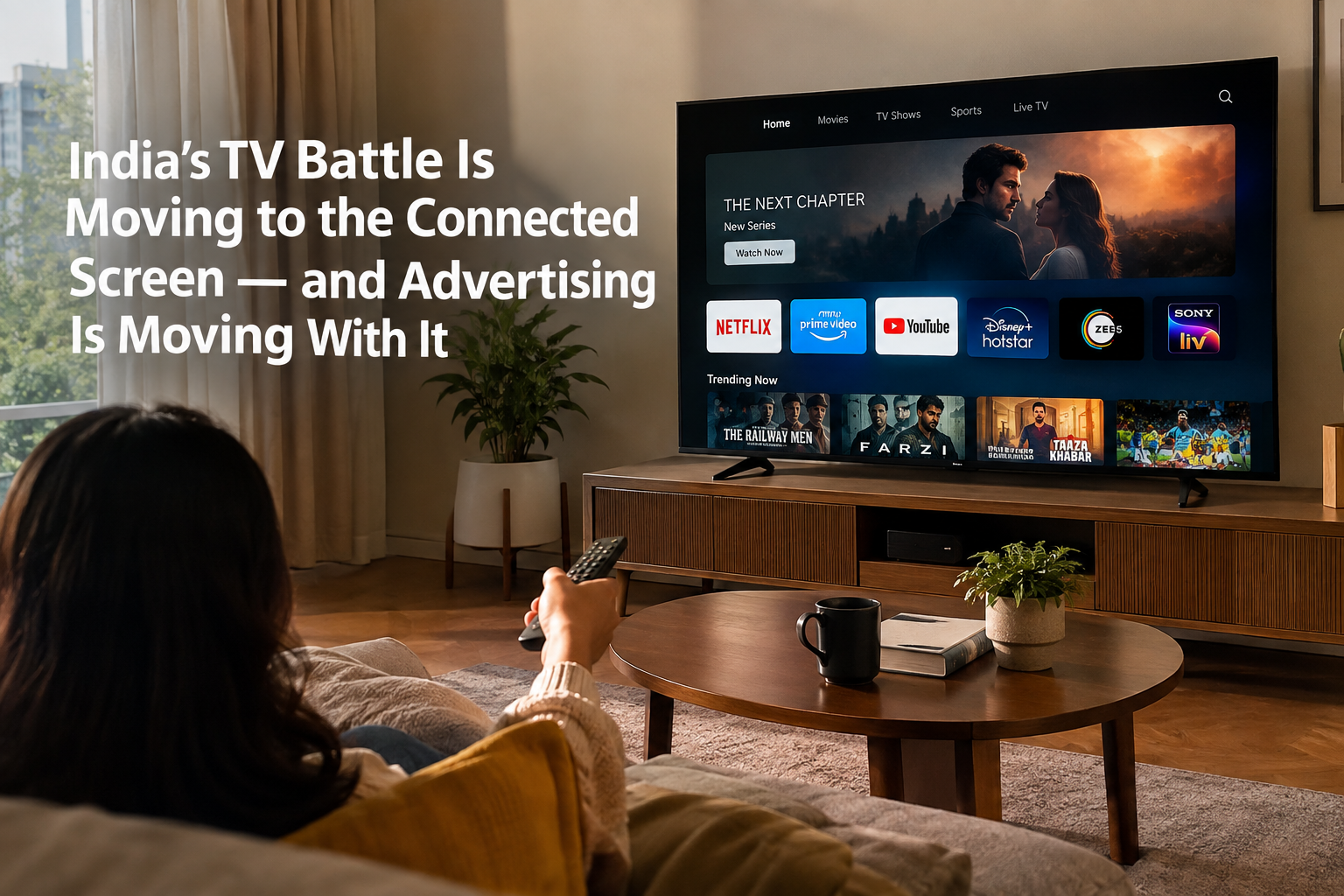
The next phase of television is being built around the connected TV (CTV) screen, where linear television, OTT platforms, FAST channels, and internet-based entertainment can coexist on the same device. Traditional DTH companies are increasingly moving into this space, while broadcasters are looking at new partnerships to keep their content and audiences connected. For brands, the bigger story is not simply where the medium is headed. It is how the shift could reshape how advertising is distributed, measured, and monetised.
From DTH Boxes To Entertainment Aggregators
The strategic move by DTH companies is significant because they are no longer looking at the set-top box as the end point of their business.
Tata Play and Sun Direct are exploring CTV propositions that can bring linear TV, OTT, and other internet-based entertainment together. Meanwhile, Vzy has launched a Linear TV Streaming platform combining more than 200 live channels with 29+ OTT platforms and free content, backed by Dish TV. Broadcasters, including JioStar and Sony Pictures Networks India, are also entering partnerships around connected television distribution. (Source: exchange4media)
Instead of simply delivering channels, distributors are increasingly competing to shape discovery as well as distribution.
That makes aggregation itself a strategic asset.
FAST Is Making Television Free — But Not Ad-Free
One of the biggest developments within this transition is FAST, or Free Ad-Supported Streaming Television. Unlike subscription-led OTT, FAST channels allow viewers to access scheduled television-like content without paying a subscription, with advertising becoming a central source of monetisation.
India’s regulatory debate around FAST and Application-based Linear Television Distribution (ALTD) reflects how quickly the category has moved. TRAI’s consultation, released in April 2026, examined the framework for internet-based services that distribute linear television through smart TVs, mobile applications and web platforms. The consultation has now closed. (Source: broadcastandcablesat)
But for advertisers, the commercial implication is more immediate than the policy question: television inventory is becoming increasingly digital.
The familiar TV ad break is evolving into a connected, addressable, and potentially more measurable advertising environment. (Source: exchange4media)
The Ad Break Is Becoming More Flexible
The bigger shift is who controls advertising inside that environment.
Traditional television largely sells audiences around programmes and channels. Connected environments can potentially add another layer of targeting based on platform data, viewing behaviour, and digital delivery infrastructure.
Industry responses to TRAI’s consultation have already highlighted the importance of advertising inventory and data. ABP Network, for instance, raised concerns around platform-controlled ad insertion, including situations where broadcaster advertisements could be replaced with platform-sold programmatic inventory. It also sought greater transparency around ad requests, rendering, and fill rates.
Buying “TV” increasingly means buying content, audience access, connected-screen inventory, and platform-level targeting at the same time.
That creates more possibilities, but also more complexity.
The Real Battle May Be Over Who Owns The Viewer
As DTH operators, broadcasters, OTT platforms, smart-TV manufacturers, and FAST services converge, the most valuable asset may no longer be the channel itself. It could be the relationship with the viewer.
Who controls the home screen? Who decides which content appears first? Who owns the viewing data? Who sells the advertising opportunity? And who gets to measure whether an impression was actually delivered?
Connected TV introduces multiple intermediaries between a brand and its audience. A broadcaster may own the content, while another platform controls distribution, another technology provider enables advertising, and the television manufacturer controls part of the discovery experience.
That fragmentation could make measurement and transparency as important as reach.
Brands Need To Stop Thinking Of CTV As Just Bigger OTT
For marketers, the bigger shift is not moving more television budgets into CTV. It is rethinking television’s role within a broader media strategy.
CTV combines television’s large-screen impact with much of digital advertising’s flexibility. FAST can provide incremental reach among viewers who are less willing to pay for multiple subscriptions. DTH-led aggregation can reduce the friction of navigating between different content services. And programmatic infrastructure can make television inventory more dynamic.
Those benefits only become meaningful when advertisers can measure who they reached, how often, where impressions appeared, and what happened afterwards—making incremental reach, frequency, completed views, audience overlap, attribution, and inventory quality increasingly important alongside traditional GRPs.
Television Is Not Disappearing. It Is Being Rebuilt.
The current DTH-to-CTV shift should therefore not be read simply as traditional television fighting to survive against OTT.
It is a restructuring of the television ecosystem itself.
DTH operators are becoming aggregators, broadcasters are expanding distribution partnerships, and FAST is making advertising the economic engine of free television. Connected TVs are becoming media platforms rather than passive screens.
For brands, the lesson is straightforward: the television screen is staying relevant, but the business model around that screen is changing.
And that means the next big television advertising battle may not be fought for the 8 p.m. slot. It may be fought for the screen that decides what the viewer sees next.