


In digital businesses, customer experience has traditionally focused on acquisition, onboarding and retention. The moment a user decides to leave has often been treated as the end of that journey—a churn event to be recorded, analysed and eventually forgotten.
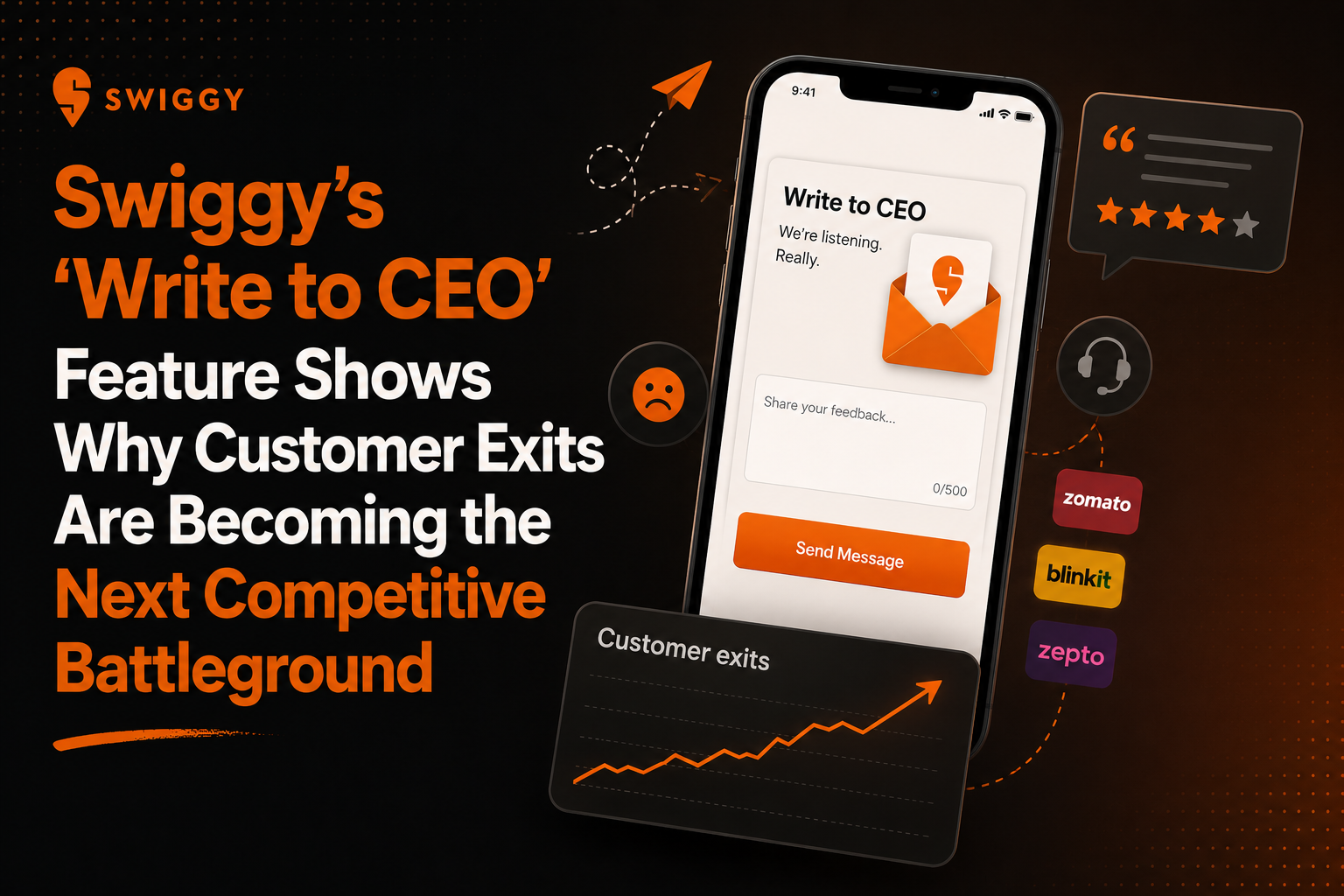
Swiggy‘s new ‘Write to CEO’ feature challenges that thinking. Instead of allowing users to silently uninstall the app, it offers them a direct channel to explain why they are leaving. On the surface, it appears to be a minor user experience enhancement. In reality, it reflects a broader shift in how digital-first brands are beginning to view customer exits: not as failures to measure, but as conversations worth having.
As India’s online food delivery market continues its rapid expansion, customer trust is becoming as important a differentiator as pricing, delivery speed, or restaurant selection.
India’s online food delivery market is projected to grow from US$46.34 billion in 2025 to US$269.77 billion by 2034, reflecting the increasing role these platforms play in consumers’ everyday lives. As the market scales, competing on convenience alone is becoming harder, making customer experience and trust increasingly important differentiators. (Source: Research and Markets)
Turning Churn into Conversation
Most feedback mechanisms are designed around successful interactions. Customers are asked to rate a completed delivery, respond to an NPS survey, or contact support after encountering an issue. By the time someone uninstalls an app, however, the opportunity for meaningful dialogue has usually passed.
Swiggy’s feature intervenes at precisely that moment.
Accessible through the app’s uninstall flow, it presents users with a short message from the CEO alongside a simple text box inviting them to explain what prompted their decision. Rather than letting dissatisfaction disappear with the uninstall, the company attempts to capture it while emotions and experiences are still fresh.
For product and customer experience teams, this creates a far richer source of insight than star ratings or CSAT scores alone. Qualitative feedback often reveals issues that metrics cannot—whether customers feel ignored, treated unfairly, or have simply lost confidence in the platform.
Trust Is Increasingly a Product Feature
India’s food delivery platforms have spent years competing on discounts, delivery times and convenience. Those advantages are becoming increasingly easy to replicate as platforms invest in faster delivery models, AI-driven recommendations, loyalty programmes and expansion into Tier-2 and Tier-3 cities. As functional differences narrow, customer trust and the quality of post-purchase experiences are emerging as more durable competitive advantages. (Source: Research and Markets)
The significance of Swiggy’s feature lies less in whether the CEO personally reads every submission and more in what the feature communicates. By placing leadership at the centre of the feedback process, the company signals that customer concerns deserve executive attention rather than being confined to a support queue.
Whether users believe every message reaches the CEO is almost secondary. The perception of accountability itself can influence how customers evaluate a brand during one of its most critical moments.
Why Small UX Decisions Matter More Than Ever
The feature does not attempt to retain users through discounts, loyalty rewards, or aggressive win-back offers. Instead, it introduces something much simpler: a pause.
That pause is strategically valuable.
Behavioural research has long shown that moments of reflection can influence decision-making. Inviting users to explain their frustration creates a brief interruption between dissatisfaction and departure. Some users may continue uninstalling the app, but others may reconsider after feeling acknowledged.
Even when churn remains inevitable, the business gains something equally valuable—a clearer understanding of why customers leave.
In increasingly competitive digital markets, these insights often become more valuable than another dashboard tracking engagement metrics.
Designing for Emotion, Not Just Efficiency
One of the more interesting aspects of the feature is its tone.
Rather than presenting feedback as a formal complaint process, the interface adopts the style of a personal letter. The language encourages users to share openly, reinforcing the idea that no concern is too small.
This reflects a broader evolution in digital product design. Customer experience is no longer measured solely by efficiency or speed. Emotional reassurance—making users feel heard, respected and treated fairly—is becoming an equally important part of the experience.
As competing platforms become increasingly similar in pricing, logistics and convenience, emotional design may prove to be one of the few sustainable differentiators.
A Lesson Beyond Food Delivery
The biggest takeaway from Swiggy’s move extends well beyond the food delivery industry.
Too often, businesses invest heavily in attracting customers while paying relatively little attention to understanding why they leave. Yet the point of exit is often where the most honest and actionable feedback exists.
Brands across industries—from fintech and e-commerce to subscription services and SaaS—can learn from this approach by asking different questions at moments of churn. Rather than focusing exclusively on post-purchase satisfaction, they should design mechanisms that capture the reasons behind customer exits and integrate those insights into product, service, and policy decisions.
Of course, collecting feedback is only the first step. Features like these create expectations. If customers repeatedly share concerns without seeing meaningful improvements, the exercise risks becoming symbolic rather than substantive.
Ultimately, Swiggy’s ‘Write to CEO’ feature is significant not because it introduces a new feedback form, but because it reframes a neglected moment in the customer journey. It recognises that the final interaction with a user can be just as valuable as the first.
As digital consumers become more vocal and less loyal, the brands that succeed will be those that treat every exit as an opportunity to learn—not simply another number in a churn report.