

Every transformative technology has shared one common purpose: to help people do more, do it better, and do it faster. The printing press expanded access to knowledge. Search engines made information easier to find. Smartphones made work more accessible from anywhere. Artificial intelligence is the latest step in that evolution. It can analyse data in seconds, generate ideas, refine writing, automate repetitive tasks, and remove hours of manual effort from our day. Its purpose has never been to replace human intelligence. It has always been to amplify it.
India offers a compelling example of how quickly AI has become part of everyday life. 2026 usage data places the country at the top of the global generative AI leaderboard, with around 73% of respondents reporting that they use generative AI tools, higher than in markets such as the United States (45%) and the UK (29%) (Source: Master of Code). As AI becomes embedded in everyday work, the question is no longer whether we should use it, but how we should use it.
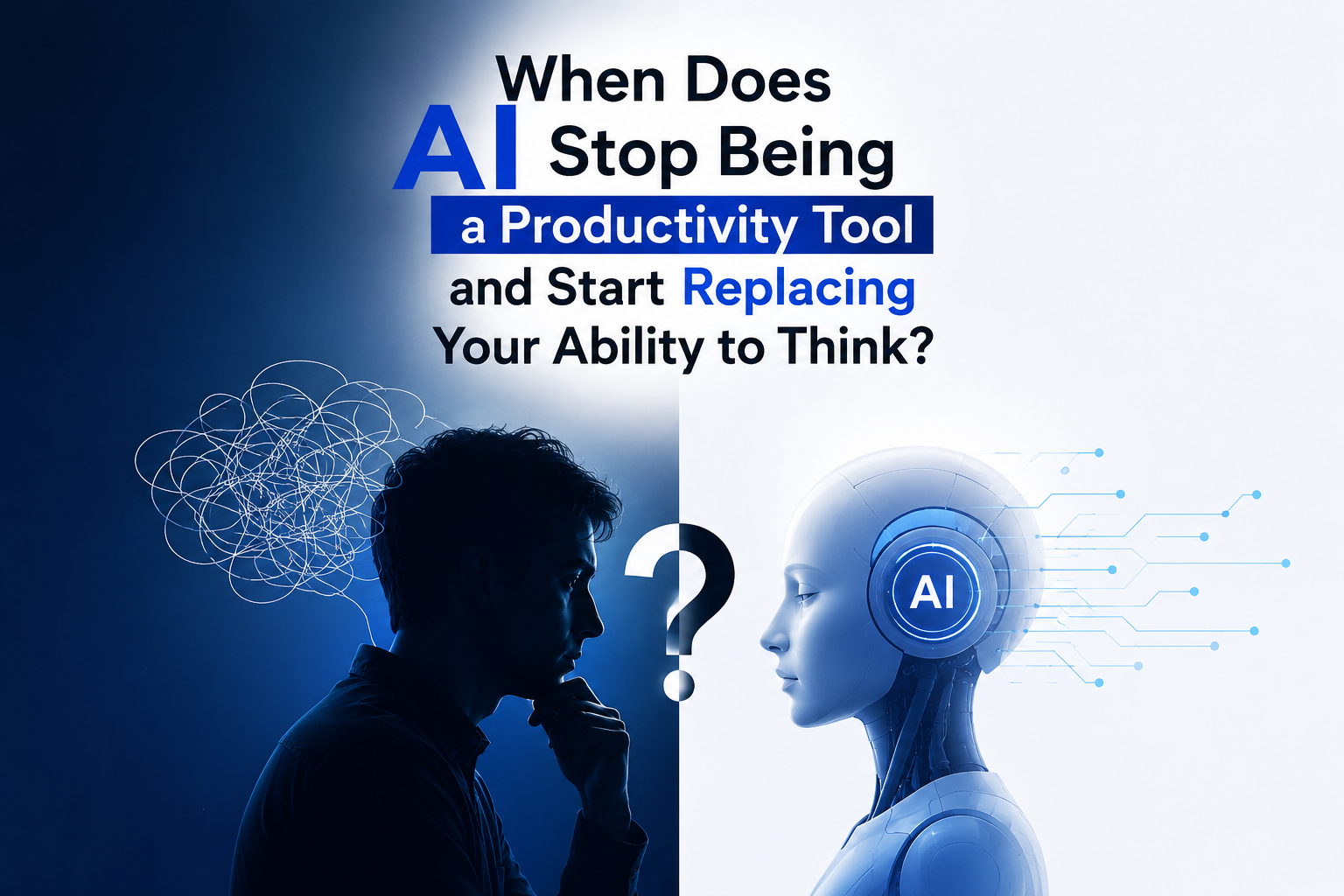
AI began as a productivity tool. It was designed to automate repetitive tasks, analyse information faster, draft documents, and free people from routine work so they could focus on higher-value thinking. When used this way, AI enhances human capability rather than replacing it. The problem begins when productivity quietly turns into dependency.
The Productivity Trap
Productivity is not the same as thinking. That point is reached when AI no longer supports our thinking but starts performing it on our behalf. This shift is no longer theoretical. Recent research suggests AI is increasingly being used for work that extends far beyond routine productivity.
Increasingly, people are turning to AI not only to research information but also to decide strategy, write LinkedIn posts, answer interview questions, prepare presentations, solve assignments, create opinions, and even summarise books they have never read. This shift is becoming increasingly evident in workplace research. AI is no longer confined to routine tasks; it is increasingly used for “complex cognitive work” such as ideation, problem‑solving, content creation and evaluative judgement. Microsoft’s 2026 Work Trend Index, based on trillions of workplace signals and a survey of 20,000 AI users, argues that the most consequential change underway is not new tools but new work design, as AI agents take on more execution while organisations struggle to preserve genuine human agency. (Source: Microsoft)
The extent of this shift is becoming increasingly clear. Stanford’s 2026 AI Index estimates that generative AI has already reached nearly 53% of the global population and 88% of organisations within just three years. (Source: Stanford University) Yet widespread adoption does not automatically translate into meaningful productivity gains. A January 2026 analysis of workplace studies finds task‑level productivity gains between 14% and 55%, yet concludes that 95% of enterprise AI initiatives fail to scale and that AI may only add around 0.5–0.7% to total productivity over the next decade. (Source: Forbes) For professionals, that leaves a question: are we becoming more productive, or are we simply outsourcing our thinking to systems that are exceptionally good at producing outputs, but not yet accountable for the ideas behind them?
Cognitive Offloading Is Real
Psychologists describe this behaviour as cognitive offloading: using external tools to reduce mental effort by shifting parts of thinking outside the brain. GPS, smartphones, and calculators have already changed which skills we practise most by making navigation, information access, and arithmetic easier while encouraging us to store less in memory. New 2026 research shows this pattern carries into deeper cognition: a review of AI use finds that frequent delegation of tasks to AI systems can weaken attention, memory, critical thinking, problem‑solving and decision‑making. (Source: Psycho Pedia Journals) At the same time, a Frontiers in Psychology study reports that cognitive offloading through digital tools is positively linked to cognitive self‑efficacy, which in turn predicts higher critical thinking, persistence and deeper learning. (Source: Frontiers) AI is simply the latest offloading tool, but unlike earlier technologies, these findings suggest its influence reaches into the reasoning and judgment that underpin human expertise.
The New Skill Isn’t Using AI
Recognising these risks does not mean AI is inherently harmful. Rather, it reinforces the importance of using AI intentionally. In fact, organisations and professionals who use AI effectively will almost certainly outperform those who ignore it. The real skill is no longer knowing how to use AI. It is knowing when not to use it.
Knowing When NOT to Use AI
AI is exceptionally good at accelerating research, brainstorming ideas, automating repetitive tasks, and producing first drafts. These are areas where speed creates value without replacing human judgement. However, AI should not become the default source for personal opinions, ethical decisions, leadership choices, hiring decisions, customer relationships, or innovation. These situations require context, empathy, experience, and accountability, qualities that cannot be generated through a prompt.
The Creativity Illusion
Knowing when to rely on AI also helps explain the growing creativity illusion surrounding it. Because AI can produce content almost instantly, it is easy to mistake rapid generation for genuine creativity. But creativity is not simply producing words or ideas. It comes from questioning assumptions, connecting unrelated concepts, learning from experience, and refining ideas through critical thinking. AI can identify patterns based on existing information, but originality still depends on human curiosity and judgement.
This distinction is perhaps best captured by TrustSignal Founder & CEO, Imran Shaikh:
“AI should amplify your productivity and unlock your creativity, not become a substitute for your ability to think creatively. The moment we rely on AI to do all the thinking, we stop innovating and start automating our imagination.”
Why Businesses Should Care
For businesses, this is more than an individual productivity issue. It is a leadership challenge. Organisations thrive when employees ask questions such as, “Why?”, “What if?”, and “Are we solving the right problem?” If every challenge is handed to AI before people attempt to think it through themselves, those habits gradually disappear. Over time, organisations risk losing innovation, strategic thinking, problem-solving capability, and ultimately, competitive advantage. Efficiency may improve in the short term, but long-term success depends on the ability to think beyond predictable answers.
Artificial intelligence is one of the most powerful productivity tools ever created, but its greatest value lies in enhancing human capability rather than replacing it. The future of work will not be defined by how often we use AI, but by how intentionally we use it. The organisations and professionals that benefit most will be those who use AI to accelerate thinking, challenge assumptions, and improve decisions—not to avoid thinking altogether. AI should help us think better, not think less.