

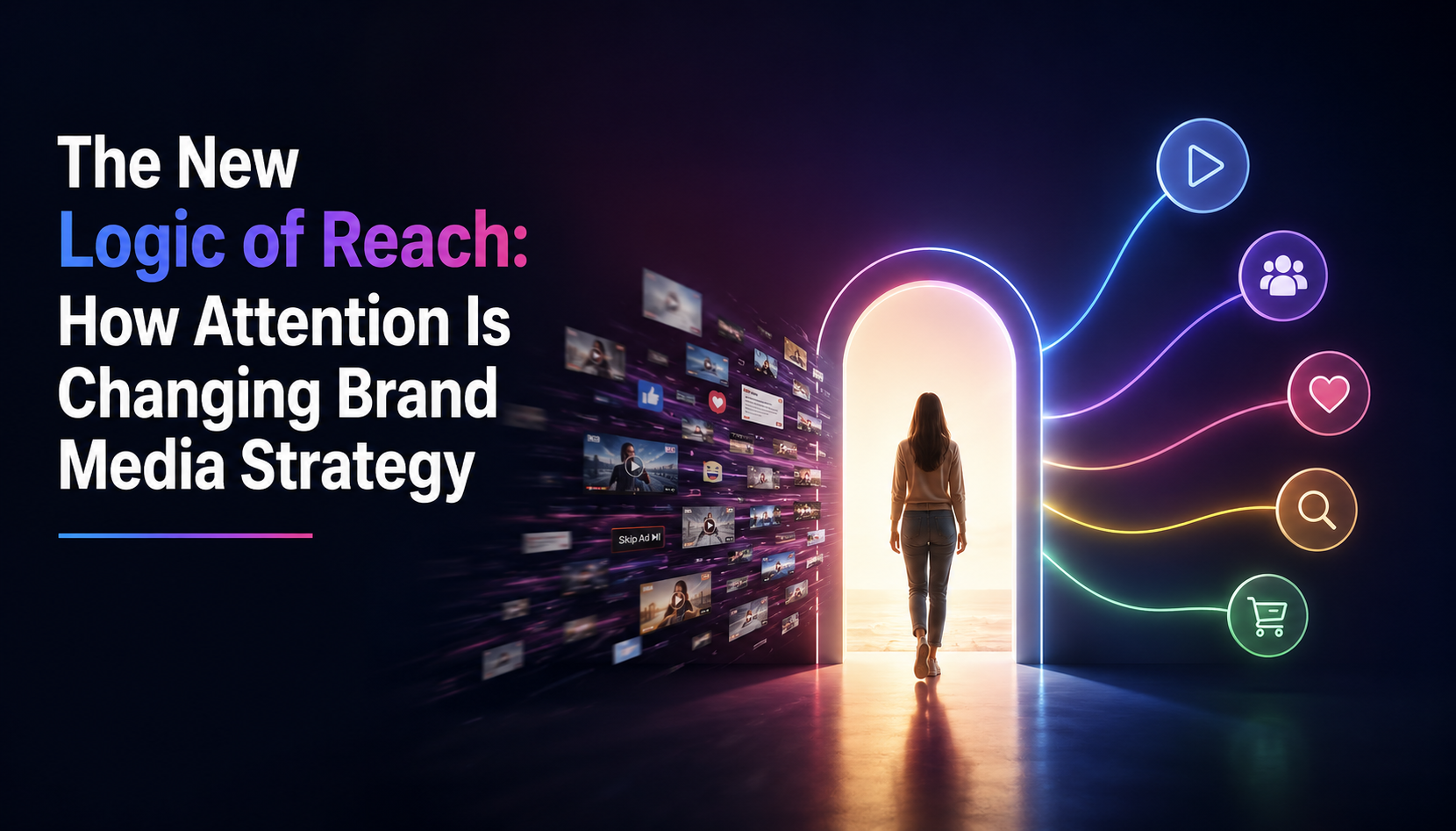
For years, brand media strategy was built around a simple idea: buy enough reach, and the message would eventually land. That logic is starting to break down. In a fragmented media environment, visibility alone no longer guarantees impact, because audiences are distributing attention more selectively and filtering more aggressively across platforms. Brands are increasingly learning that the real challenge is not airtime, but attention. This shift is changing how marketers think about media planning, creative strategy, and audience connection.
A report found that attention-driven campaigns delivered an average 33% lift in upper-funnel KPIs and a 53% increase in lower-funnel impact, underscoring why brands are moving beyond reach as a standalone metric. Instead of treating reach as the final goal, brands are beginning to focus on when, where, and how attention is most likely to be earned. (Source: Adelaide Metrics)
The New Logic of Media Reach
Traditional media planning was built on exposure. If a campaign appeared often enough, across enough placements, it could generate recall and eventually influence behavior. But in a world producing 2.5 quintillion bytes of data every day, exposure is no longer the same as attention. Ipsos’ 2026 attention research also describes focus as both “precious and elusive” in today’s fractured, AI-driven environment, reinforcing the idea that people are filtering more aggressively than ever before. (Source: Vision Factory)
This is why brands are moving toward more precise forms of reach. Rather than chasing the broadest possible audience, many are prioritising environments where attention is more intentional and more valuable. Premium placements, creator-led content, and contextually relevant media are becoming more important because they increase the chance that a message will actually be noticed, not just delivered.
The role of context
Attention is increasingly shaped by context. Ipsos’ 2026 What the Future: Attention report describes attention as “precious and elusive” in today’s fractured, AI-driven world, underscoring how difficult it is for any message to break through. (Source: Ipsos) Deloitte’s 2026 digital media research similarly points to a fragmented consumption landscape, where audience intent, platform behavior, and content format all affect whether a brand message gets absorbed or ignored. (Source: Delloitte)
That is pushing brands toward a more selective media mindset. Further marketing trends from reports call time on “blind marketing spend,” while Eskimi’s 2026 contextual advertising guide says contextual campaigns can deliver a 48% lower CPC than behavioral targeting and up to 30% lower cost per impression. In practice, that means tighter audience definitions, sharper creative, and more deliberate placement decisions. (Source: Eskimi)
Creativity Has to Earn Attention
Creativity has to earn attention. As exchange4media notes, viewability is no longer enough; attention is the new currency, and not all attention carries the same value. That means brands can no longer depend on frequency alone to make weak ideas work; the message itself has to create enough relevance, curiosity, or emotional pull to make someone pause. In practical terms, this is why better formats matter. (Source: Exchange4Media)
Video, immersive placements, and context-aware storytelling tend to hold attention more effectively than static, low-context messaging because they feel more natural in the environments where people are already engaged. The real shift is from simply being seen to being remembered, which is why creative quality now plays a much bigger role in media performance.
Measuring What Matters
As media strategy evolves, so does measurement. Reach is still important, but it is no longer enough on its own. Brands are increasingly looking at attention quality, time spent, completion rates, interaction depth, and downstream brand lift to understand whether a campaign is actually working. This does not mean reach is obsolete. It means reach now has to be evaluated differently.
A million impressions with little attention may be less valuable than a smaller audience that is more engaged, more present, and more likely to respond. The smartest brand strategies are beginning to balance scale with selectivity, using reach as a starting point rather than the end measure of success.
A New Media Mindset
The new logic of reach is not about abandoning scale. It is about recognizing that scale without attention is increasingly inefficient. In a crowded media environment, brands win not by being everywhere, but by being noticed in the places that matter most.
That requires a different mindset: one that treats attention as a scarce resource, context as a performance driver, and creativity as the mechanism that turns exposure into meaning.
As brand media strategy continues to evolve, the winners will be the brands that stop asking only how far they can reach and start asking how deeply they can matte