


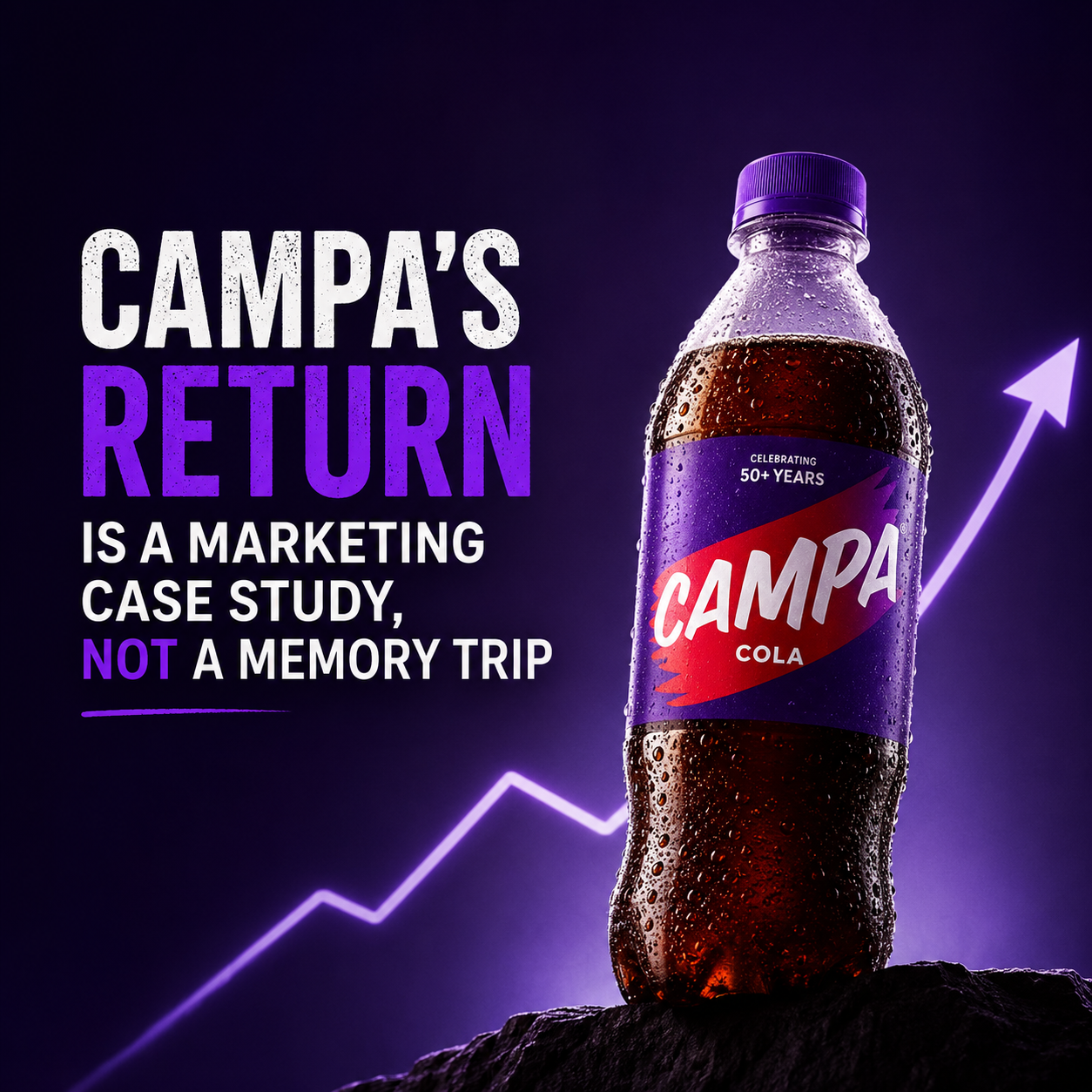
Every few years, a company rewrites the assumptions of an industry. Not because it invents an entirely new category, but because it proves that the rules everyone accepted were never as fixed as they seemed.
For decades, India’s carbonated soft drink market appeared to be one of those industries. Coca-Cola and PepsiCo had spent years building vast distribution networks, deep retail relationships, and unmatched brand equity. Conventional wisdom suggested that challenging such incumbents would require decades of investment and extraordinary marketing budgets.
Campa’s return challenged that assumption.
One number captures the scale of its comeback.
In FY24, just one year after its relaunch, Campa crossed ₹400 crore in revenue. (Source: ET India Times) By March 2026, it had reached ₹4,700 crore, making it India’s fourth-largest carbonated soft drinks brand, sitting alongside Coca-Cola and PepsiCo in a category they have dominated for decades. (Source: ET Retail)
The easy story here is nostalgia. A beloved Indian brand from the 1970s, absent for more than four decades, returns and wins hearts all over again. It is a compelling narrative. It is also an incomplete one.
Because nostalgia does not build a ₹4,700 crore business in three years, execution does.
Campa’s resurgence is less a story about reviving a legacy brand and more a lesson in how established markets can still be disrupted through disciplined strategy. The real question is not why consumers remembered Campa. It is why an industry long considered impenetrable suddenly became vulnerable.
The answer lies not in a single breakthrough, but in the way multiple strategic advantages reinforced one another. Brand heritage created curiosity. Distribution ensured availability. Competitive pricing encouraged trial. Behind it all was the operational scale and disciplined execution needed to turn consumer interest into sustained growth.
Nostalgia Opens the Door. It Does Not Build the Business.
One of Campa’s biggest advantages was that it did not have to introduce itself to the market. Unlike most new brands that spend years building awareness, Campa returned with decades of brand recall despite being absent for more than forty years.
For many consumers, the brand evokes memories of India’s pre-liberalisation era, creating familiarity that sparks curiosity and lowers the barrier to trial.
But recognition is not the same as commercial success.
Nostalgia may attract attention and encourage a first purchase, but it cannot sustain a business on its own. Repeat purchases depend on more practical factors: whether consumers can find the product, whether the price feels right, whether the quality meets expectations, and whether the brand remains relevant in today’s market.
This is where the narrative around Campa often falls short. Its comeback is frequently portrayed as a triumph of nostalgia, when in reality, nostalgia was only the catalyst. The growth that followed was driven by disciplined execution.
Reviving a legacy brand may be the beginning of the journey. Building one that can compete with entrenched incumbents is the real challenge.
Consumers Buy What They Can Find
Nostalgia may have sparked curiosity, but curiosity alone does not create market share.
The soft drink industry has long been shaped by a simple reality: consumers often choose from the options available in front of them. Unlike high-consideration purchases, beverage decisions are frequently made in seconds—at a neighbourhood kirana store, a supermarket aisle, a restaurant counter, or increasingly through quick commerce apps.
This is where Campa’s comeback differed from most brand revivals.
Many legacy brands return with awareness but struggle with reach. Campa returned with both. Backed by Reliance Retail’s extensive network, the brand gained access to a distribution ecosystem that would normally take years to build. Instead of spending time creating availability, Campa could immediately focus on driving adoption.
The significance of this advantage is often underestimated. For decades, Coca-Cola and PepsiCo have protected their market leadership not only through advertising, but through their ability to be present wherever consumers make purchase decisions.
Campa did not attempt to out-advertise the incumbents. It focused on ensuring that when consumers were ready to buy, the product was already within reach.
In categories driven by impulse purchases, availability is not a support function. It is often the first step toward preference.
Once consumers could easily find Campa, the next challenge was giving them a reason to choose it.
Making Trial an Easy Decision
Winning consumer attention is difficult. Convincing consumers to change their habits is even harder.
Most established categories are protected by inertia. Consumers continue buying familiar products not necessarily because they are deeply loyal, but because switching requires a reason.
Campa created that reason through pricing.
By introducing aggressively priced entry packs, the brand lowered the barrier to experimentation. The question for consumers shifted from “Why should I switch?” to “Why not try?
Campa Is a Playbook, Not a One-Off
Campa’s return is often narrated as a feel-good story about a forgotten Indian brand finding its way back into the cola wars. That framing is convenient, but incomplete.
What its growth really shows is how quickly “settled” categories can shift when someone enters with structural advantages, control over distribution, the ability to reset price expectations, and an ecosystem that collapses the distance between attention and purchase. The incumbents did not lose because consumers suddenly fell out of love with their brands; they were forced to react because the rules of the game they had optimised for were quietly rewritten around them.
For marketers, that is the real lesson.
Nostalgia may light up the brief, but it is the combination of distribution, pricing, and operational scale that determines whether a comeback becomes a new start. Campa’s story reminds us that disruption in mature markets now looks less like a clever campaign and more like a coordinated attack on the cost structures, channels, and assumptions incumbents believe are too big to be challenged.