

Over the past decade, three questions have shaped most marketing conversations: Where are people spending time? Who controls that attention? And how do brands show up there at the right moment?
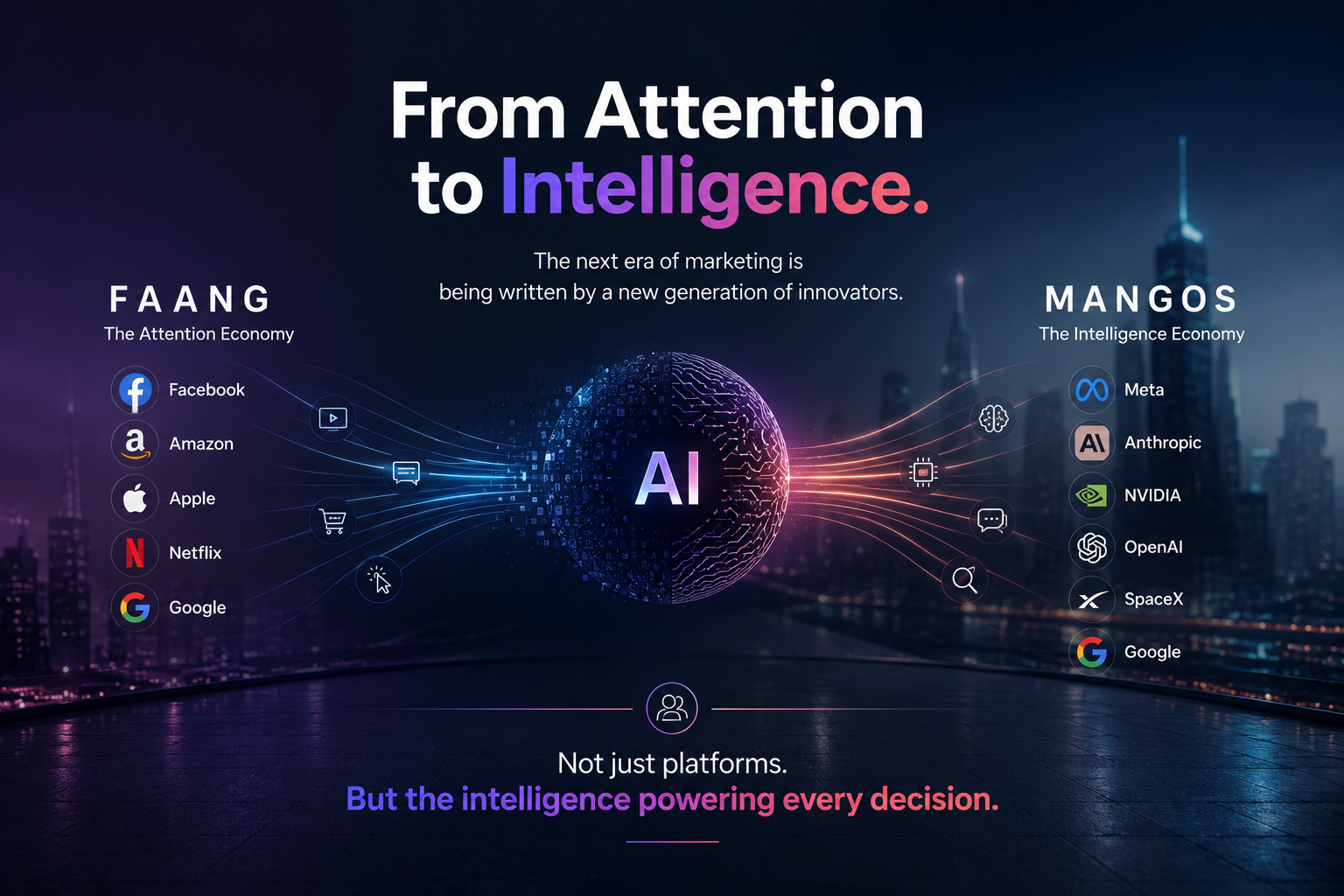
For much of the digital era, the answers pointed to the same group of technology companies. FAANG, Facebook, Amazon, Apple, Netflix, and Google, became shorthand for the platforms where consumers discovered information, consumed entertainment, connected with others, and shopped. Entire marketing playbooks were built around winning attention inside these ecosystems.
Today, a different acronym is beginning to enter the conversation: MANGOS, Meta, Anthropic, NVIDIA, Google, OpenAI, and SpaceX. Unlike the FAANG companies, which largely compete to capture our attention, this group is building the intelligence infrastructure that increasingly shapes how people discover information, evaluate options, and make decisions. From the chips powering advanced AI models to the systems answering questions and, increasingly, acting on users’ behalf, the shift represents more than a change in technology leadership. It signals a fundamental change in how brands will compete for growth. (Source: Exchange4Media)
From the Attention Economy to the Intelligence Economy
The FAANG era gave rise to what became known as the attention economy. Success was measured by a familiar set of metrics: impressions, clicks, views, watch time, and engagement. The objective was straightforward: capture attention, convert it, and measure the outcome.
The emerging AI era operates differently. Rather than simply helping consumers find information, AI systems are increasingly helping them interpret it. Whether comparing health insurance plans, selecting a smartphone, evaluating investment options, or deciding what to watch, AI is becoming part of the decision-making process itself.
For marketers, this changes the nature of competition. Success will increasingly depend not only on reaching the right audience but also on becoming the most credible answer when AI systems assemble recommendations. The next battle will not simply be for clicks. It will be for inclusion in the recommendation itself.
The Shift from Clicks to Choices
The change becomes easiest to understand through an everyday purchase journey.
A few years ago, someone searching for a family health insurance plan would typically begin with a search engine, open multiple websites, compare policies, read reviews, and gradually narrow their options. Every stage of that journey generated impressions, traffic, and clicks.
Increasingly, the same journey begins with a question posed to an AI assistant. Instead of navigating multiple websites, consumers receive a synthesised comparison, an explanation of trade-offs, and a shortlist of recommended options within a single interface. In some cases, there are no search results pages and no clicks at all.
The consumer still makes the final decision. What changes is the path leading to it. Brands are no longer competing only for visibility; they are increasingly competing to become part of the recommendation itself.
From Campaigns to Intelligent Marketing Systems
The implications extend well beyond creative automation.
For decades, marketing has largely been organised around campaigns: develop a brief, launch media, measure performance, and repeat the cycle. AI is beginning to challenge that operating model.
Marketing leaders are asking different questions. Can planning be automated? Can optimisation happen continuously rather than after a campaign ends? Can customer journeys adapt dynamically? Can AI improve commercial decisions faster than traditional campaign cycles allow?
The future is unlikely to revolve around isolated campaigns. Instead, marketing is moving towards connected systems that continuously learn, optimise, and improve. Organisations that integrate creativity, customer data, technology, and commercial intelligence will be better positioned than those relying solely on larger media budgets.
Execution will become increasingly automated. Strategic judgement, integration, and decision-making will become more valuable.
Assistants, Agents, and the Next Customer
Recommendation is only the first stage of this transformation. The next stage is delegation.
Today’s AI assistants help users write, research, and compare options. The next generation of AI agents will increasingly complete tasks on behalf of users.
Consumers may soon ask an agent not simply what to buy, but to compare prices, evaluate reviews, apply loyalty benefits, select a retailer, and complete the purchase automatically.
This creates a new competitive reality. The next customer a brand seeks to influence may not always be a person making decisions manually. It may increasingly be an AI agent acting on that person’s behalf.
Traditional marketing was designed to persuade people. The next decade may require brands to persuade both people and the intelligent systems assisting them.
New Gatekeepers, New Rules
Every major technology shift creates new gatekeepers.
Television networks once controlled access to audiences. Search engines became the starting point for digital discovery. Social platforms transformed how consumers found products, creators, and communities.
AI assistants and AI agents may become the next generation of gatekeepers.
For publishers, that creates obvious challenges, including fewer clicks and changing traffic patterns. Yet it also creates opportunity. As AI-generated content becomes increasingly abundant, original reporting, expert analysis, and research-backed information become significantly more valuable.
The organisations that succeed may not be those producing the largest volume of content, but those consistently producing the most credible content, content that both people and AI systems recognise, reference, and trust.
India’s AI Opportunity
India’s opportunity in this transition is unlikely to come from building another OpenAI. It is more likely to emerge where language, scale, and everyday challenges intersect: regional-language healthcare guidance, agricultural advisory services, financial literacy, personalised education, and digital tools that enable millions of small businesses.
Many of the most significant AI-driven shifts may not occur inside chat interfaces at all. They will emerge where discovery, commerce, and transactions already meet. Marketplaces, retail media networks, and quick-commerce platforms are rapidly evolving into decision engines rather than simply digital storefronts. As AI becomes embedded within these ecosystems, the distance between recommendation and purchase may shrink to a single interaction.
India does not need to replicate Silicon Valley. It needs to solve Indian problems on an Indian scale.
Why Brands May Matter More, Not Less
A common assumption is that AI will diminish the importance of brands. The opposite may prove true.
As AI-generated content becomes increasingly abundant, differentiation becomes harder. Consumers may rely on AI to surface options, but they will continue to use familiarity, credibility, and trust to validate those recommendations.
Algorithms can generate content at scale. Credibility cannot.
Brands that consistently earn trust will enjoy an advantage over those that merely achieve visibility. The strongest brands of the coming decade will combine technological capability with cultural relevance. Neither alone will be sufficient.
What Marketing Leaders Should Do Next
Marketing leaders should begin with a simple question: if a consumer, or an AI agent acting on that consumer’s behalf, asks about our category today, does our brand appear in the answer?
Most organisations do not know. That is a strategic problem worth solving.
Addressing it requires more than adopting AI tools. It means strengthening first-party data capabilities, investing in direct customer relationships, breaking down silos between marketing, analytics, technology, and customer experience, and continuing to build brands that people, and increasingly AI systems, recognise as credible.
The FAANG era rewarded brands that mastered attention. The MANGOS era will reward brands that earn recommendations. In the age of AI-assisted choice, being seen is no longer enough. Brands will need to be chosen.