

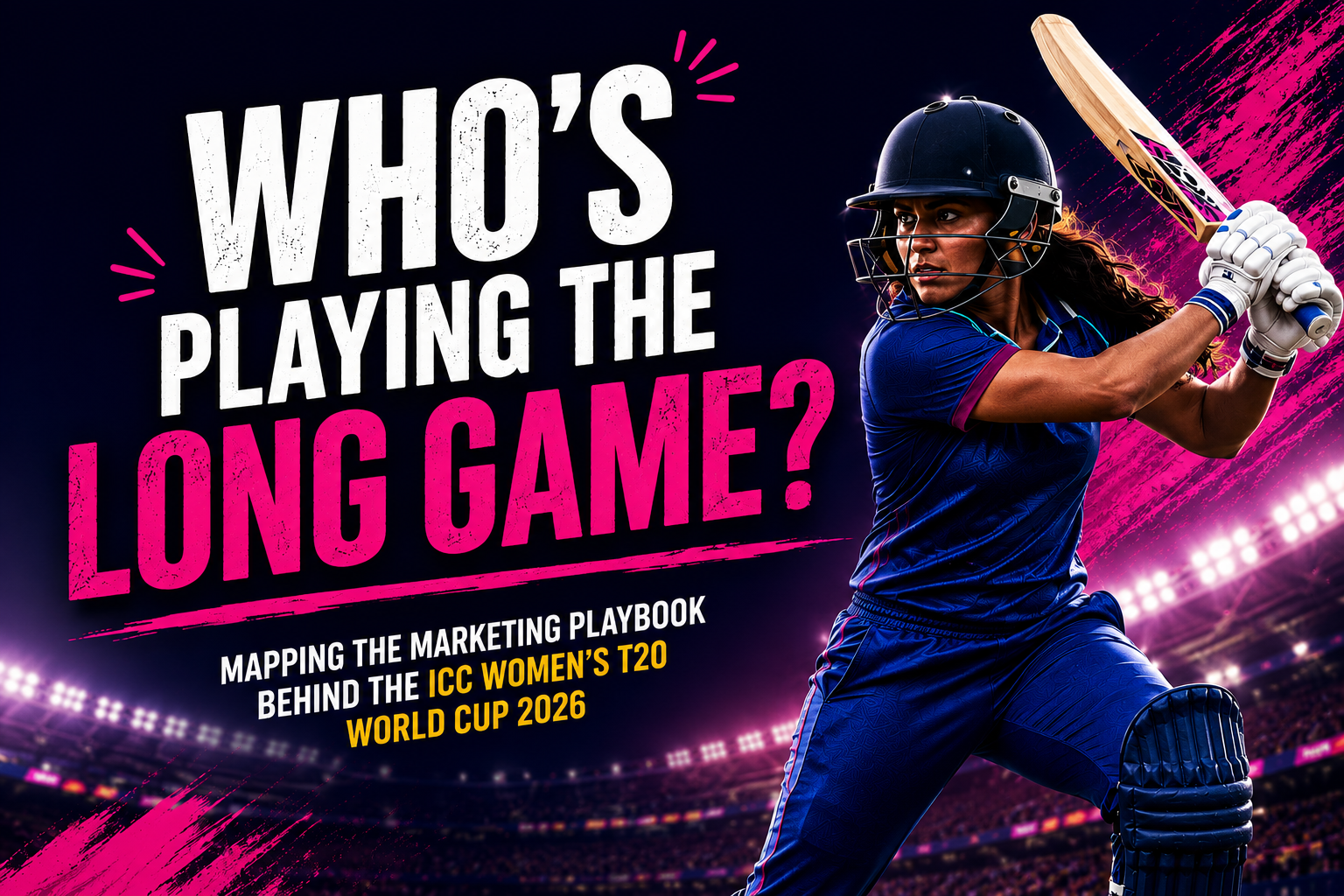
Women’s cricket has quietly transformed from a “CSR‑flavoured experiment” into one of the fastest‑expanding commercial properties in global sport. In earlier editions of the ICC Women’s T20 World Cup, brands largely treated the event as a marginal add-on, with limited fan-facing campaigns and a narrow, TV-centric gaze. The 2020 edition, held in Australia, drew 136,549 fans across the entire tournament, an honest but modest baseline by today’s standards. (Source: ICC-Cricket)
By 2024-25, the game’s commercial footprint had already begun to shift. The ICC Women’s T20 World Cup 2024 was backed by 14 national‑ and regional‑level sponsors across automotive, tech, finance, and FMCG, signaling that brands were no longer just “testing” women’s cricket but investing in measurable reach. (Source: Sports Mint)
Now, the ICC Women’s T20 World Cup 2026 is on course to become the biggest edition in the tournament’s history, with ticket sales having already crossed 145,000 and projections pointing toward 150,000+ as the 5 July final approaches, according to cricket‑news coverage of the record‑shattering box‑office. Ticket‑sales data show that the 2026 edition has already surpassed the 136,549‑fan total recorded across all matches of the 2020 Women’s T20 World Cup in Australia, a figure widely cited as the prior attendance benchmark.
Women’s T20 World Cups in the last cycle delivered over 1.3 billion video views and several hundred million viewing hours, according to ICC‑reported data and media analysis of the 2023 event, turning the tournament from a ‘feel‑good’ sidebar into a high‑attendance, high‑engagement IP that brands actively bid to associate with. (Source: Female Cricket)
In this article, we unpack which brands are investing in the ICC 2026 Women’s T20 World Cup, how they are scaling their marketing beyond logo‑only visibility, and what this evolving sponsorship tapestry reveals about 2026‑style, audience‑centric brand‑building, not just in cricket, but across industries.
The Brands Driving Women’s Cricket Forward
The ICC Women’s T20 World Cup 2026 is evolving into more than a sporting event; it is becoming a multi-industry marketing platform. Brands are using the tournament to drive digital engagement, grassroots participation, fan experiences, and global visibility, reflecting the growing commercial confidence in women’s cricket. (Source: Business Outreach)
1. Premier Partners Driving Global Visibility
At the top of the sponsorship structure are the ICC’s premier global partners, brands that are attached to major ICC events across the 2026–27 cycle, including the ICC Women’s T20 World Cup 2026. This tier includes Emirates, Aramco, DP World, and Hyundai. These brands form the tournament’s highest-visibility commercial layer, with strong presence across broadcast integrations, stadium branding, and global event campaigns. Their involvement helps position the Women’s T20 World Cup as a premium international sporting property rather than a niche event.
2. Global Brands Expanding the Women’s Cricket Ecosystem
The second layer of sponsors includes category-specific global brands that are increasingly investing in the ICC’s women’s events portfolio. This includes Coca-Cola, Sobha Realty, Rexona under Unilever, Budweiser, Marriott Bonvoy, and Google. These partnerships go beyond logo visibility and focus more heavily on fan engagement, hospitality, digital experiences, grassroots participation, and lifestyle-driven marketing around the women’s game. (Source:
3. Official Supporters Focused on Tournament Activations
The third sponsorship layer consists of official supporters directly attached to the ICC Women’s T20 World Cup 2026 itself. Kettle Chips was announced as an official supporter with a strong focus on youth audiences, fan activations, and on-ground engagement across England and Wales. Alongside it, Royal Stag has also been positioned within the official supporter tier, helping strengthen the tournament’s commercial reach in major cricket markets like India. These partnerships are more activation-led and audience-focused, helping extend the tournament’s cultural and consumer presence beyond the matches themselves.
(Source: Business Outreach)
What the 2026 Sponsorship Ecosystem Tells Brands About Brand Building
The sponsorship mix around the ICC Women’s T20 World Cup 2026 isn’t just a list of logos; it’s a live‑run model of how brands are reallocating budgets from legacy‑centric events to high‑growth, equity‑driven platforms. ICC Chief Commercial Officer Anurag Dahiya has explicitly framed the 2026 Women’s T20 World Cup as a “period of unprecedented growth” for women’s cricket, where stronger consumer brands don’t just buy rights, but create new fan‑engagement formats, co‑branded experiences, and digital activations that amplify the sport’s visibility.
For brands, this suggests a clear playbook:
- Tech platforms (like Google) anchor themselves as infrastructure partners, using the tournament as a high‑traffic sandbox for AI‑driven, data‑smart storytelling and product‑led engagement.
- FMCG and challenger brands (such as Kettle Chips, Unilever, Coca Cola, Rexona, Budweiser, and Royal Stag) invest in community‑rooted, category‑specific campaigns, pack‑on‑pack SKUs, on‑stadium activations, and digital‑payment‑driven fan journeys that deepen emotional equity rather than just broadcast presence.
What makes this 2026‑specific is that women’s cricket is no longer a “test‑market”; it has measurable growth, sell‑out‑level ticket demand, and global digital‑viewership jumps that justify long‑term commercial partnerships.
Conclusion: A 2026‑Style Marketing Blueprint
The ICC Women’s T20 World Cup 2026 has evolved into a high‑growth, data‑driven marketing ecosystem where brands don’t just buy visibility, but build equity. Global tech platforms like Google act as infrastructure partners, while FMCG, payments, and hospitality brands such as Kettle Chips, BHIM, and Marriott Bonvoy invest in community‑rooted, product‑led activations.
Together, they reveal a 2026‑style playbook: long‑term brand building now happens on purpose‑aligned, audience‑centric platforms that solve real‑time problems, accessibility, engagement, and experience, rather than relying on legacy‑centric, one‑off campaigns. In this sense, the Women’s T20 World Cup 2026 becomes less a cricket event and more a live‑run blueprint for integrated, data‑smart marketing across industries.