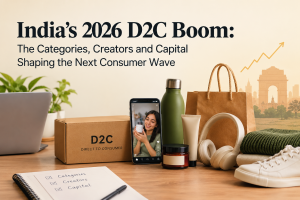



Customer loyalty is becoming an increasingly important business priority in India. According to industry estimates, the country’s loyalty market is expected to grow by 17.7% annually, reaching US$4.07 billion by 2026, reflecting how aggressively brands are investing in customer retention and engagement strategies. (Source: Yahoo Finance)
For years, loyalty was often measured through repeat purchases, discounts, cashback offers, customer feedback, and rewards programmes. But in today’s digital-first market, especially across fashion and personal care, loyalty metrics aren’t achieved simply because a brand is visible or affordable. They are staying loyal to brands that feel relevant, trustworthy, and consistent in the experiences they provide.
This shift is becoming increasingly visible among modern Indian D2C brands.
The rise of social commerce, now a powerhouse at USD 114.42 billion in 2026, alongside seamless online discovery and fast-moving trends, has made brand switching effortless for users through Instagram Reels, WhatsApp checkouts, and quick commerce deliveries within minutes. (Source: Research and Markets) In high-competition categories like skincare, wellness, fashion, and apparel, consumers face endless options at their fingertips, with over 60% of Gen Z relying on digital influencers and creator content for decisions, often prioritizing trend-aligned efficacy over legacy names. (Source: Makreo Research)
India’s e-retail grew 25% in Q1 CY2026 per Flipkart-Bain, fueled by quick commerce (16-17% of total GMV, vs. China’s share), which drives impulse trials via 8-12 minute deliveries and matured shopper behavior. (Source: The Economic Times) Consequently, modern loyalty depends less on transactions and more on product credibility, customer experience, transparency, and emotionally relevant storytelling, especially in highly competitive D2C sectors like apparel and beauty.
That transition is evident in the way emerging brands are positioning themselves today.
In the personal care space, brands are moving away from generic marketing promises and instead focusing on efficacy, research, and ingredient transparency. Consumers are becoming more informed about formulations and product claims, which means trust is increasingly tied to whether products genuinely deliver value.
This shift is also becoming increasingly visible across the market itself. Consumers today are moving toward brands that prioritise efficacy, transparency, and credibility, particularly in categories like beauty and personal care, where trust plays a central role in purchase decisions.
This is one of the ideas that shaped Innovist, a company with sister brands like Vinci Botanicals, Chemist at Play, SunScoop, and Bare Anatomy.
The company entered the market after identifying a growing gap between consumer expectations and the products available in India’s personal care ecosystem. Instead of competing through exaggerated claims, the brand focused on building research-backed and effective products that remained accessible to Indian consumers.
As Rohit Chawla, one of the founders of Innovist, puts it:
“What makes a brand stand out is delivering the same great experience every time. It’s all about maintaining that consistency of providing the best of your brand, basically.” (Source: Interview with Rohit Chawla, CEO, Innovist)
Consumer loyalty, not only in India, but everywhere, thrives when consumers feel the brand is fair, transparent, and consistent in how it delivers value, reinforcing fairness-driven brand preference. (Source: Market Xcel)
This is especially true in personal care, where trust directly influences retention. Consumers are increasingly aware, often researching ingredients and formulations before making decisions. Eventually, true and result-driven are beginning to create stronger emotional and functional connections with their audiences.
The same transformation is taking place in fashion. Redseer’s 2026 report notes 150+ new-age BPC brands will cross Rs 100 crore revenue by 2030, capturing India’s $40B beauty market through digital-first models and Gen Z’s demand for transparency, a pattern emerging in trend-driven apparel too. (Source: Professional Beauty India) Brands are ramping up influencer marketing investments to build authentic consumer trust, as a favorite influencer’s PR thumbs-up delivers instant recognition on social media.
That thinking is reflected in brands like OffDuty India.
Founded around the idea of bridging the gap between international denim trends and what Indian consumers could easily access, the brand built its identity around contemporary silhouettes, comfort, and youth-driven styling. But beyond fashion itself, the company’s larger focus has remained rooted in customer experience.
As the founders themselves explain:
“Our only clear vision is to always be for the people because we are made by the people. Our focus right now is the experience we provide to our customers – style, quality, fit, and service.” (Source: OffDuty India, About Us)
That idea captures one of the biggest changes shaping modern loyalty today.
This has become increasingly important as customer acquisition costs continue rising across digital platforms. D2C CAC has surged 22-35% in India, averaging ₹5,500-₹7,000 per customer due to ad competition and privacy norms. (Source: Sudha Solutions)
This has become increasingly important as customer acquisition costs continue rising across digital platforms. In many sectors, acquiring attention has become easier than retaining trust. As a result, brands are beginning to shift their focus from short-term conversions toward long-term relationship building.
For some companies, that means investing in better research and product development. For others, it means improving personalization, customer support, or community-led engagement. But across categories, the larger goal remains the same: building meaningful consumer relationships that extend beyond individual transactions.
That is where brands like Innovist and OffDuty become particularly relevant to the broader conversation around loyalty.
While both operate in different industries, they are responding to a shared consumer expectation: authenticity. One is building loyalty through research-backed credibility and consistency, while the other is building it through customer experience and cultural relevance.
And perhaps that is the clearest shift defining modern loyalty today.
In an era shaped by endless choice and constant digital discovery, consumers are not staying loyal because brands ask them to. They stay loyal because certain brands continue to give them reasons to return.