

For a long time, online shopping followed a familiar pattern. Consumers searched for a product, compared prices across websites, read reviews, and eventually made a purchase. But that journey is beginning to change. Today, a product recommendation in a video, a creator demonstrating a new gadget or a skincare routine shared online, can influence what someone decides to buy.
Shopping is increasingly becoming part of the content people consume every day. Recognising this shift, YouTube has expanded its Shopping affiliate programme to the UAE, Saudi Arabia and Egypt, bringing content and commerce closer together in the Middle East.
The programme, launched on October 26, 2026, allows eligible creators to tag products directly in their videos, YouTube Shorts and livestreams. When viewers purchase these products through the tags, creators earn commissions. Amazon has joined as the programme’s first retail partner in the three markets, with YouTube planning to bring more retailers on board. (Source: Campaign Middle East)
While the announcement is another step in the growth of the creator economy, its implications extend beyond creators earning from product recommendations. It points towards a larger change in how people discover products, evaluate brands, and make purchasing decisions.
Shopping Is Moving Beyond Search And Product Listings
Traditionally, e-commerce platforms have depended heavily on consumers knowing what they want before they begin shopping. A person looking for a new smartphone, for instance, might search for different models, compare specifications, and read customer reviews before choosing one.
Video platforms like YouTube are introducing another way to approach this journey.
A consumer watching a smartphone review may discover a model they had not considered. Someone following a fitness creator might come across a new fitness accessory, while a viewer watching a cooking tutorial could discover kitchen products being used in real time.
In these situations, the shopping journey begins with interest rather than a specific product search.
YouTube’s own numbers indicate how significant this behaviour has become. The company says people worldwide watch more than 40 billion hours of shopping-related content on the platform every year. In June 2026 alone, more than 40 million logged-in users across Egypt, Algeria, Morocco, Saudi Arabia and the UAE conducted shopping-related searches on YouTube. (Source: Arabian Business)
This suggests that consumers are increasingly using video platforms not just for entertainment but also to research products and make informed buying decisions.
For e-commerce brands, this creates an opportunity to reach potential customers much earlier in their purchasing journey.
Also Read: Newspaper Advertising in 2026: How Brands Are Making Print More Creative – TrustCircle
Why Creator Recommendations Are Becoming Important To Shopping
One of the biggest reasons behind this shift is the growing influence of content creators.
Unlike conventional advertisements, creator-led content often places products within everyday situations. A beauty creator can demonstrate how a product works, a technology reviewer can explain its strengths and limitations, and a fashion influencer can show how different products look when worn.
This gives consumers an opportunity to see products in use rather than relying entirely on product descriptions and promotional images.
A Kantar survey cited by YouTube highlights this influence in the Gulf. Among surveyed viewers in Saudi Arabia and the UAE, 94% associated YouTube with the best shopping-related instructional videos, while 85% said the same about product reviews and 80% about unboxing videos.
The survey also found that 86% considered YouTube to have the most trusted creators for shopping recommendations. In Saudi Arabia, 84% of surveyed viewers said the platform helped them make more confident purchasing decisions. (Source: Arabian Business)
These findings point towards an important development: trust is becoming a significant part of product discovery.
For brands, the question is no longer simply how many people see their products. It is also about who introduces those products to consumers and whether the recommendation carries credibility.
YouTube Is Bringing Product Discovery Closer To Purchase
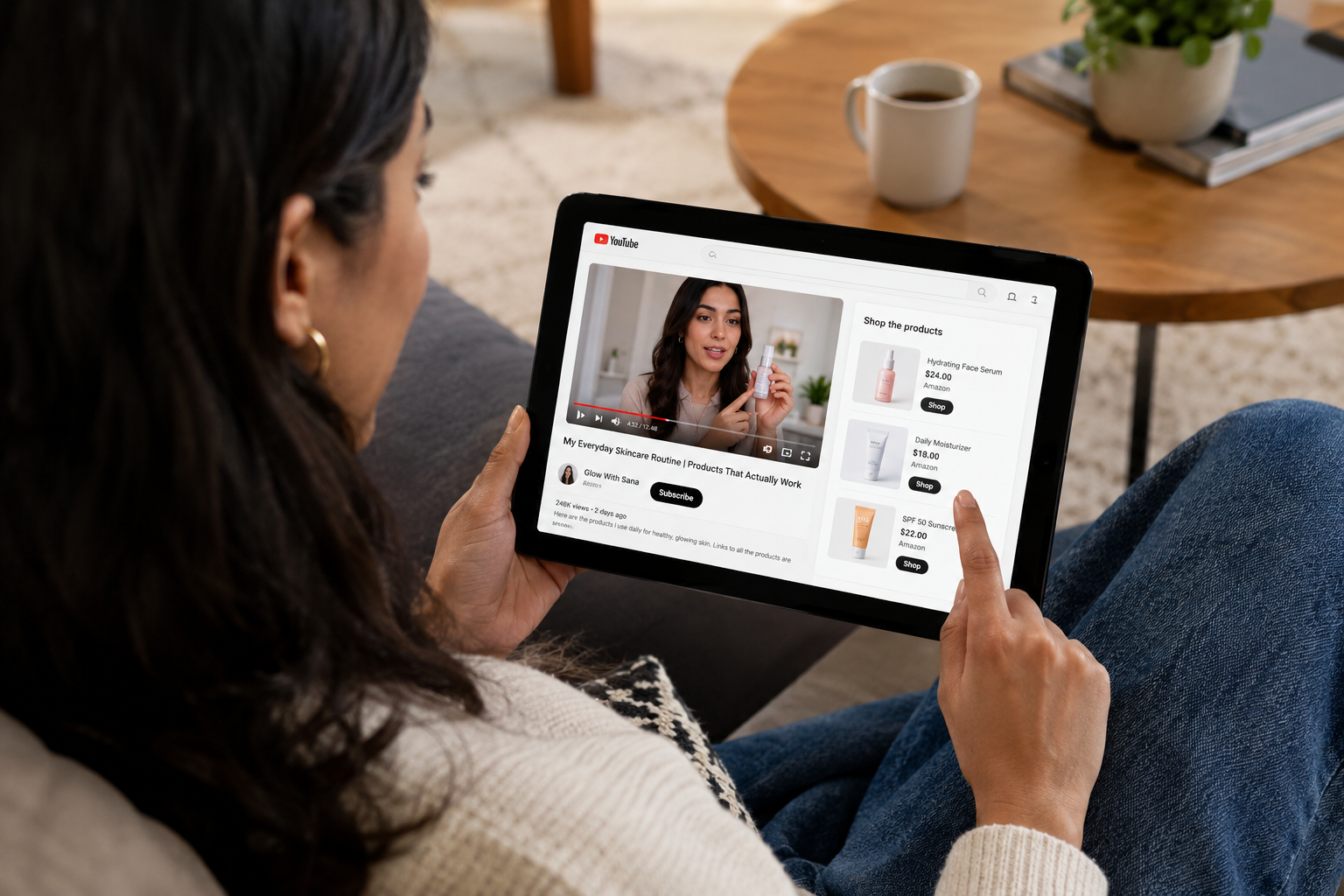
The new Shopping affiliate programme takes this relationship a step further by connecting product recommendations with the purchasing process.
Previously, creators often shared product links in video descriptions, pinned comments, or separate social media posts. Viewers had to leave the content, find the relevant link, and visit the retailer’s website.
YouTube Shopping makes this process more direct. Eligible creators can tag products within their videos, Shorts, and livestreams, allowing viewers to access product information and continue to the retailer’s checkout page.
The platform is also using Google AI to identify products appearing in videos and suggest relevant product tags. This reduces the manual effort involved in finding and adding product links.
Another interesting feature extends the experience to television screens. Viewers watching YouTube on connected TVs can scan an on-screen QR code using their smartphones and continue with the purchase.
Together, these features reflect a larger direction for digital commerce. The focus is gradually moving towards making purchasing easier at the moment a consumer becomes interested in a product.
However, the transaction still takes place through the retailer’s website. The shift is not necessarily about replacing e-commerce platforms but about making them accessible from more places where consumers already spend their time.
Also Read: Beyond Reach: How Cultural Moments Are Changing the Economics of Advertising – TrustCircle
What This Means For D2C And E-commerce Brands
For D2C and e-commerce businesses, the expansion of YouTube Shopping offers a reason to rethink how they approach digital visibility.
For years, brands have invested heavily in search engine optimisation, paid advertising, marketplace listings and social media campaigns to attract customers. These channels will continue to matter, but content-led discovery is becoming another important part of the mix.
1. Product content will need to do more than attract views
Brands may need to look beyond creating videos simply to generate reach and engagement. Product demonstrations, comparisons, tutorials, and honest reviews can help consumers understand how a product fits into their everyday needs.
A video that answers a genuine customer question may influence a buying decision more effectively than content focused entirely on promoting a product.
2. Creator partnerships could become more performance-oriented
The affiliate model introduces a direct link between product recommendations and purchases. Rather than relying only on fixed-fee collaborations or brand awareness campaigns, businesses can explore partnerships where creators earn commissions on qualifying sales.
This also creates opportunities to work with smaller, niche creators whose audiences may be highly interested in particular product categories.
The lower eligibility threshold of 500 subscribers for creators in the YouTube Partner Programme makes the programme accessible to a wider range of emerging creators, subject to YouTube’s requirements.
For brands, this could mean building relationships with creators based on audience relevance, product knowledge, and the quality of their recommendations rather than follower numbers alone.
3. Product discovery will become more distributed
A brand’s potential customers may not always arrive through its website or a marketplace search. They could discover a product through a YouTube review, a creator’s livestream, or a short video shared across social platforms.
This makes it important for businesses to develop a consistent product presence across different digital environments. Product information, pricing, availability, and customer experience need to remain reliable wherever consumers discover the brand.
4. The quality of the buying experience will still matter
Making a product easier to discover does not automatically guarantee a sale. Consumers still consider pricing, delivery timelines, payment options, return policies, and customer support before completing a purchase.
Brands that attract attention through creators but fail to provide a dependable buying experience may struggle to convert that interest into long-term customer relationships.
The opportunity, therefore, lies in connecting engaging content with a reliable e-commerce experience.
AI Could Make Content-Led Shopping More Seamless
Another development worth watching is the role of artificial intelligence in connecting content with commerce.
YouTube’s AI-powered product identification is an early example of how technology can reduce the distance between what viewers see and what they can purchase.
As these capabilities develop, product discovery could become more contextual. Instead of searching manually for an item featured in a video, consumers may increasingly be able to identify products, compare available options, and access relevant buying information directly from the content they are watching.
This could also create new opportunities for brands to make their product catalogues more accessible across platforms.
For e-commerce businesses, it will become increasingly important to maintain accurate product information, clear descriptions, and updated availability. As AI-powered discovery tools become more common, the quality of the information brands make available could influence how easily their products are identified and recommended.
Also Read: Southeast Asia’s AI Boom: Why Adoption Must Now Translate Into Business Value – TrustCircle
The Future Of Shopping Will Be About Being Present At The Right Moment
YouTube’s expansion into the UAE, Saudi Arabia, and Egypt is an important development for the region’s creator and e-commerce industries. With Amazon as its first retail partner and plans to introduce more local and international retailers, the programme also signals the possibility of a wider social commerce ecosystem taking shape across the Middle East.
But the larger change is not limited to one platform or one affiliate programme.
Consumers are increasingly discovering products through content, seeking recommendations from people they trust, and expecting fewer steps between interest and purchase. The boundaries between entertainment, information, and shopping are becoming less distinct.
For D2C and e-commerce brands, this means that future growth may depend not only on where products are listed but also on where and how consumers encounter them.
Traditional online stores, search engines, and marketplaces will remain important. However, they will increasingly operate alongside content platforms, creator communities and AI-assisted discovery experiences.
The brands that recognise this shift early will be better placed to build visibility beyond conventional storefronts. Because the next phase of e-commerce may not begin when a consumer opens a shopping website. It may begin much earlier, when a product catches their attention in a video they were watching for entirely different reasons.