

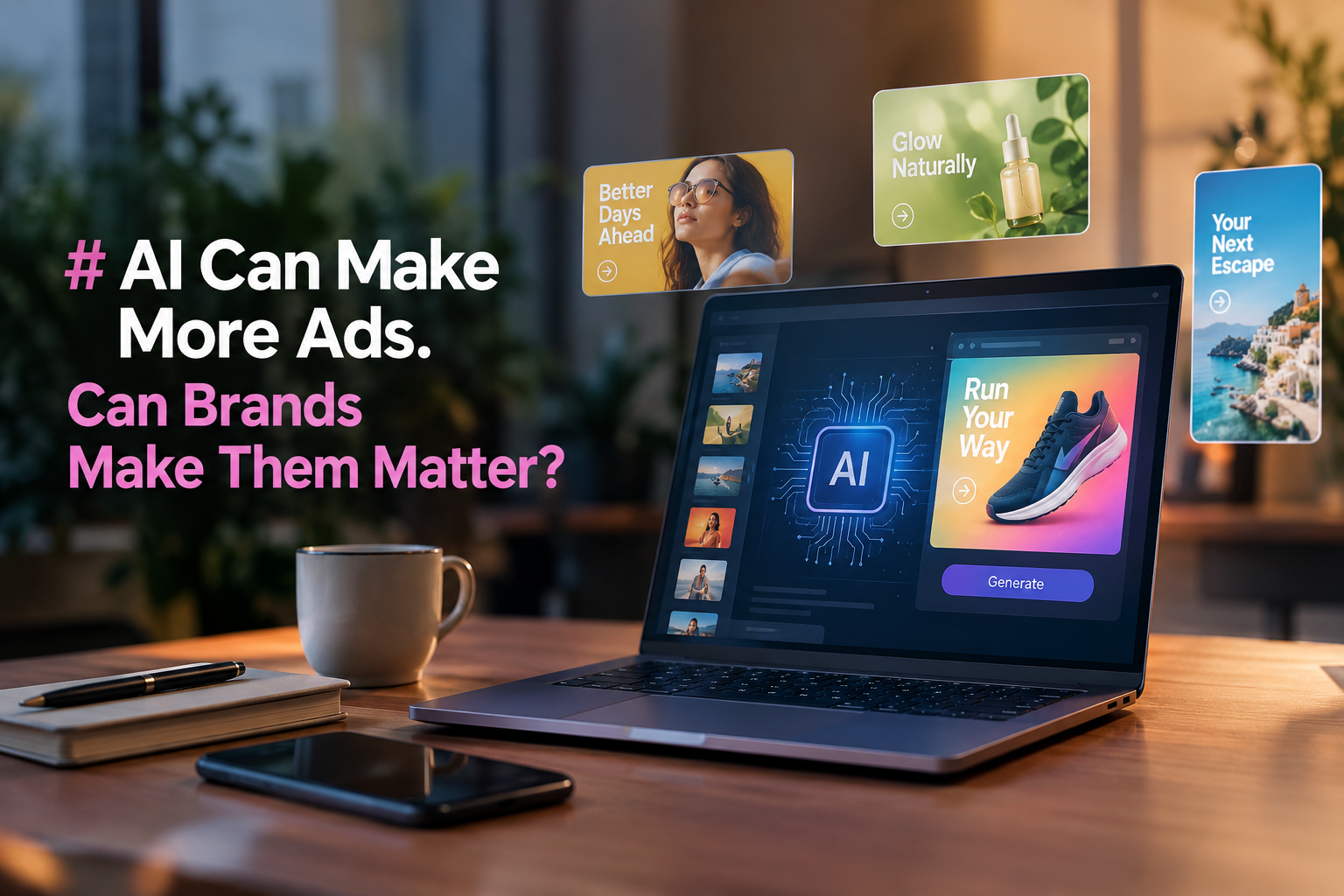
Digital advertising has long rewarded brands for reaching more people, generating more clicks, and producing more creative variations. Generative AI has accelerated all three. A campaign that once required weeks of production can now be adapted into dozens of formats, messages, and visual treatments in a fraction of the time. But as AI makes advertising easier to produce, a more important business question is emerging: what happens after the ad gets noticed?
That distinction is becoming more important as India’s digital advertising ecosystem becomes more fragmented and brands compete not just for reach, but for attention and action.
The Production Problem Is Being Solved. The Attention Problem Isn’t.
AI has fundamentally changed the economics of creative production. Brands can generate multiple product visuals, rewrite copy for different audiences, test formats and personalise communication without rebuilding every asset from scratch. That creates an obvious advantage for performance marketing. More variations mean more opportunities to test what works. Yet more content does not automatically create more attention.
A September 2026 advertising industry analysis cited an August NP Digital study in which fully AI-generated content represented 52.1% of new content but attracted only 4.9% of organic traffic, while human-created content represented just 14.5% of output but accounted for 87% of organic traffic. The figures are about organic content rather than paid advertising, but they illustrate a broader challenge: production volume and audience interest are not the same thing. (Source: exchange4media)
For brands, that means AI should not simply become a way to increase content output. Its greater value may lie in helping marketers make smarter creative decisions faster.
When More Clicks Don’t Mean More Customers
The gap becomes clearer when advertising is judged further down the funnel. A June 2026 randomized field experiment involving more than 150 video ads found that AI-generated creatives delivered stronger click-through rates and viewer retention, but were less effective at driving conversions than human-created ads. (Source: scholars.hkbu.edu.hk)
A separate large-scale study of display advertising, covering more than 16 billion impressions and 116 million clicks, found that AI-generated images could deliver higher CTRs than human-made visuals—but the advantage depended on whether the ads appeared obviously AI-generated. (Source: business.columbia.edu)
Together, these findings point to a useful lesson for marketers: winning attention and winning the customer are not necessarily the same thing. An ad can generate the click without necessarily creating enough trust, relevance or intent to complete the purchase.
AI’s Strongest Role May Be Inside the Funnel
The most commercially interesting use of AI may not be replacing the creative idea at all. It may be helping brands adapt a strong idea to different consumer contexts. The value, then, is not simply in producing more ads, but in making each variation serve a clearer purpose. A shopper comparing two products may need a different message from someone who has already visited a product page. A first-time buyer may need education, while a returning customer may respond to an offer or reminder. AI can help create these variations at scale.
A recent Usha campaign with Amazon Ads’ AI-powered image generation, for example, reported a 2.4-fold increase in branded searches, 36% higher ad-driven page views and a 32% improvement in ROAS. The campaign also involved audience targeting and a broader advertising strategy, so the results cannot be attributed to AI-generated imagery alone. Still, the case demonstrates where AI can become commercially useful: connecting faster creative production with a specific consumer and purchase context. (Source: exchange4media)
This is a more practical way for brands to think about AI—not as a replacement for creative strategy, but as an engine that makes strategy more responsive.
The New Creative Advantage Is Relevance
The bigger challenge for AI-powered advertising may not be a shortage of ideas. It may be that consumers start seeing too many variations of the same idea. When every marketer has access to similar models, image generators and optimisation tools, production speed stops being a sustainable differentiator. The advantage then shifts towards factors that cannot be created simply by increasing output: consumer insight, cultural context, originality and a reason to care.
That is particularly important as advertising becomes increasingly personalised. Personalisation only creates value when the message feels useful. Otherwise, it simply allows brands to deliver irrelevant communication more efficiently.
For businesses, this changes the creative brief. Instead of asking, “How many versions can AI create?”, marketers need to ask, “Which consumer problem are these versions helping us solve?”
From Creative Efficiency to Business Efficiency
The next phase of AI advertising will therefore be less about proving that machines can make ads and more about proving that they can improve marketing outcomes. That requires brands to connect creative metrics with business metrics. CTR can indicate interest. Engagement can indicate interaction. ROAS can indicate attributed return on ad spend. But none, by itself, establishes incremental sales, profitability, or long-term customer value.
AI gives marketers the ability to test more, personalise faster and respond to signals sooner. The opportunity is significant—but only when those capabilities are tied to a clear business objective. The advertising industry may soon have more creative than it knows what to do with. The brands that benefit won’t necessarily be the ones producing the most. The real advantage will come from using AI to make every piece of creative more relevant, every interaction more purposeful, and every marketing decision more closely connected to business value.