

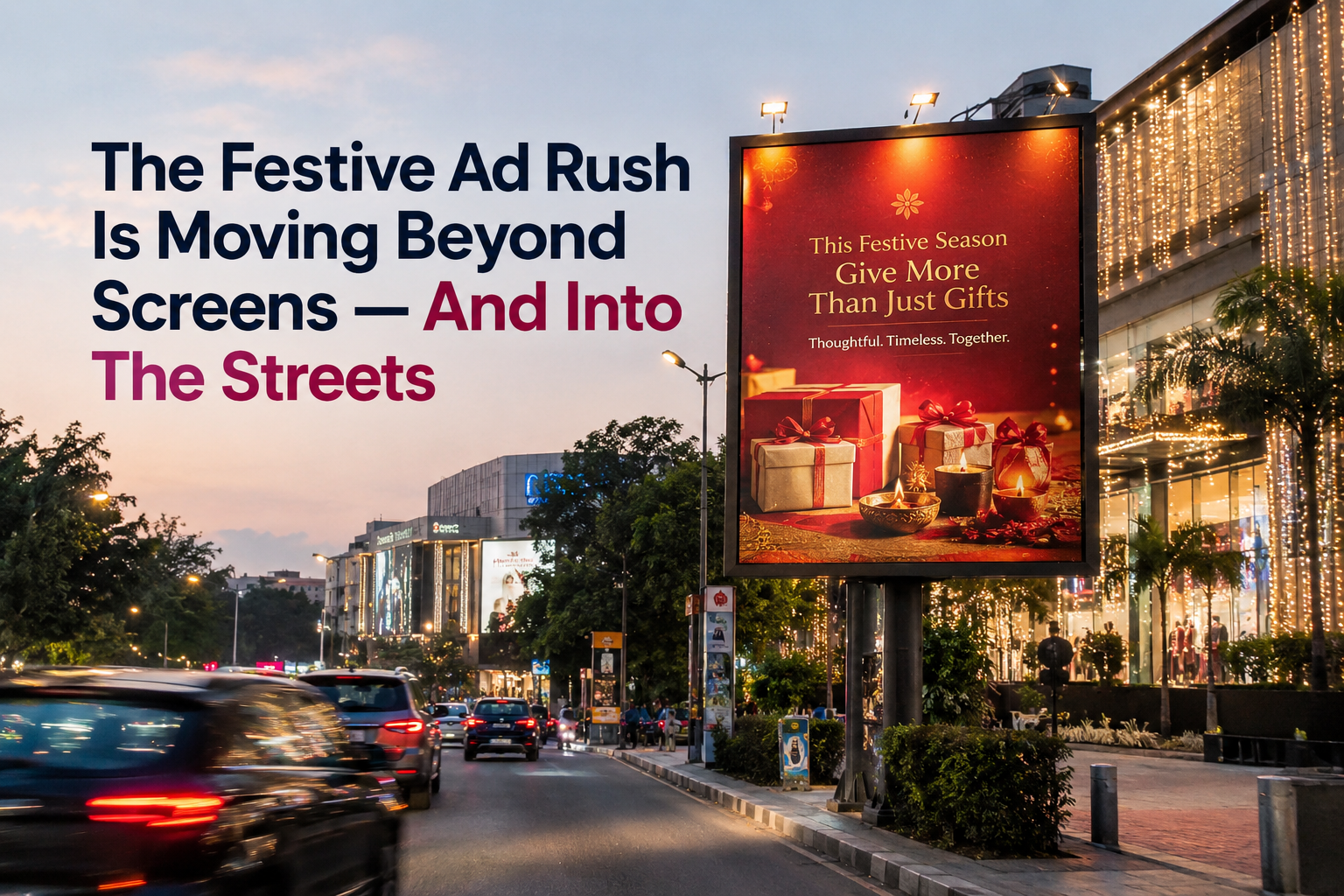
India’s festive advertising season is becoming a much longer and more competitive media cycle, with out-of-home (OOH) advertising emerging as an important part of that shift. Festive OOH spending is expected to grow by 15–20% in 2026, with the opportunity estimated at around ₹2,300–2,400 crore. More significantly, premium inventory across key markets is already seeing heavy demand, with around 70–80% of prime festive inventory booked or committed. (Source: exchange4media)
But the bigger story is not simply that OOH is growing. It is who is buying it, why they are buying it, and how they are using it. As brands rethink their festive media strategies, OOH is increasingly becoming part of a broader effort to build visibility, strengthen brand recall and influence consumers beyond the digital screen.
Digital-First Brands Are Buying Physical Attention
For years, brands built around apps, marketplaces and digital acquisition largely treated OOH as a supporting medium. That equation is changing. E-commerce, quick commerce, smartphones, fintech, and BFSI brands are increasingly appearing on streets, transit networks, airports, and in premium retail environments during the festive period.
This signals a broader maturity in digital-first marketing. Once customer acquisition becomes increasingly expensive and competitive online, simply appearing in another feed does not necessarily create stronger brand memory. A physical presence can add scale, familiarity and legitimacy before the consumer returns to a screen to search, compare or purchase.
For brands accustomed to measuring every click, OOH therefore represents a different but complementary role: creating consideration before conversion begins.
The Festive Calendar Is Creating A Bigger Advertising Window
The demand is also being supported by the structure of India’s festive calendar. The season now stretches across Onam, Ganesh Chaturthi, Navratri, Durga Puja, Dussehra, Diwali, and eventually Christmas and New Year. In 2026, Diwali, falling in November, provides an additional runway for brands to build momentum. This is an extended cycle in which consumer mobility, spending, and brand activity converge. ( Source: storyboard18 )
That matters for OOH because the medium benefits from increased movement outside the home. Consumers are travelling, visiting markets, going to malls, and spending more time in public spaces. Consequently, the value of a billboard, airport screen, or transit asset is no longer just the number of impressions it can generate. Its location within the consumer journey becomes equally important.
Premium Inventory Is Becoming A Strategic Asset
The growing importance of OOH is changing the way brands need to approach media planning. When visibility depends heavily on location, context and consumer movement, buying OOH cannot simply be treated as another line item added after digital, television or commerce budgets have been finalised.
For marketers, the strategic question is no longer just where an advertisement can be placed, but where it can add value to the consumer journey. A high-traffic location may build broad awareness, while an environment closer to retail, transit, or commercial hubs can reinforce consideration at a more relevant moment.
This makes OOH planning less about securing space and more about securing the right context. Brands that define their audience, campaign objective, and desired consumer action before selecting locations can use outdoor media as a more purposeful part of the overall festive strategy.
The shift also makes early planning important. Rather than approaching OOH as a last-minute visibility play, brands can build it into the campaign from the beginning and connect outdoor exposure with the digital, commerce, and retail experiences that follow.
OOH Is Becoming More Data-Led, Not Less
The evolution of OOH is also visible in the formats brands are choosing. Large-format billboards remain important for scale, but transit, airports, malls and digital OOH are attracting increasing interest. Industry estimates cited by Exchange4media put DOOH at roughly 18–24% of OOH, depending on the market definition, while some operators report a considerably higher share of their Diwali bookings coming from digital formats. (Source: exchange4media)
The significance of DOOH (Digital Out‑of‑Home advertising) goes beyond putting a digital creative on a larger screen. It allows brands to change messages, respond to context, and use shorter tactical bursts around specific moments.
That makes OOH more compatible with the way modern marketing teams already think. Instead of buying a site simply because it is available, marketers can consider audience profile, dwell time, visibility, location,n and the role of each asset within the wider campaign.
The Real Opportunity Is Integration
OOH is increasingly becoming part of a broader media strategy rather than operating as a standalone channel. Its value lies in how it works alongside digital, television, commerce, and retail touchpoints, allowing brands to create visibility at different stages of the consumer journey. Digital can drive targeting and engagement, while OOH can add physical scale, familiarity and presence.
That distinction is important for brands. A festive campaign does not need every medium to perform the same role. A large billboard can build stature, transit can deliver repeated exposure, DOOH can offer flexibility, while retail and commerce environments can bring the consumer closer to purchase.
The opportunity, therefore, is not about choosing OOH versus digital, but about understanding where each medium can complement the other. When these touchpoints are planned as part of one connected journey, OOH can move beyond visibility and become a meaningful contributor to the wider campaign.
From Visibility To Consideration
The biggest change in festive OOH may ultimately be strategic rather than technological. As digital-first brands enter physical spaces, OOH is being asked to do more than generate reach. It is becoming part of the journey that takes a consumer from recognition to consideration and eventually to action.
For marketers, that means the question is no longer simply, “How many people saw the billboard?” It is increasingly, “What role did that visibility play in the consumer’s path to purchase?”
With premium inventory tightening and festive advertising becoming more fragmented across digital, commerce and physical environments, brands that understand that connection early can build campaigns around the entire consumer journey rather than individual media channels.
The festive advertising battle is therefore not just getting bigger. It is becoming more strategic — and increasingly, part of that strategy is happening outside the screen.