

Brands have spent years making technology feel more human. Now, it is finding its place in one of the most personal spaces of all: the family living room.
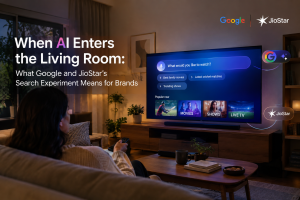
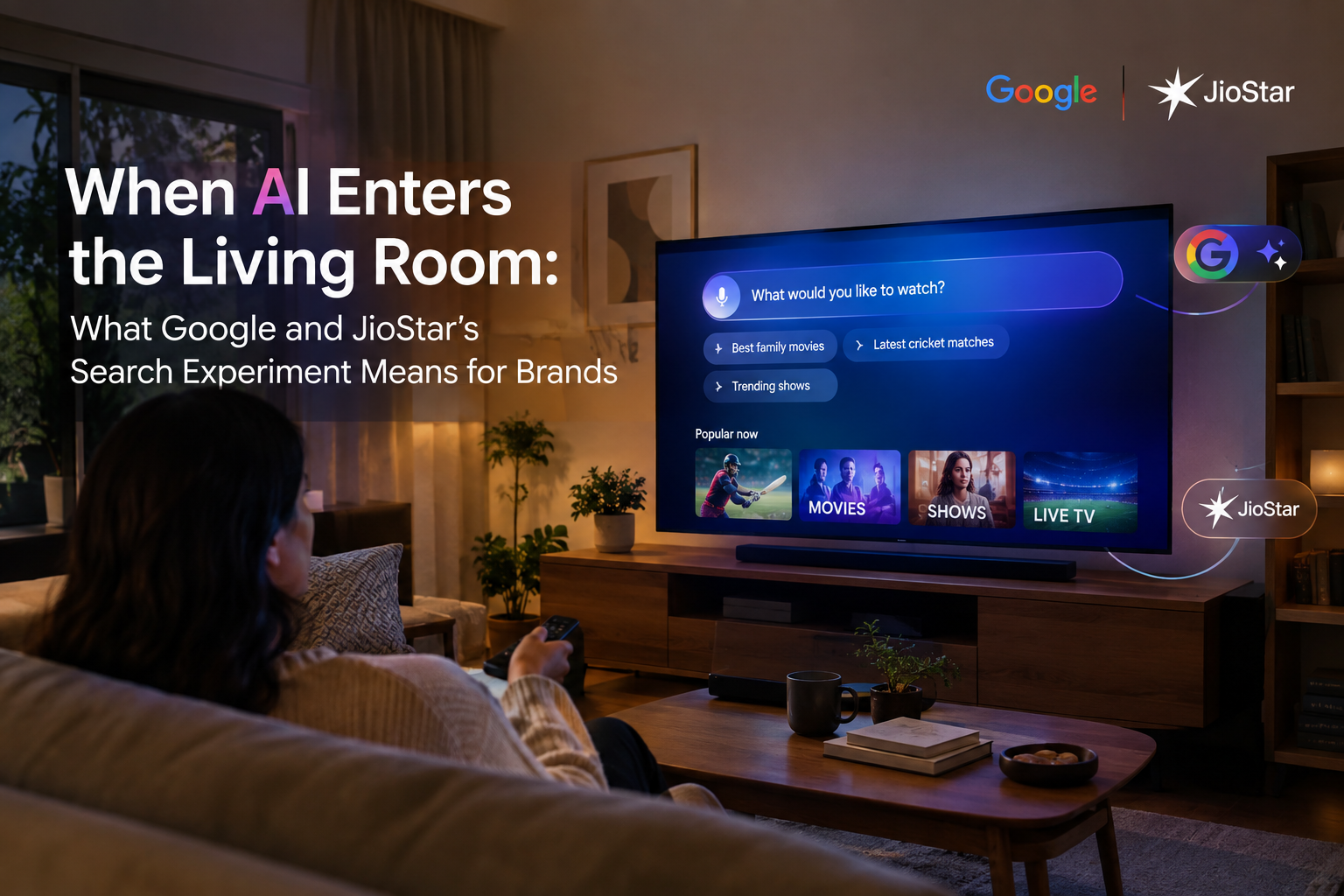
Google India and JioStar’s new partnership brings Google Search AI Mode into the storylines of popular Hindi television shows Anupama and Yeh Rishta Kya Kehlata Hai. Rather than presenting AI as a distant piece of technology, the campaign places it inside familiar situations involving household budgets, career decisions, children’s education and even building a new home. The campaign will run across television, JioHotstar, and digital out-of-home formats, with JioStar saying its television network and streaming service together reach more than 800 million viewers every week. (Source: Economic Times)
That makes the initiative bigger than a conventional product integration. It points towards a changing philosophy of how technology can be marketed: don’t explain what AI can do; show people where it can fit into their lives.
From Product Demonstration to Everyday Storytelling
AI still carries a familiarity problem. For many consumers, particularly those who do not actively follow technology, terms such as generative AI, reasoning models and conversational search can sound abstract. The Google-JioStar campaign tackles that gap through context. When a character encounters a problem and another character suggests using AI Mode, the technology becomes part of an everyday decision rather than the subject of a technical demonstration.
That distinction matters for marketers. Consumers rarely adopt products because a brand tells them a feature exists. They adopt them when they understand why that feature is useful to them. Google’s AI Mode itself is designed around this shift. Users can ask longer, more complex questions, follow up conversationally, and use text, voice, or images to interact with Search. The partnership essentially translates those capabilities into situations that viewers already understand.
For brands, the lesson is straightforward: demonstration is becoming more powerful than description. (Source: Economic Times)
The Consumer Journey Is Becoming More Conversational
Traditional search behaviour was built around keywords. A consumer knew what they wanted, typed a few words, and received a list of links.
AI-powered Search changes the starting point. A person can explain a problem, add context, ask follow-up questions, and explore alternatives within the same interaction. Google says early AI Mode testers were asking queries two to three times longer than traditional searches, particularly for complicated tasks such as comparisons, planning and how-to questions. (Source: marketingmind)
This has significant implications for brands because consumer discovery is moving closer to intent-rich conversations.
A consumer researching skincare, for example, may no longer simply search “best moisturiser.” They could describe their skin type, budget, weather conditions and existing routine and then ask for recommendations. The opportunity for brands is therefore not merely to rank for one keyword, but to become relevant across the questions surrounding a consumer’s problem.
That requires a different content strategy: build useful information around consumer needs, not just product claims.
Entertainment Could Become the New AI Classroom
The choice of Anupama and Yeh Rishta Kya Kehlata Hai is particularly revealing. These are not technology-focused programmes. Their value lies in familiarity and emotional connection. That creates an important strategic opportunity for marketers. Entertainment can act as a bridge between emerging technology and mainstream behaviour.
Instead of asking audiences to step into a technology environment to understand a product, brands can bring the technology into environments audiences already inhabit. The result is potentially lower cognitive friction: viewers see a familiar character encounter a familiar problem and observe a technology solving it.
This approach can extend well beyond AI. Financial brands could demonstrate digital financial tools through everyday family decisions. Healthcare companies could use storytelling to explain preventive services. Retailers could show AI-assisted product discovery through realistic shopping dilemmas. The principle is the same: context creates comprehension.
The Next Advertising Advantage May Be Relevance, Not Reach
For advertisers, the partnership also signals a broader evolution in media strategy. JioStar is combining television, streaming and digital out-of-home formats rather than treating them as isolated channels. This reflects a consumer journey that increasingly moves across screens and contexts. But simply appearing everywhere is no longer enough. The more valuable question is whether a brand appears at the right moment with the right message.
Search itself is also becoming more conversational, with consumers moving beyond simple keywords to ask more detailed questions shaped by their specific needs and intent. As this behaviour evolves, brands need to think beyond visibility and focus on whether they can remain relevant throughout the consumer’s decision-making journey. ( Source: marketingmind)
That should encourage brands to rethink media planning. Instead of asking only, “How many people can we reach?” marketers should increasingly ask, “What question is the consumer asking at this moment, and can our brand help answer it?”
What Brands Should Do Next
The takeaway is that technology adoption is increasingly driven by relatable use cases.
Brands should identify the real questions consumers ask before, during, and after purchasing. They should create content that answers those questions naturally, optimise for conversational and multimodal discovery, and look for entertainment environments where those use cases can be demonstrated rather than merely advertised.
The Google-JioStar partnership therefore represents more than another media collaboration. It is a glimpse into a future where the boundaries between entertainment, search, technology, and advertising become increasingly fluid.
The brands that benefit from that future may not be the ones that talk the loudest about AI. They may be the ones who understand the simplest question: when consumers encounter a problem, can the brand become part of the answer?