

Digital advertising has competed for attention for years. Brands bought search keywords, social feeds, video placements and display inventory in the hope that a consumer would stop scrolling, notice a message and eventually make a purchase. ChatGPT is beginning to challenge that model by placing advertising much closer to the moment when a consumer is actually making a decision.
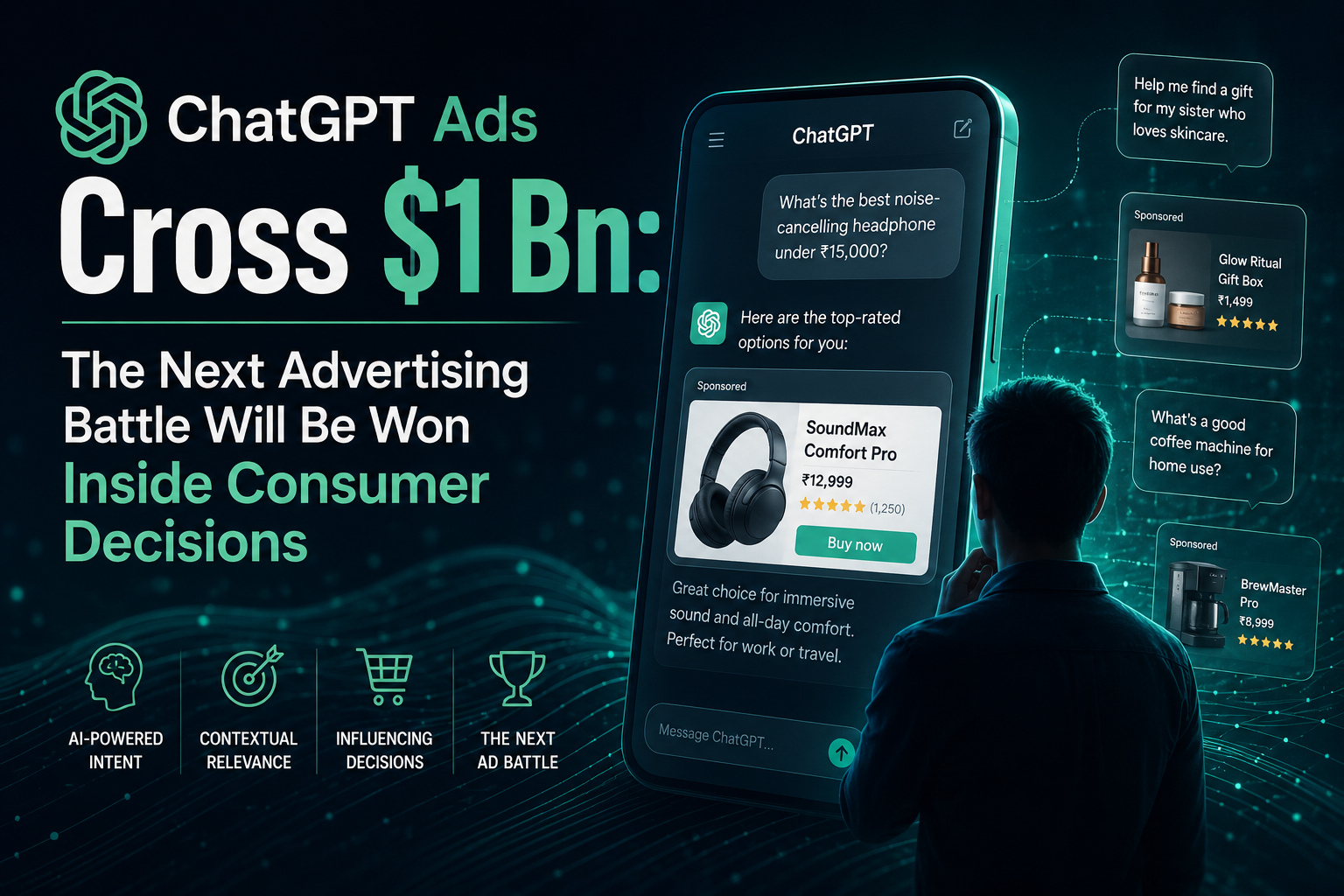
OpenAI’s ChatGPT Ads business has crossed a $1 billion annualised revenue run rate in less than 200 days, with tens of thousands of advertisers now using the platform. The company has also expanded advertising to more than 40 countries and is opening self-service Ads Manager access across India, Europe, the Middle East, and North Africa. (Source: marketingmind)
The significance of the milestone, therefore, is not simply that another technology company has entered the advertising business. It is that advertising may be moving from being discovered in media environments to being surfaced inside decision environments.
From Audience Targeting To Conversation Targeting
The bigger change is not simply that ChatGPT has become another advertising channel; it is that brands can increasingly think about targeting through the conversations consumers are having. Instead of relying only on predefined audience segments, advertisers can provide contextual signals describing the kinds of discussions in which they want their products to appear.
ChatGPT then uses those signals to determine whether an ad is relevant to the active conversation.
For marketers, this creates a different planning exercise. A beauty brand, for instance, should not only identify consumers interested in skincare but also understand the questions they ask when trying to solve a skincare problem.
A laptop brand could similarly focus on conversations around choosing a device for a specific professional requirement rather than simply targeting “technology enthusiasts.” The strategic question, therefore, becomes less about who the consumer is and more about which conversations indicate that the consumer is moving towards a decision. (Source: marketingmind)
The Consumer Persona May Matter Less Than The Consumer Moment
Traditional digital advertising has often relied on audience characteristics, interests, or keyword signals. ChatGPT Ads introduce another layer: the context and intent expressed within an ongoing conversation.
This changes the strategic question from “Who should we target?” to “Which decisions should our brand be present in?”
That is a much more demanding question for marketers because it requires understanding the consumer journey at a deeper level. Brands will need to identify the questions customers ask before they buy, the objections that prevent conversion, the comparisons they make, and the language they use when describing their problems.
In other words, the new media plan may increasingly need a decision map, not just an audience map.
The Next Opportunity May Belong To Smaller Brands
The expansion of Ads Manager could make ChatGPT less of an experimental channel for large advertisers and more accessible to smaller businesses. OpenAI has expanded self-serve advertising to India, Europe, the Middle East and North Africa, with the platform now operating across more than 40 countries and counting tens of thousands of advertisers.
In India, 50 brands participated in the launch, while self-serve access is set to open with a daily minimum budget of ₹725 — a significant reduction from the $50,000 minimum lifetime spend requirement previously associated with the platform. (Source: Techtimes)
For Indian brands in particular, the lower entry barrier changes the question from whether ChatGPT Ads can deliver scale to whether a brand can identify the right moments of consumer intent before its competitors do. Rather than immediately moving large portions of existing search or social budgets, businesses should use smaller test budgets to identify high-intent conversations, measure qualified traffic and understand which customer questions consistently lead towards purchase.
The brands that learn from those signals early could build an advantage before AI advertising becomes as crowded as traditional digital media.
Brands Need To Prepare For The “Answer Layer”
If ChatGPT Ads move brands closer to the moment of decision, they also expose a second reality: winning that moment will not depend on advertising alone.
Consumers rarely stop after seeing a sponsored recommendation. They continue asking follow-up questions, comparing alternatives, checking reviews, and looking for evidence that a brand deserves their trust. Inside AI assistants, those actions increasingly happen within the same conversation rather than across multiple tabs and websites.
That changes what brands need to optimise for. Being highly visible on a search results page may no longer be enough. Having millions of social impressions may not be enough either. Brands will increasingly need strong product information, credible reviews, differentiated positioning, useful content, and consistent factual signals across the web because those signals help shape how they appear throughout AI-assisted decision journeys.
In that sense, advertising and brand strategy are becoming harder to separate. A paid placement may create the opportunity to enter the conversation, but the rest of the conversation still determines whether the consumer stays. The brands most likely to benefit from AI-driven discovery will therefore be those that treat their digital presence as a source of decision-making information, rather than simply a collection of promotional assets.
The Winning Strategy Will Be Relevance Without Losing Trust
There is, however, an important boundary that the advertising industry cannot afford to overlook: trust.
ChatGPT Ads are clearly labelled and separate from ChatGPT’s answers, so that advertising does not influence the answers generated by ChatGPT, and that advertisers do not receive access to users’ private conversations.
That separation will be critical because the closer advertising gets to a consumer’s decision, the greater the sensitivity around commercial influence becomes.
For brands, the lesson is straightforward: do not optimise only for visibility; optimise for usefulness and credibility.
The $1 billion run rate demonstrates that advertisers are already willing to experiment with this new environment. But the more important question is whether brands can adapt their marketing thinking quickly enough. The next phase of digital advertising may not be about interrupting consumers while they consume content. It may be about becoming relevant while they are actively trying to make sense of a choice.
ChatGPT’s advertising milestone suggests that this shift is no longer theoretical. The next advertising battleground is being built around the consumer’s question — and brands that learn how to earn a place in that question may have an advantage long before the rest of the market catches up.