

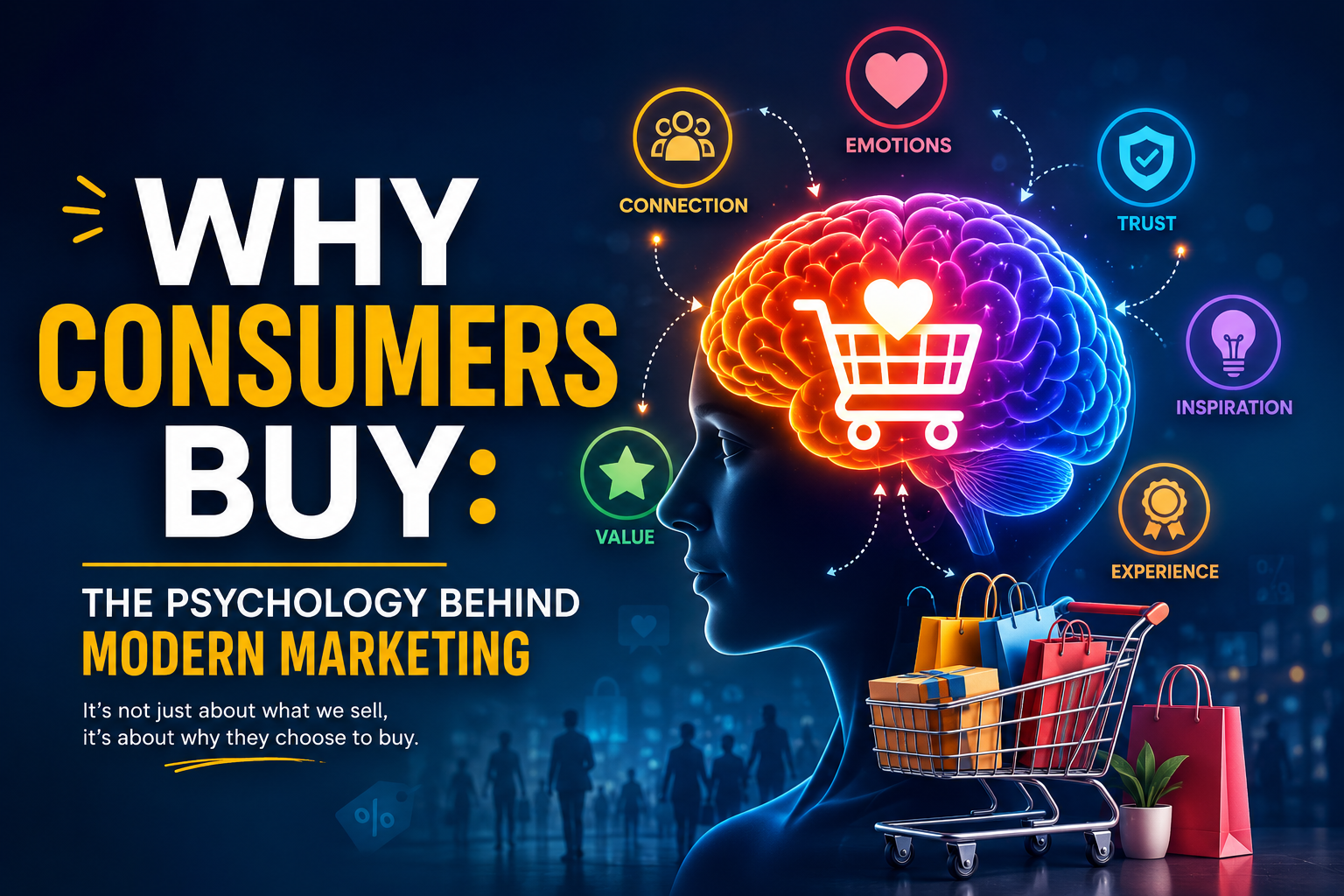
Marketing has evolved far beyond catchy slogans and mass advertising. Today, the most successful brands are those that understand a fundamental truth: consumers do not make decisions purely based on logic. Human behavior is shaped by emotions, cognitive shortcuts, habits, social influences, and attention constraints. This intersection of psychology and marketing has become one of the most important areas of study for modern marketers.
As behavioral economist Rory Sutherland famously argues, people often do not value things based on objective reality but on how they perceive reality. Similarly, Nobel Prize-winning psychologist Daniel Kahneman demonstrated that human decision-making is frequently irrational, guided by mental shortcuts and biases rather than careful analysis.
Understanding these principles can help marketers design experiences that resonate more deeply with consumers.
Why People Buy: Logic Justifies, Emotion Decides
One of the biggest misconceptions in marketing is that consumers buy products because they carefully compare features and benefits. In reality, purchasing decisions are often driven by emotions first and rationalized later.
People buy luxury watches not merely to tell time but to signal status. They choose premium coffee brands not because of measurable quality differences but because of how the brand makes them feel. They subscribe to fitness apps not only for exercise routines but for the promise of becoming a better version of themselves.
Consumers are ultimately buying outcomes, identities, and emotions. A product is simply the vehicle that helps them achieve those aspirations.
As Rory Sutherland notes:
“The opposite of a good idea can also be a good idea.”
This highlights how human behavior often defies traditional logic. What appears irrational on paper can be highly effective because it aligns with how people actually think and feel.
The Hidden Biases That Shape Decisions
Daniel Kahneman’s groundbreaking work revealed that human beings rely on two systems of thinking:
- System 1: Fast, intuitive, emotional thinking
- System 2: Slow, analytical, deliberate thinking
Most everyday decisions, including many purchase decisions, are made using System 1.
This creates opportunities for cognitive biases that influence consumer behavior.
Anchoring Bias
People rely heavily on the first piece of information they encounter.
When a product is initially displayed at ₹10,000 and later offered at ₹6,999, consumers perceive it as a bargain—even if ₹6,999 was always the intended selling price.
Social Proof
Consumers often look to others when making decisions.
Reviews, ratings, testimonials, and customer counts reduce uncertainty and increase trust. A restaurant with 5,000 reviews feels safer than one with 50 reviews, even if both offer similar quality.
Loss Aversion
Kahneman’s research found that people feel the pain of loss more intensely than the pleasure of an equivalent gain.
This is why messages such as “Don’t miss out” or “Offer ends tonight” can be more persuasive than simply highlighting benefits.
Availability Bias
People judge likelihood based on how easily examples come to mind.
If consumers repeatedly hear about cybersecurity breaches, they become more likely to invest in security software, regardless of actual risk levels.
The Battle for Attention in an Overloaded World
Modern consumers face an unprecedented volume of information.
Every day, people encounter thousands of marketing messages across social media, email, messaging apps, websites, streaming platforms, and physical environments. As a result, attention has become one of the most valuable resources in business.
This is where the concept of attention economics becomes critical.
In a world where information is abundant, attention is scarce.
Consumers no longer reward the loudest brands; they reward the most relevant brands. Messages that are personalized, contextual, and timely stand a significantly better chance of being noticed.
Successful marketers understand that attention is earned through relevance rather than interruption. The goal is not simply to reach consumers but to become meaningful enough to occupy a small but valuable space in their minds.
Habit Formation: The Secret to Long-Term Growth
While many marketers focus on acquisition, sustainable growth often comes from habit formation.
When a behavior becomes habitual, consumers stop making active decisions and begin acting automatically.
Companies like streaming platforms, food delivery apps, and digital payment services have mastered this principle by embedding themselves into everyday routines.
Behavioral scientists often describe habits using a simple framework:
Cue → Action → Reward
For example:
- A notification appears (cue)
- The user opens the app (action)
- The user receives value or satisfaction (reward)
Repeated enough times, the behavior becomes automatic.
The most successful brands are not merely chosen; they become default choices.
When consumers instinctively think of a particular platform for ordering food, booking travel, or making payments, the brand has successfully moved beyond marketing and into habit formation.
Emotional Triggers That Influence Consumer Behavior
Emotions play a powerful role in shaping purchasing decisions. Some of the most effective marketing campaigns leverage universal emotional triggers.
Trust
Consumers buy from brands they believe will deliver on their promises.
Trust is built through consistency, transparency, reviews, recommendations, and reliable customer experiences.
Belonging
People want to feel part of a community.
Brands that create tribes, communities, or shared identities often generate stronger loyalty than those focused solely on product features.
Aspiration
Many purchases are motivated by who consumers want to become rather than who they currently are.
Fitness brands sell transformation. Educational platforms sell growth. Luxury brands sell status and achievement.
Fear and Security
Fear can be a powerful motivator when used responsibly.
Insurance companies, cybersecurity providers, and healthcare organizations often emphasize protection and risk reduction because consumers naturally seek security.
Joy and Delight
Positive emotional experiences create memorable brand associations and encourage repeat engagement.
Consumers may forget product specifications, but they rarely forget how a brand made them feel.
What Modern Marketers Should Learn from Behavioral Science
The future of marketing belongs to organizations that understand people better, not simply those that spend more on advertising.
Behavioral science teaches us that consumers are not perfectly rational decision-makers. They are influenced by context, emotion, habits, biases, social dynamics, and attention constraints.
Daniel Kahneman’s research reminds us that much of human behavior is automatic rather than deliberate. Rory Sutherland’s work shows that perception often matters as much as reality.
For marketers, the lesson is clear: success comes not from forcing consumers through a sales funnel, but from designing experiences that align with how people naturally think, feel, and behave.
In an increasingly crowded marketplace, the brands that win will be those that understand the psychology behind every click, conversation, and purchase decision.