

For years, influencer marketing in India was largely a metro phenomenon. Brand collaborations, agency relationships, and creator campaigns were concentrated in cities like Mumbai, Delhi, and Bengaluru, where access to production resources and brand networks was strongest.But the creator economy has undergone a dramatic transformation.The rapid adoption of smartphones, affordable mobile data, expanding internet access, and the rise of short-form video platforms have democratized content creation. Today, creators no longer need a metropolitan address or expensive equipment to build a loyal audience. A smartphone and a unique voice can reach millions.This shift is reflected in India’s internet landscape. According to the latest Internet in India report, a majority of active internet users now come from rural India, with growth in Tier 2, Tier 3, and rural markets outpacing urban regions. As attention moves beyond the metros, influence is following the same path.With over 5.78 billion smartphone users worldwide, smartphones have become the primary gateway to content creation and consumption. (Source: Demand Sage) In India, this single device has fundamentally reshaped the creator economy, removing the need for expensive production setups or metropolitan addresses to build an audience.
The latest Internet in India study by IAMAI and Kantar, released in early 2026, shows that a majority of the country’s active internet users, about 57%, now live in rural India, and that this rural cohort is expanding significantly faster than urban users. (Source: IAS Parliament Current Affairs) In other words, the heaviest growth in India’s attention economy is coming from outside the metros, and the odds of the next breakout creator emerging from a small town or village are higher than ever.
The Power of Regional Voices
One of the biggest drivers of this shift has been the rise of regional-language content.
Whether it’s comedy, fashion, finance, education, food, or technology, creators are connecting with audiences in the languages they speak at home rather than the language brands traditionally marketed in. Platforms such as Instagram Reels, YouTube Shorts, and Moj have dramatically lowered distribution barriers, allowing compelling content to travel far beyond geographical boundaries.
Today, audiences are rewarding authenticity over polish. A creator speaking in Bhojpuri, Marathi, Assamese, Tamil, or Haryanvi can build communities that are just as engaged, if not more engaged, than those following mainstream urban influencers.
From Metros to Mohallas
For much of the last decade, brands equated “influencer” with “urban tastemaker”: a Mumbai fashion girl shooting in glossy studios, a Delhi comic riffing on South Delhi stereotypes, a Bengaluru techie reviewing gadgets from a co‑working space. The unspoken belief was that real influence lived where premium brands, agencies, and production houses were headquartered.
That logic made sense when influence was closely tied to access. Today, access is no longer the constraint it once was.
But look at how Indians actually consume content today. The sharpest growth is coming from small towns and rural districts, where the smartphone is often the primary screen. Short‑video and social platforms have compressed the distance between a Kanpur lane and a Bandra boardroom. The geography of attention has changed; the geography of influence is simply catching up.
Today’s most magnetic creators aren’t toning down their accents or moving to Andheri West. They’re doing the opposite, rooting deeper into their own lanes, languages, and lived realities, and taking the brands with them. The “metro advantage” is no longer a given; in many categories, it is the regional or small‑town lens that delivers distinctiveness.
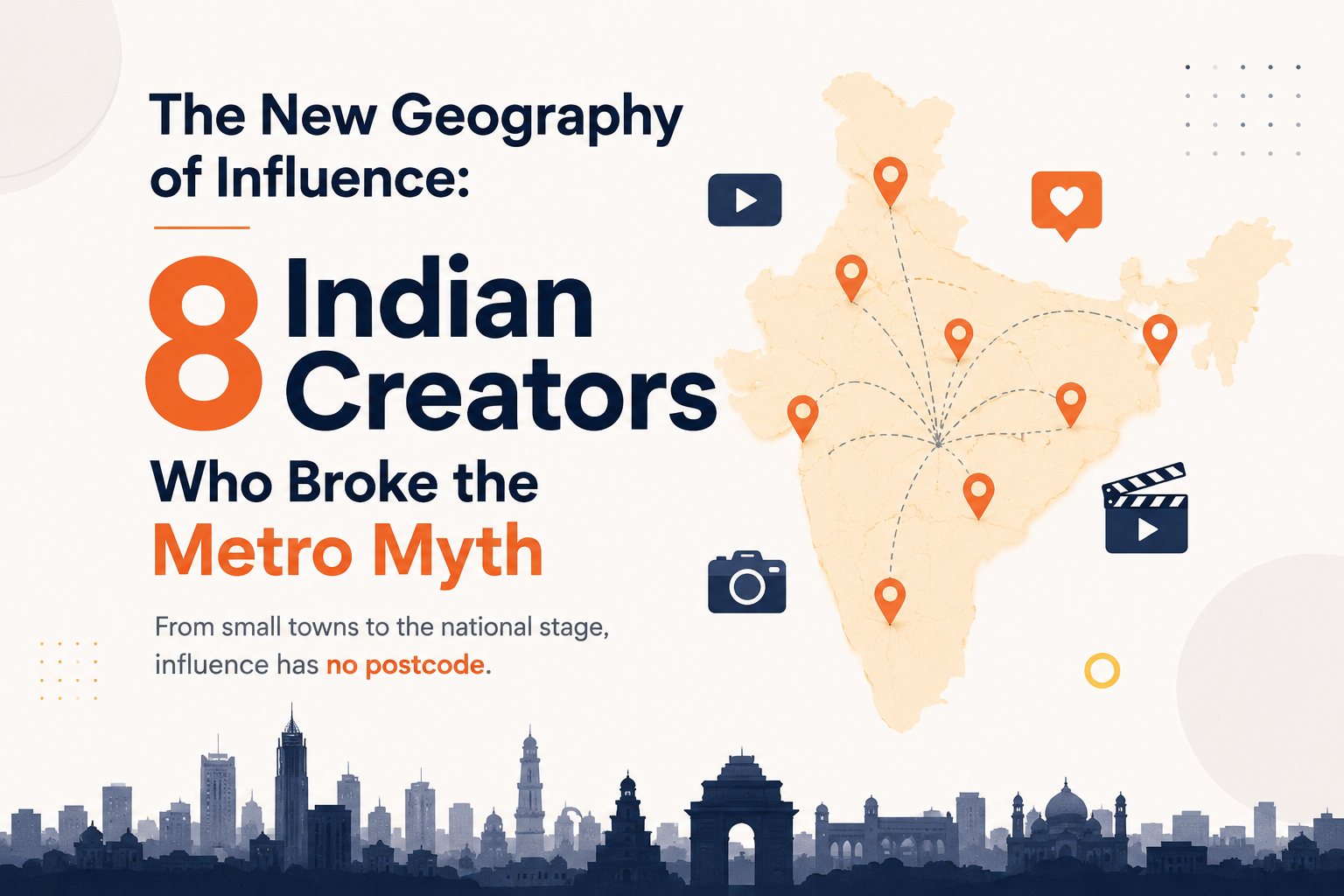
The shift is no longer theoretical. It’s already visible in the creators reshaping India’s digital landscape. Here are eight who have quietly broken the metro myth.
1. Saurabh Pandey: From UP village to global fashion sets
Saurabh Pandey, better known as @saurabhinsync, grew up in a small village in Uttar Pradesh before moving to Mumbai to study fashion. He hustled through rejection and financial instability, eventually designing for global luxury houses, and then turned that journey into viral storytelling.
His signature characters, an Avadhi‑speaking “Bua” and a hyper‑dramatic “Toxic HR”, are aggressively soaked in small‑town quirks, household drama, and office politics. Instead of softening his accent or queer identity to fit urban expectations, he makes both central to his content, proving that high‑fashion credibility no longer requires a South Bombay surname.
2. Preeti Prajapati: Bhopal’s gullies as a runway
In Bhopal, Madhya Pradesh, Preeti Prajapati (@preeti.prajapatiii) built a fashion and lifestyle audience without ever touching a traditional fashion hub. Her father works as a labourer; her sister Rekha stitches outfits from scrap fabric and old clothes. Preeti turns the narrow lanes and terraces of her lower‑middle‑class neighbourhood into a runway, serving high‑fashion walks against visibly modest backdrops.
She is a case study in how aspiration has decoupled from geography. The audience isn’t asking whether she walked at a major fashion week; they are asking where they can buy the dress her sister just upcycled. Social media became the runway, allowing Bhopal to become a fashion capital in its own right.
3. Meethika Dwivedi: Lucknow’s slang, pan‑India resonance
Meethika Dwivedi, aka @the_sound_blaze, started filming rants in secret during the lockdown at her home in Lucknow. She mashed local slang, teenage angst, and hyper‑expressive delivery into tight, meme‑able clips, and they exploded.
She has since grown into one of India’s most recognisable young comedy creators, earning mainstream recognition and brand collaborations without ever sanding off her “Lucknowi” edges. In a landscape once obsessed with neutral Hindi and English, she proves that regional texture is a growth engine, not a risk.
4. Astuti Anand: Bihari family drama as IP
Astuti Anand, also known as @astuti_mw, sketches the everyday chaos of Bihari families—nosy aunties, wedding negotiations, “nibba‑nibbi” teen drama. Originally from Samastipur, Bihar, she moved to Delhi to prepare for medical entrance exams, briefly studied physiotherapy, and finally surrendered to content creation.
Her accent is thick, her characters are unapologetically desi, and her sets are recognisably middle‑class. In a media ecosystem that long mocked Bihari accents, Astuti’s success is a quiet referendum: cultural pride beats polished parody.
5. Sakshi Sharma: Bhopal’s everyday storyteller
Sakshi Sharma (@whosakshisharma) has built a loyal audience from Bhopal by turning everyday moments into highly relatable content. Her skits on relationships, college life, family dynamics, and daily frustrations feel familiar because they are rooted in lived experiences rather than carefully curated lifestyles. Instead of relying on glossy production or aspirational aesthetics, she has grown through consistency, authenticity, and a strong understanding of her audience.
She demonstrates that relatability has become a stronger differentiator than location. Audiences are increasingly drawn to creators who reflect their everyday lives, proving that genuine community connection often outperforms polished, metro-centric storytelling.
6. Kapil Kanpuriya: Kanpur as a character, not a backdrop
Kapil Kanpuriya (@kapilkanpuriya) left accounting jobs in Delhi to bet on content full‑time, then turned his hometown Kanpur into a recurring character. His family‑centric comedy, often featuring his wife and mother, leans heavily on local humour, street food, and the joys and irritations of Tier‑2 life.
He didn’t move to Mumbai to scale; he scaled Kanpur instead, even landing an acting role in a web series. For brands chasing “Bharat”, Kapil is an important reminder: cultural codes travel; the creator doesn’t always have to.
7. Pujarini Pradhan: A feminist bookshelf in rural Bengal
From a village in East Medinipur, West Bengal, Pujarini Pradhan (@lifeofpujaa) records videos in a simple cotton sari, often while chopping vegetables or sitting on the floor. Her topics, however, are anything but “simple”: Kafka, Sylvia Plath, Premchand, cinema, patriarchy, and parenting.
Her rapid rise and the “industry plant” accusations that followed revealed how deeply urban bias still runs in our perception of intellect. The idea that a woman in a modest village home, speaking fluent English about literature, could be an organic success felt implausible to many. Her community’s defence of her is itself a cultural moment: audiences are ready for new archetypes of “smart”.
8. Sourav Joshi: Haldwani’s everyday life at a massive scale
Sourav Joshi (@soravjoshivlogs), India’s most-watched daily vlogger, started as an artist sharing sketches from Haldwani, Uttarakhand, and later Haryana. During the 2020 lockdown, he challenged himself to post a video every day; his family‑centric vlogs quietly snowballed into one of the country’s biggest channels.
What he sells isn’t glamour; it’s the ordinariness of middle‑class life—siblings, neighbours, minor upgrades, and constant money anxiety. His dominance is perhaps the clearest signal yet that mainstream Indian aspiration has moved well beyond high‑rises and luxury cars.
Sourav demonstrates that scale no longer depends on projecting an aspirational lifestyle. Everyday authenticity can be just as powerful as aspiration in building enduring audience loyalty.
What this means for marketers
For brands, this opens an entirely new playbook.
Collaborating with creators from Tier 2 and Tier 3 markets enables deeper cultural relevance, stronger audience trust, and access to communities that traditional metro-centric campaigns often struggle to engage. These creators bring something increasingly valuable in today’s attention economy: credibility.
In many categories—from FMCG and fintech to edtech, beauty, and consumer technology—regional creators are delivering engagement and influence that rivals, and sometimes surpasses, their metro counterparts.
The shift is not simply about geography. It is about understanding where culture is being created, where conversations are happening, and where trust is being built
The Future of Influence Is Distributed
The geography of attention has changed. The geography of influence is catching up.
Influence in India is no longer concentrated in a few urban neighbourhoods. It is being shaped in small towns, emerging cities, and local communities across the country. The next breakout creator is just as likely to emerge from a village in Bihar or a town in Assam as from a Mumbai suburb.
And for brands willing to look beyond the metros, the opportunity has never been bigger.
The shift is no longer emerging, it is already here. Across India, a new generation of creators is proving that influence is no longer defined by a metropolitan pin code, but by the ability to connect authentically with an audience, wherever they may be.