

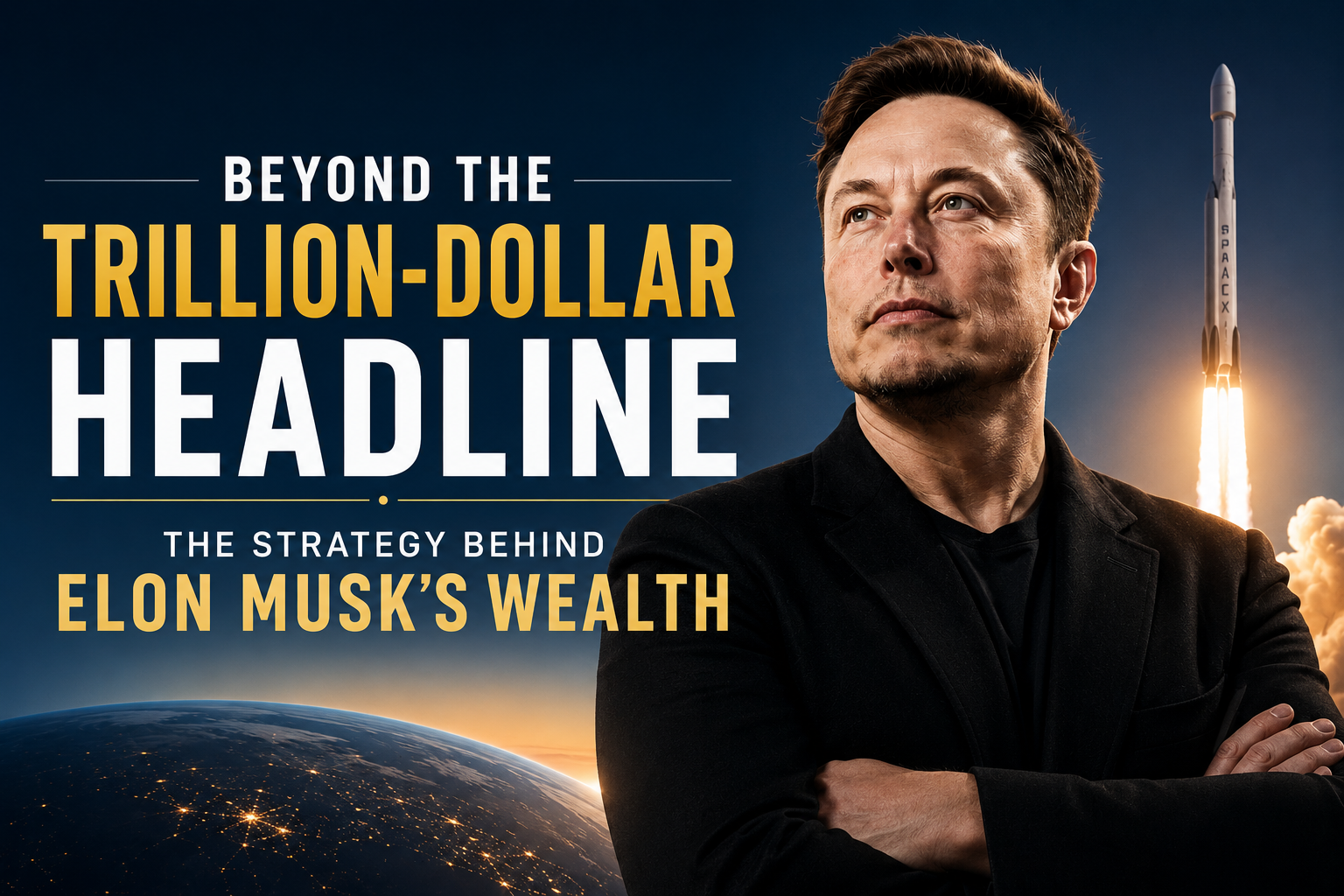
The world has long measured business success in billions. This week, that benchmark shifted dramatically. Elon Musk’s rise to becoming the world’s first trillionaire is not merely a story about personal wealth or a record-breaking IPO; it is a reflection of how modern markets reward companies that position themselves at the intersection of transformative technologies and long-term belief. SpaceX’s historic public debut has sparked conversations far beyond Wall Street, raising questions about valuation, vision, and the future of industries that are still being built. As investors, business leaders, and entrepreneurs dissect the numbers, the more important story lies beneath them: what does it take to create a company that markets believe can shape the future itself?
The IPO That Changed Everything
SpaceX began trading publicly on Friday at a valuation approaching $2 trillion, making it the largest initial public offering in history.
As the company’s founder and chief executive, Musk owns roughly 40% of SpaceX, meaning the listing added hundreds of billions of dollars to his net worth on paper and pushed him beyond the trillion-dollar threshold.
Before the IPO, Forbes estimated Musk’s wealth at around $780 billion. (Source: Forbes) By comparison, the world’s second-richest individual, Google co-founder Larry Page, has an estimated net worth between $269 billion and $285 billion, highlighting just how significant the gap has become. (Source: Bajaj Finserv)
The milestone also means Musk now holds major ownership stakes in two of the world’s largest companies by market capitalisation: Tesla and SpaceX. That valuation reflects more than investor enthusiasm; it reflects confidence in what SpaceX has become and where investors believe it is headed.
Why SpaceX Commands Such a Premium
The valuation reflects far more than SpaceX’s launch business. Over the past decade, SpaceX has evolved from a launch company into a diversified technology business spanning commercial launches, satellite communications, and artificial intelligence.
Its reusable launch systems continue to reshape the economics of space travel, while its Starlink satellite network has become one of the world’s largest broadband infrastructures, serving millions of customers globally.
Earlier this year, the company also merged with Musk’s artificial intelligence venture, xAI, bringing the Grok AI platform into the broader SpaceX ecosystem and reinforcing investor expectations that the business could play a much larger role in the future digital economy.
These businesses position SpaceX across multiple long-term growth markets rather than a single industry, helping explain why investors have assigned such a valuation.
Why Investors Are Looking Beyond Today’s Numbers
SpaceX’s financial performance has undoubtedly strengthened investor confidence.
The company generated $18.7 billion in revenue during 2025, representing 33% year-on-year growth. Nearly a quarter of that revenue came from Starlink, whose subscriber base continues to expand rapidly. Yet despite this growth, SpaceX was not profitable, reporting a $4.9 billion loss for the year. (Source: Yahoo Finance)
That contrast illustrates an important principle of modern capital markets. Investors are valuing what they believe the company can become, not simply what it earns today. Much like Tesla before it, SpaceX commands a premium because markets view it as building infrastructure for industries expected to expand over the coming decades.
What Public Markets Will Test Next
Going public also changes the expectations placed on a business. Unlike private companies, publicly listed firms operate under greater scrutiny from investors, regulators, and financial markets. SpaceX will now be judged not only on its vision, but also on its ability to consistently deliver against it.
Some analysts remain highly optimistic about the company’s prospects across aerospace, satellite communications, and artificial intelligence. Others question whether ambitious initiatives, including concepts such as space-based data centres, will ultimately justify today’s valuation.
Jason Schloetzer, Professor of Accounting at Georgetown University, notes that while Musk has repeatedly exceeded conventional market expectations, it remains uncertain whether SpaceX can sustain its current valuation under the transparency and accountability that accompany public ownership. (Source: Fortune)
The Strategic Lesson for Business Leaders
The trillion-dollar headline is remarkable, but it is not the most valuable takeaway.
What stands out is the consistency of that strategy. Rather than building businesses around existing markets, Musk has repeatedly positioned his companies at the centre of industries he believes will become foundational to the next phase of technological growth, from electric vehicles and reusable rockets to satellite internet and artificial intelligence.
That approach has allowed each business to benefit not only from operational growth but also from long-term investor confidence.
For business leaders, the lesson extends beyond scale. Sustainable value is rarely created by chasing short-term valuation or quarterly performance alone. It comes from solving meaningful problems, building capabilities that competitors struggle to replicate, and creating a vision compelling enough for customers, employees, and investors to believe in.
Conclusion
Elon Musk becoming the world’s first trillionaire has dominated headlines, but the number itself is only the outcome. The more meaningful story is how long-term positioning, sustained investment, and the ability to build businesses that investors believe will shape the future can create extraordinary value over the long term.
Whether SpaceX ultimately justifies its nearly $2 trillion valuation remains to be seen. Public markets will test that conviction over the years ahead. What is already clear, however, is that enduring value is built not by chasing short-term gains but by creating infrastructure, solving meaningful problems, and earning long-term market confidence.
For business leaders, that may ultimately be the more valuable lesson than the trillion-dollar milestone itself.